The dairy and culinary landscape in Saudi Arabia is undergoing a significant evolution. As lifestyle habits shift, dining options diversify, and the domestic food service industry accelerates, demand for versatile dairy products – particularly cheese – has experienced steady expansion.
From versatile mozzarella used across quick-service pizza chains to processed slices and specialty spreadable options for busy working households, cheese has become an essential kitchen staple and food service ingredient across the Kingdom.
Market Overview:
Cheese represents a nutrient-dense, solid food product derived from milk, available in a vast array of textures, flavor profiles, and culinary applications. Standard varieties span soft and creamy cheeses like brie, high-melting structural cheeses like mozzarella, cheddar, and parmesan, and distinct aged variants such as blue cheese. Rich in essential nutrients including calcium, protein, and vitamin B12, cheese serves as an integral ingredient in home cooking, fast food, bakery items, cheesecakes, cheese boards, and gourmet hospitality offerings.
Between 2020 and 2025, steady urbanization, demographic growth, and expanding modern retail infrastructure established a firm foundation for the market. Looking ahead through 2034, the Saudi Arabian cheese sector is positioned for resilient long-term development.
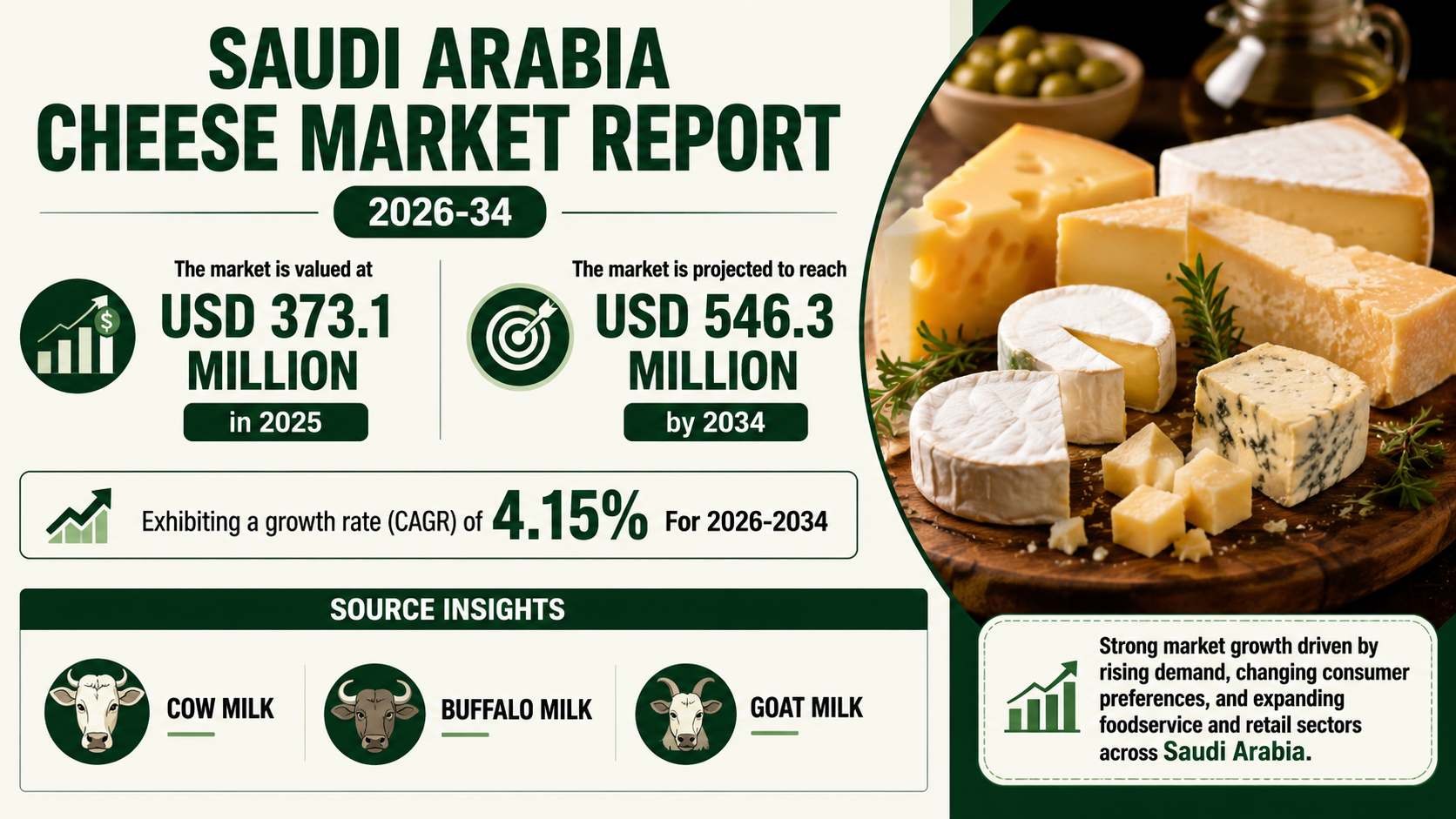
According to market research published in the Saudi Arabia Cheese Market Report, the market reached a valuation of USD 373.1 Million in 2025. It is projected to climb to USD 546.3 Million by 2034, expanding at a Compound Annual Growth Rate (CAGR) of 4.15% throughout the 2026–2034 forecast period.
Key Market Growth Drivers:
The sustained demand for cheese products across Saudi Arabia is propelled by several socio-economic factors, changing employment dynamics, and technological advances:
1. Rapidly Growing Applications in the Foodservice Industry
The thriving food service sector is a key catalyst for market expansion. As consumer dining-out habits expand, restaurant operators and quick-service chains heavily integrate cheese into pizzas, burgers, sandwiches, and pasta dishes. Western-style and fusion culinary offerings have heightened the use of diverse cheese types.
- Market Momentum: The broader Saudi Arabia foodservice market is projected to reach USD 58,310 Million by 2033, reflecting a CAGR of 8.21% from 2025 to 2033.
- Bulk Demand: Expanding quick-service restaurants and pizzerias require consistent, high-volume supplies of cheese, boosting both local production and import activities.
2. Increasing Employed Population and Busy Lifestyles
A growing workforce drives demand for convenient, time-saving meal solutions.
- Workforce Scale: Data from CEIC indicates Saudi Arabia’s employed population reached 17,181,335 individuals in September 2024.
- Convenience Trends: Busy working professionals increasingly favor ready-to-use cheese options like slices, spreads, and shredded cheese for quick preparation in sandwiches, wraps, and salads.
3. Expansion of Modern Retail Channels
The retail environment in Saudi Arabia continues to broaden across urban and semi-urban areas.
- Retail Growth: Industry reports highlight moderate retail sector expansion, with sales reaching SAR 37.4 Billion in Q3 2024.
- Accessibility: Supermarkets, hypermarkets, specialty stores, and e-commerce grocery services provide better cold storage, in-store promotions, and direct home delivery, giving consumers continuous access to local and imported dairy options.
4. Flavor Innovations and Gourmet Varieties
Dairy processors are continually launching unique flavor profiles – including spicy, herb-infused, and regionally inspired formulations – that cater to both traditional and modern culinary preferences.
5. Advanced Packaging Technologies
Adoption of modern packaging methods such as vacuum sealing, modified atmosphere packaging (MAP), and resealable packs preserves product freshness, prevents moisture contamination, and extends shelf life in high-temperature environments.
6. Surging Tourism Activities
Expanding tourism and hospitality infrastructure for leisure and religious travelers has elevated demand for gourmet dairy items, specialty cheese boards, and international menu options across hotels, cafes, and fine-dining establishments.
Explore in-depth findings for this market:
https://www.imarcgroup.com/saudi-arabia-cheese-market/requestsample
Key Market Segmentation:
The Saudi Arabia cheese market is segmented by source, product type, specific product varieties, format, and distribution channel.
1. Breakup by Source:
- Cow Milk: The primary source for most commercially produced natural and processed cheeses due to its wide availability and balanced fat content.
- Buffalo Milk: Preferred for specific rich, high-fat cheese preparations.
- Goat Milk: Serves niche consumer segments seeking distinct flavor profiles or alternative dairy options.
- Others: Includes specialty dairy sources used for boutique or artisanal cheeses.
2. Breakup by Type:
- Natural Cheese: Comprises traditional varieties produced through direct curdling and aging processes without chemical additives.
- Processed Cheese: Includes emulsified cheese formulations designed for long shelf life, uniform texture, and superior melting performance.
3. Breakup by Product:
- Mozzarella: Highly favored for its exceptional elasticity and melting properties in pizzerias and Italian cuisine.
- Cheddar: Widely consumed in slices and blocks for burgers, sandwiches, and daily home meals.
- Feta: Popular in salads, Mediterranean dishes, and savory pastries.
- Parmesan: Utilized as a hard grating cheese for pastas, soups, and gourmet dishes.
- Roquefort: Known for its blue veins and bold, tangy flavor profile.
- Others: Includes brie, cream cheese, and regional specialty varieties.
4. Breakup by Format:
- Slices & Spreads: Dominant choices for quick sandwich assembly and breakfast applications among busy households.
- Diced/Cubes & Shredded: Essential formats for food service operators, pizzerias, and home cooking.
- Blocks & Liquid: Preferred for commercial food processing, catering, and industrial food manufacturing.
- Others: Encompasses specialty portion packs and artisanal shapes.
5. Breakup by Distribution Channel:
- Supermarkets and Hypermarkets: Major retail outlets featuring cold-chain display units and promotional sampling.
- Convenience Stores & Specialty Stores: Essential for quick impulse purchases and gourmet cheese selections.
- Online: Rapidly growing digital channels offering home delivery and exclusive bundle deals.
- Others: Direct supply contracts to food service operators and institutional buyers.
Regional Breakup:
Cheese consumption and distribution vary across regions based on population density, urbanization, and hospitality infrastructure:
- Northern and Central Region: Anchored by Riyadh, this major market leads in corporate food service consumption, modern retail density, and institutional demand.
- Western Region: Encompassing Jeddah, Makkah, and Medina, this region experiences strong demand driven by religious tourism, hotel dining, and vibrant local restaurant networks.
- Eastern Region: Supported by industrial hubs, high household disposable income, and active modern retail chains.
- Southern Region: Characterized by expanding modern supermarket networks and growing urban adoption of packaged dairy products.
Need customized data or a tailored scope? Speak directly with an IMARC
analyst:
https://www.imarcgroup.com/request?type=report&id=20606&flag=E
Competitive Landscape: Key Players and Strategic Positioning
The competitive environment in the Saudi Arabia cheese market features a mix of multinational dairy corporations, regional processors, and domestic specialty producers. Key market participants focus on cold-chain optimization, localized product development, strategic flavor adaptations, and partnerships with leading food service chains to maintain market share.
Recent News & Industry Developments:
- June 2025: The Government of Saudi Arabia announced a major dairy industrial complex spanning 1 Million sq. m in Al-Kharj during the Saudi Dairy Forum. Designed under the National Industrial Strategy, the hub aims to strengthen domestic processing infrastructure and establish the Kingdom as a regional dairy hub.
- May 2025: The Saudi government finalized trade agreements with China to facilitate dairy product exports, boosting bilateral trade and customs collaboration.
- November 2024: Fifteen Saudi and Italian chefs collaborated at Azzuro Restaurant in the Ritz Carlton for an ‘Italy meets KSA’ culinary showcase featuring fresh locally crafted mozzarella produced by Sana Cheese Company.
- July 2024: Puck launched its limited-edition Zaatar Cream Cheese jar across Saudi Arabia and neighboring Middle Eastern markets, blending popular regional flavors with daily dairy staples.
About Us:
IMARC Group is a global management consulting firm that helps the world’s most ambitious changemakers to create a lasting impact. The company provide a comprehensive suite of market entry and expansion services. IMARC offerings include thorough market assessment, feasibility studies, company incorporation assistance, factory setup support, regulatory approvals and licensing navigation, branding, marketing and sales strategies, competitive landscape and benchmarking analyses, pricing and cost research, and procurement research.
Contact Us:
IMARC Group‚
134 N 4th St‚ Brooklyn‚ NY 11249‚ US
Email: sales@imarcgroup․com
Tel No: (D) +91 120 433 0800
United States: (+1–201–971–6302)