
Introduction
At 11:20 on a Friday, a restaurant group’s cash manager sees the operating account dip below its buffer. At Tech Leads IT, we use this scenario in Oracle Cloud Financials Online Training to show why timing matters. Payroll and produce payments posted, but two card settlements haven’t arrived. Should she move reserve cash now or wait?
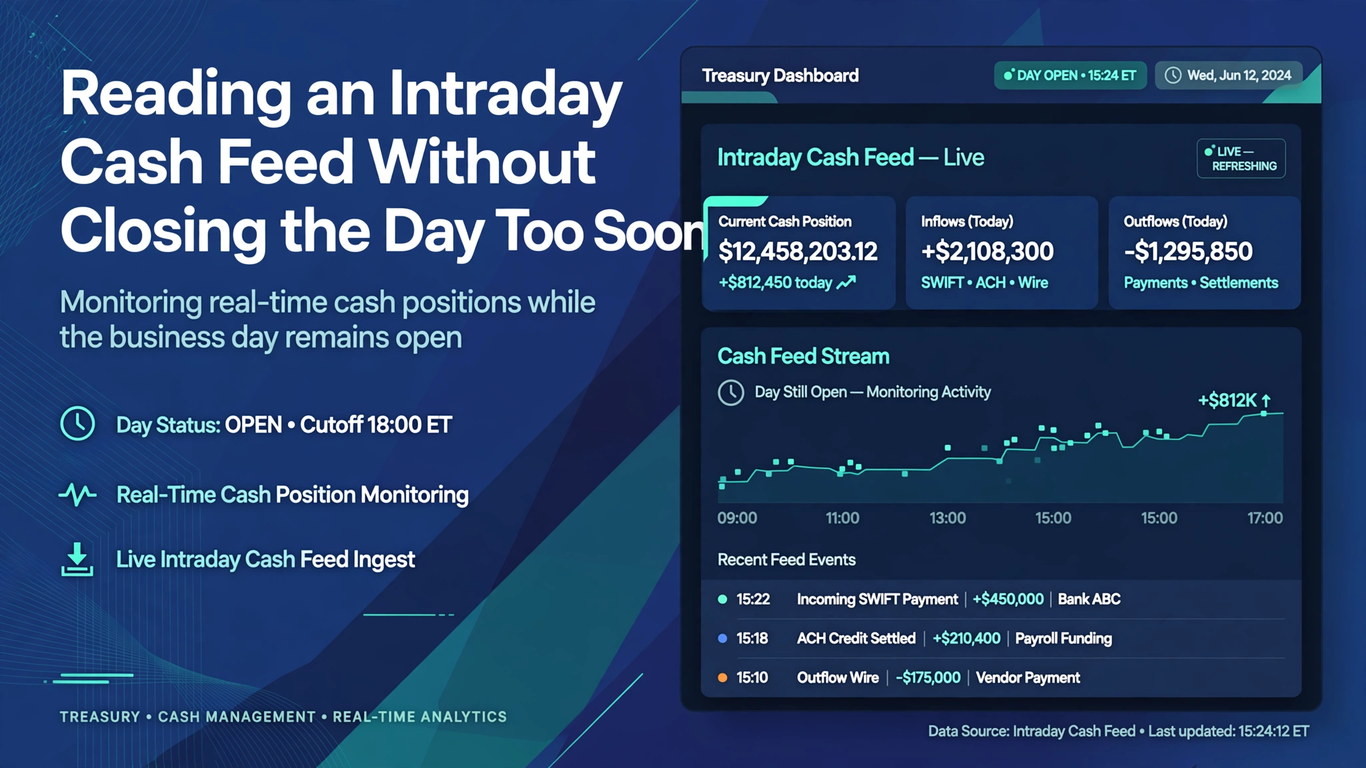
Oracle Cloud Financials Training Online reminds us that an intraday feed is fresher, yet it is neither a finished statement nor a reconciliation. Treat it as evidence and timing, and keep three things apart: what the bank reported, what is forecast, and what’s verified.
Label Every Number Before You Act
She starts by noting the observation time, the bank account, the currency, the statement sequence, and the opening balance she is working from. Then she lists each payroll debit and supplier payment that is visible and compares the expected card receipts with the processor’s settlement notices.
That comparison matters because a missing receipt can mean different things. It may simply not have reached the bank yet. It may belong to a later incremental file. Or it may have failed somewhere upstream. What she does not do is add the forecast receipt to the reported balance as if the money had cleared.
Instead, the team keeps three columns: reported activity, confirmed but not yet reported activity, and uncertain forecast. Each amount in the funding decision can then be traced to the evidence behind it. Another reviewer can pick up the sheet and understand the position at a glance, and nobody pretends a moving feed is more precise than it is.
Writing this down feels slow when the balance is red and the clock is running. In practice it takes a few minutes, and it saves a much longer argument later about why the team acted the way it did.
What Oracle Cloud Financials Online Training Teaches About Incremental Files
Intraday activity only makes sense when you read it in order. If the bank sends incremental files, the noon file may hold just the movements added since the previous transmission, not a restatement of everything since morning. So the analyst records each file identifier and import time, confirms that processing finished, and checks that the new activity follows logically from the prior position. A short note beside each file, saying what it contained and whether it loaded cleanly, costs almost nothing.
She doesn’t add a line twice just because it still appears in a consolidated inquiry. She also doesn’t assume a missing file means nothing happened. A gap, a delayed import, or a rejected file becomes an operational exception with a named owner. This guards against two opposite mistakes: double counting an earlier debit, and treating an incomplete series as the bank’s final word. Either one can produce a liquidity recommendation that sounds confident and is wrong.
Oracle’s guidance on intraday bank statement processing under Embedded Banking Services describes how incremental CAMT.052 statements from supported banking partners can be retrieved and imported through the day, giving current transaction and balance information. It is also clear about the limit: automatic reconciliation is not started for these intraday statements, and prior-day statements remain the basis for final reconciliation.
For the restaurant group, that means the feed can make the funding call faster and better informed, but it cannot prove every expected receipt and payment has been matched. The team should confirm that files loaded successfully, keep the sequence context, and save final clearing conclusions for the prior-day process. Availability also depends on having the embedded connectivity provisioned and incremental intraday reporting arranged with the participating bank, so the workflow should reflect the connections that are actually switched on.
Keep the Funding Decision Proportionate and Reversible
At noon the reported shortfall is 180,000 units. Confirmed card settlements total 140,000, and uncertain receipts could add another 70,000. Funding the whole gap automatically would be wasteful, and waiting just because expected receipts exceed the shortfall would be reckless.
So the manager goes back to treasury policy. Protect the minimum operating buffer until the next reliable review point, allow for payment cutoffs, and pick a transfer amount that doesn’t create a new shortage in the reserve account. A 90,000 transfer could be reasonable if it covers the verified exposure plus a defined cushion until the next file arrives. The case record should hold the calculation and the approval, not just a screenshot of a balance that has since changed. If someone asks later why 90,000 and not 180,000, the note should answer without anyone needing to remember the morning. And if the next increment brings in the expected receipts, the excess cash can be returned through the ordinary process instead of being buried under an unsupported same-day reversal.
Before anything moves, a second person checks the source and destination accounts, currency, amount, payment route, and authority limits. Seeing balances sooner doesn’t relax beneficiary verification or segregation of duties. The reviewer also rules out a duplicated imported line, an opening-balance mismatch, or a file sequence failure as the cause of the apparent deficit. If the movement can’t be explained, the decision goes down the documented exception path, not a chat summary. Sensitive account data stays in controlled records, and the decision note uses masked references and internal identifiers.
These controls keep the response quick without letting an informational feed turn into an unreviewed payment instruction. They also make plain that a recommendation built on current evidence can change when a later increment brings new facts.
How Oracle Cloud Financials Training Online Prepares You for Final Reconciliation
Through the afternoon, each new import should refresh the position from the movements actually reported, without overwriting the earlier decision record. The manager compares new lines with the expected card settlements, flags what’s unmatched, and updates the residual forecast. If one settlement lands for a different amount, she looks into merchant fees, reversals, timing, or a bad assumption rather than forcing the forecast to match the bank.
A timestamped trail should show what was known when the transfer was approved and what arrived later. That chronology protects staff from hindsight judgments, and it shows whether the forecasting process needs work. It also helps the treasury tell a bank-connectivity problem from a genuine cash-flow variance. In a single balance snapshot the two can look identical, yet they need different owners and different fixes.
The next business day, the team imports the prior-day statement and runs its normal reconciliation. Payroll, supplier payments, card settlements, and the reserve transfer all get matched, and anything left open gets investigated. The closing balance should be confirmed independently, not taken from yesterday’s last intraday view.
Then the manager compares the outcome with her funding rationale. Was the amount enough? Did the receipts arrive in the predicted window? Did any sequence or import issue skew the decision? Lessons go where they belong: forecast assumptions, connectivity monitoring, or approval procedures. And the original estimate stays on file even if the final statement differs, because keeping both is evidence of decision quality and supports a more realistic buffer the next time the banking day runs short.
Conclusion
Intraday bank activity is most useful when a team is honest about its limits. Incremental files can sharpen the same-day cash position, show a shortfall as it forms, and support a sensible transfer before the final statement lands. They don’t complete automatic reconciliation, and they can’t promise every expected item is there.
Tech Leads IT builds this habit through Oracle Cloud Financials Online Training and Oracle Cloud Financials Training Online: keep file sequence, separate reports from forecast, verify imports, and label every number by its evidence and time. The next reviewer follows the path from first shortfall to final balance.