
Introduction
Every filing season, a regional agricultural cooperative has to report payments to mechanics, landlords, grant recipients, and members earning interest. Tech Leads IT shows through Oracle Fusion Financials Training how one clear control chain keeps these four groups from blurring together. The team classifies activity, checks recipient data, reconciles each form population, and keeps the acknowledgement.
In Oracle Fusion Financials Online Training, learners see a tax lead freeze the extract, track late changes, and route unclear items to tax review. A vendor name never settles reportability. An Oracle Fusion Financials Course teaches discipline, so every return and exclusion is explainable.
Build Four Defensible Populations With Oracle Fusion Financials Training
Contractor compensation comes first. The payables analyst reviews eligible payments net of voids and confirmed corrections, then checks recipient identifiers and reporting classifications. The rental analyst separates property rent from reimbursed utilities wherever policy calls for different treatment. Grant specialists distinguish reportable awards from payments that fall outside the selected reporting rule, and they write down the basis instead of trusting the word grant in a description. The treasury analyst examines interest calculations and account ownership for the retained balances. Each group delivers a population total, a return count, a withholding total, and an exception list. These control figures are more useful than a single grand total because they expose a missing category or a duplicate source before payment types get blended together in the transmission process.
Recipient data gets its own quality review. The cooperative checks taxpayer names and identifiers against approved records, confirms current addresses through governed maintenance, and flags records with missing or inconsistent classifications. Nobody overwrites master data inside a filing worksheet just to make an error vanish. Corrections follow the normal authorization path, with effective dates and supporting evidence. Duplicate detection looks at taxpayer identifier, recipient account, payment source, and legal entity, because one person may legitimately hold several supplier records. Potential duplicates are investigated before anything is consolidated. Access stays restricted because the working population holds sensitive tax information, and reviewers use masked summaries whenever full identifiers are not needed for the task.
This is the part many beginners underestimate. Population building is not a data-pull exercise. Each group answers to a different owner, a different policy, and a different kind of evidence, and the filing process has to respect those differences before any numbers are combined.
Reconcile Before Creating the Submission: An Oracle Fusion Financials Online Training Lesson
The filing team reconciles source payments to reportable amounts in a bridge that another accountant can reproduce. It starts with eligible ledger activity, subtracts voids and excluded transactions, adds approved adjustments, and arrives at a total for each form type. Withholding balances are reconciled on their own. Return counts are compared with unique recipients and investigated wherever one recipient legitimately receives more than one form. The controller then samples high-value records, zero or negative anomalies, round-dollar grants, address changes, and amounts sitting just above or below a threshold. She also confirms that the tax year and filing legal entity are correct. Creating the electronic file stays blocked until the bridge, the exception dispositions, and the sample review all carry named approvals.
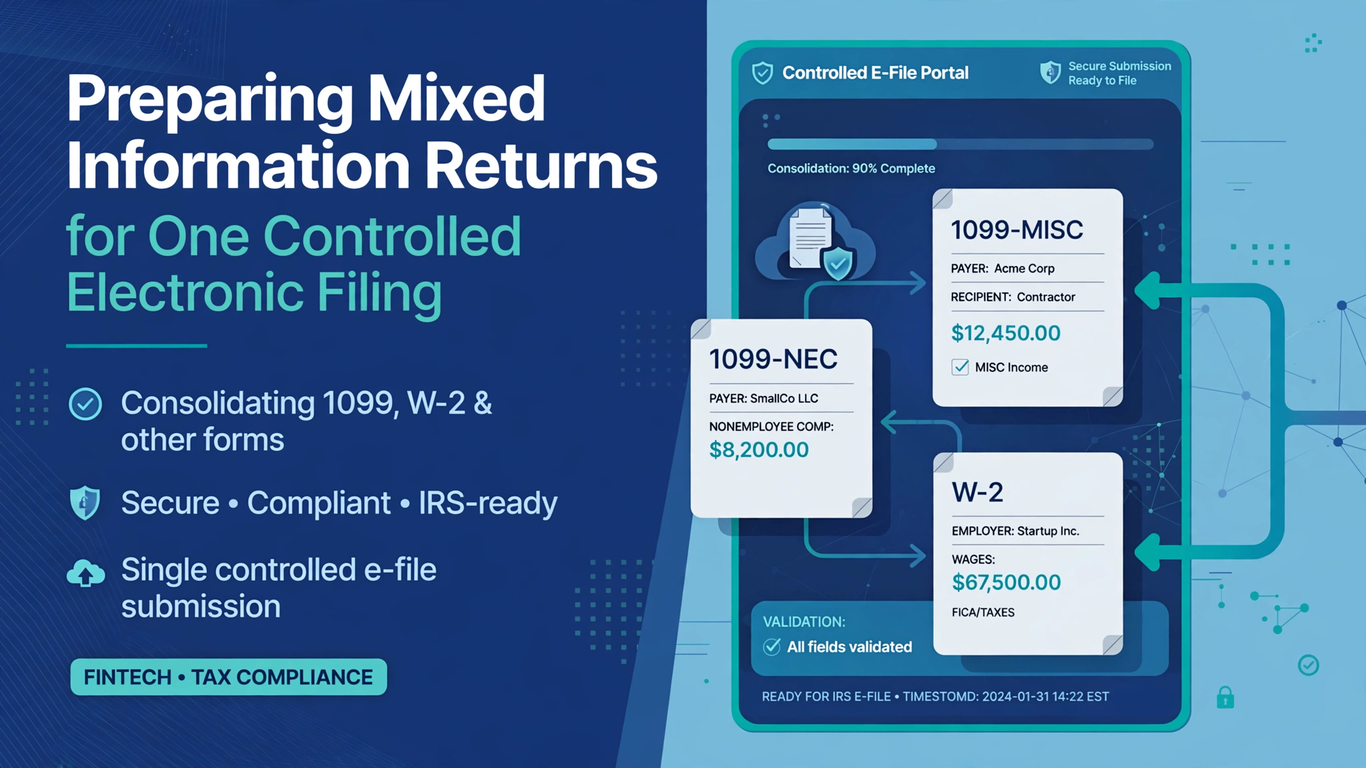
The release guidance Electronic Filing of Forms 1099-MISC, 1099-NEC, 1099-G, and 1099-INT using Information Returns Intake System states that these information-return types can be filed electronically in high volumes through the IRS taxpayer portal. That capability gives the cooperative a supported route for the mixed population, but it does not decide whether a particular payment is reportable, and it does not certify recipient data. The team must still apply current filing instructions, organizational tax policy, and sound professional judgment. It should also confirm the feature’s enablement, credentials, environment, and operational prerequisites well before deadline week. A new electronic path changes the mechanics of delivery. It does not remove the responsibilities for classification, balancing, security, or approval.
A practical way to test the bridge is to hand it to someone who did not build it. If that reviewer can rebuild each form total from the source ledger activity, using only the documented steps, the reconciliation is sound. If the reviewer has to ask the preparer what a line means, the bridge is not finished, and the file should not be created yet.
Treat Transmission as a Controlled Event
Once approval is in place, an authorized operator creates the filing output from the frozen population. A second person compares its return counts and monetary control totals with the approved bridge before release. File identity, creation time, tax year, transmitter context, and population version are recorded without exposing sensitive content in an open log. The operator uses the authorized portal route and follows the cooperative’s credential and multifactor controls. Files never travel through personal email or consumer storage. A successful upload action is not the same as acceptance. The team records the submission reference and waits for the proper acknowledgment, keeping the exact approved population that produced the transmitted file. Any retry must be easy to tell apart from the original attempt.
Acknowledgment handling has named owners and deadlines. If the submission is accepted, the reviewer ties the acknowledgment to the file identity, counts, totals, and approval package. If records are rejected, the team isolates those recipients, identifies the stated reason, and corrects only the defects it can support. It does not resend the entire population blindly, and it does not edit values simply to satisfy a format check. A corrected submission receives a new version and its own approval whenever the change affects reportable data. The log shows which returns were accepted, rejected, corrected, replaced, or still pending, which prevents the same recipient from being filed twice. Material interpretation issues go back to the tax lead rather than being treated as technical transmission errors.
Think of the acknowledgment as the final receipt for the whole project. Until it arrives and has been matched to the approved package, the work is still open, no matter how smooth the upload looks on screen.
Keep Recipient Delivery and Corrections Connected
The cooperative coordinates recipient statements with the approved filing population and the applicable deadlines. Returned mail, corrected addresses, and recipient questions enter a case process linked to the original return. When a mechanic disputes the reported amount, staff compare payment details, voids, withholding, and classification evidence before promising a correction. A changed address does not automatically change the filed amount, and a payment disagreement is not solved by issuing a duplicate statement. If a formal correction is required, the team documents the original value, the corrected value, the reason, the authorization, the filing event, and the recipient communication. This linked history protects both the recipient and the cooperative when a question arrives months after the filing project has closed. Handled this way, a late question becomes a quick lookup rather than a frantic scramble.
Protect Sensitive Data and Prove Who Approved What
Tax filing work concentrates sensitive information in one place, so the cooperative treats security as part of the process rather than an afterthought. Role-based access limits who can see full taxpayer identifiers, and most reviewers work from masked summaries. Preparers cannot approve their own populations, and the person who creates the file is not the person who releases it. Every approval is tied to a named individual, a date, and the version of the population that person actually reviewed. If the population changes after approval, the approval does not carry over automatically. It has to be earned again.
Retention matters just as much. The cooperative keeps the bridge, exception list, sample review, approval record, file identity, and acknowledgment together in one package. Months later, an auditor or a recipient’s question can be answered from that package without anyone reconstructing events from memory or searching through inboxes. Good records are not paperwork for its own sake. They are what turns a one-time filing effort into something the organization can repeat next year with less stress and fewer surprises.
Conclusion: Taking an Oracle Fusion Financials Course Into Real Filing Work
A mixed information-return filing stays manageable when every form population can be traced from the source payment to the final acknowledgment. Classify first, extract second, approve data corrections properly, and bridge control totals to each form type before anyone transmits. Rejected records and acknowledgments are outcomes to track, not things to assume after an upload.
Oracle Fusion Financials Training, Oracle Fusion Financials Online Training, or an Oracle Fusion Financials Course can all teach the same lesson: software handles mechanics, people own judgment. Define the population, support exclusions, reconcile counts and money, protect data, approve the exact output, and prove what was accepted.