Chemical plants require reliable pipeline components to manage different fluids across processing, storage and transfer systems. Valves play an important role in controlling fluid movement, isolating equipment and supporting safe plant operations. When pipelines handle aggressive chemicals, selecting the correct valve material becomes especially important.
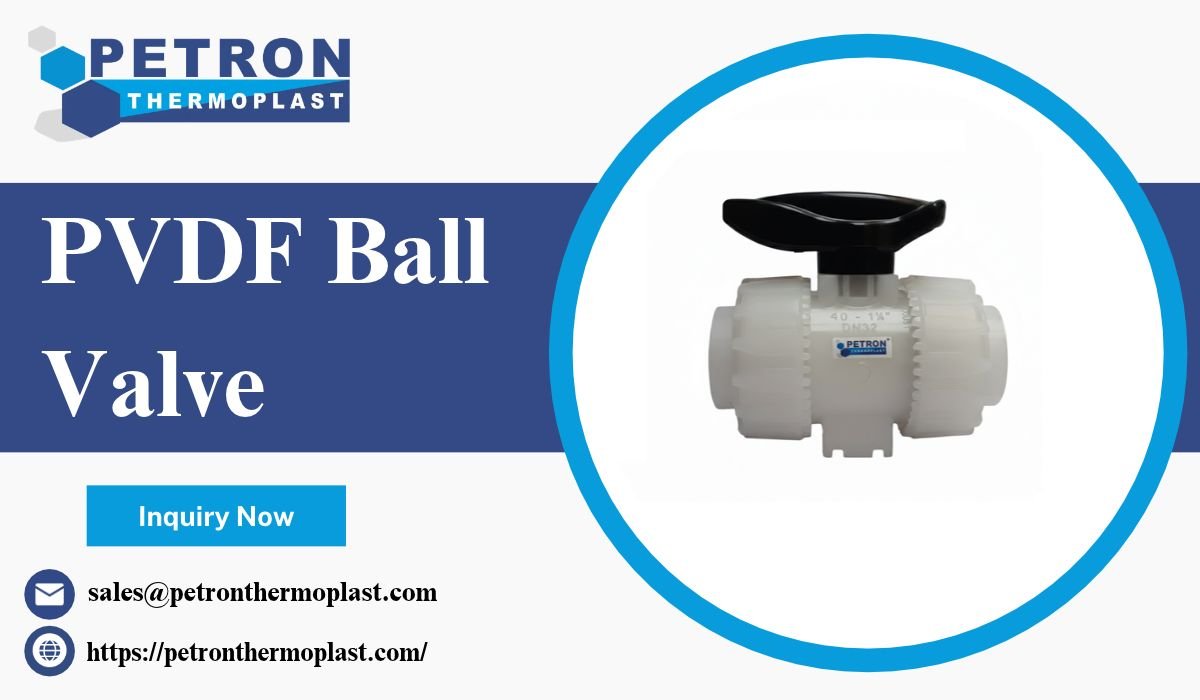
PVDF Ball Valves are used in selected industrial applications where chemical resistance, dimensional stability and dependable shut-off performance are required. Manufactured from polyvinylidene fluoride (PVDF), these valves offer useful material properties for demanding fluid-handling environments.
Petron Thermoplast focuses on thermoplastic piping solutions for industrial requirements, including PVDF Ball Valve applications. Choosing the right valve configuration helps plant operators develop piping systems that match their process conditions, installation layouts and maintenance requirements.
Why PVDF Ball Valves Are Used in Chemical Plants?
PVDF is a high-performance fluoropolymer known for its chemical resistance and mechanical properties. It is considered for applications where conventional materials may require careful evaluation due to corrosion or chemical exposure. PVDF ball valves use a rotating ball with a central opening to control fluid flow. Turning the handle rotates the ball, allowing the passage to open or close.
Important reasons for considering PVDF ball valves include:
- Chemical resistance: PVDF offers resistance to many acids, bases and industrial chemicals, depending on concentration and temperature.
- Corrosion resistance: Unlike conventional metal valves, PVDF does not rust.
- Lightweight construction: Thermoplastic valves can be easier to handle and install than many metal alternatives.
- Smooth internal surfaces: The valve design supports fluid passage through the internal bore.
- Convenient operation: Quarter-turn operation allows straightforward opening and closing.
- Industrial applications: PVDF valves are considered for selected chemical processing and fluid transfer systems.
Understanding the Construction of a PVDF Ball Valve
A PVDF ball valve consists of several components that work together to control fluid movement.
- PVDF Valve Body
The body contains the main flow passage and supports the internal valve components. PVDF construction provides chemical resistance for suitable applications.
- Ball
The ball contains a central opening through which fluid passes when the valve is open. Rotating the ball changes the flow position.
- Valve Seat
The seats support the ball and help create a sealing interface when the valve is closed. Seat material selection is important for chemical compatibility and operating performance.
- Stem
The stem connects the operating handle to the internal ball mechanism. It transfers rotational movement to open or close the valve.
- Handle
The handle allows manual operation. A quarter-turn movement generally changes the valve between open and closed positions.
- Sealing Components
Seals and O-rings help prevent leakage around moving and connected components. Their material compatibility should be checked separately from the PVDF body.
Important Features of Premium PVDF Ball Valves
Chemical plant operators should evaluate several features before selecting a valve for their pipeline network.
| Feature | Industrial importance |
| PVDF body | Provides resistance to many chemicals |
| Ball mechanism | Controls the opening and closing of flow |
| Quarter-turn operation | Supports convenient manual operation |
| Sealing arrangement | Helps prevent leakage |
| Connection options | Supports different pipeline installation requirements |
| Compact construction | Helps accommodate various piping layouts |
| Chemical compatibility | Determines suitability for the intended fluid |
Applications of PVDF Ball Valves in Chemical Plant Operations
PVDF ball valves can be considered for different industrial processes where their material properties match the operating environment.
- Acid Transfer Systems
Chemical plants often transfer acids between storage tanks, processing equipment and distribution lines. Selected PVDF valve designs may be suitable for compatible acid-handling applications.
The chemical concentration and operating temperature must be verified before installation.
- Chemical Dosing Systems
Dosing systems require controlled isolation and connection of chemical lines. PVDF ball valves may be used in suitable dosing arrangements where the required shut-off function and material compatibility are confirmed.
- Chemical Storage Facilities
Storage installations use valves to isolate tank outlets, transfer pipelines and connected equipment. PVDF valves can be considered for compatible chemical storage and transfer arrangements.
- Water Treatment Plants
Industrial water treatment facilities handle different treatment chemicals and process fluids. PVDF ball valves may be used in selected chemical distribution and treatment lines.
- Pharmaceutical Manufacturing
Pharmaceutical facilities use specialized utility and process systems. PVDF components may be considered where the required material specifications, cleanliness requirements and process approvals are satisfied.
- Semiconductor and Specialty Chemical Industries
Certain high-purity chemical handling applications require carefully selected materials and valve designs. PVDF is used in some specialty chemical systems, subject to the required purity, compatibility and industry specifications.
Benefits of Choosing the Right PVDF Ball Valve
Selecting a suitable PVDF ball valve can support efficient pipeline operation and reduce material-related maintenance concerns.
Resistance to Corrosive Environments
PVDF offers resistance to a wide range of chemicals. This makes it a material worth evaluating for applications where corrosion resistance is important.
Convenient Flow Isolation
The quarter-turn mechanism provides a straightforward way to isolate compatible pipeline sections during maintenance or process operations.
Reduced Corrosion-Related Maintenance
Because PVDF does not rust like conventional metal materials, it can help avoid certain corrosion-related issues in suitable applications.
Lightweight Installation
Thermoplastic valve construction can simplify handling and installation, especially in systems involving multiple valve connections.
Flexible Pipeline Integration
Different connection arrangements may be available depending on the valve model and project requirements.
How to Select PVDF Ball Valves for Chemical Plant Operations?
Choosing a valve requires more than checking the material and nominal pipe size. The following factors should be reviewed before purchasing.
| Selection parameter | What to check |
| Chemical type | Exact fluid or chemical name |
| Concentration | Percentage or concentration range |
| Operating temperature | Normal and maximum temperature |
| Operating pressure | Maximum working pressure |
| Valve size | Required nominal diameter |
| Connection type | Socket, threaded, flanged or other configuration |
| Seal material | Compatibility with the process fluid |
| Operating method | Manual or approved automated arrangement |
| Installation conditions | Space, orientation and maintenance access |
Why Choose Petron Thermoplast for PVDF Ball Valve Requirements?
Petron Thermoplast provides thermoplastic product solutions for industrial piping and fluid-handling applications. For projects requiring PVDF ball valves, product selection can be discussed according to the intended fluid, pipeline dimensions and operating conditions.
Key considerations include:
- PVDF ball valve requirements for industrial piping systems.
- Product selection based on chemical handling applications.
- Customized requirements according to project specifications.
- Different pipeline connection arrangements, subject to product availability.
- Bulk order enquiries for industrial projects.
- Support for project-based product requirements.
Industries That Use PVDF Ball Valves
Depending on the application and material compatibility, PVDF ball valves may be considered for:
- Chemical processing plants
- Acid handling facilities
- Water and wastewater treatment
- Pharmaceutical manufacturing
- Semiconductor industries
- Specialty chemical production
- Industrial laboratories
- Chemical storage and transfer systems
Conclusion
Premium PVDF ball valves are important components to consider in chemical plant operations where suitable chemical resistance, convenient flow isolation and reliable pipeline connections are required. Their lightweight construction, corrosion resistance and quarter-turn operation make them useful for selected industrial fluid-handling systems.
However, selecting the correct valve requires careful evaluation of chemical compatibility, concentration, temperature, pressure, sealing materials and connection specifications. Petron Thermoplast can discuss PVDF ball valve requirements for industrial piping projects based on technical drawings and application details. Contact the team to explore suitable valve options for your chemical plant operations.