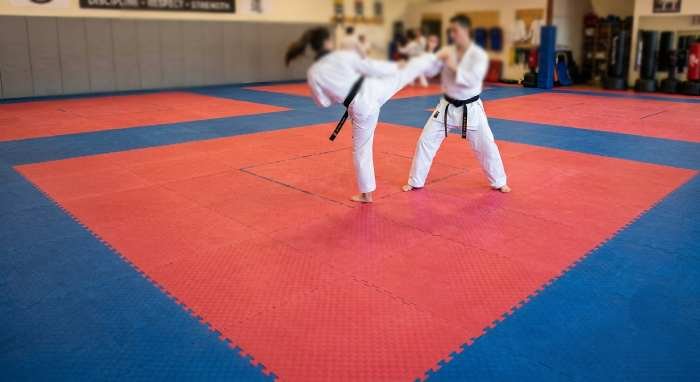
Martial arts mats are an essential part of any dojo, MMA academy, combat sports gym, school, training center, or professional sports facility. The right flooring provides athletes with a stable training surface while helping accommodate movements such as kicking, grappling, takedowns, throws, rolling, sparring, and controlled falls.
Whether you need MMA mats, training mats for martial arts, interlocking martial arts mats, martial arts crash mats, martial arts floor mats, or folding mats, selecting the right product requires more than comparing thickness and price. Surface texture, density, cushioning, durability, installation method, and the intended martial art should all be considered.
What Are Martial Arts Mats?
Martial arts mats are specialized sports flooring systems designed for disciplines such as MMA, Judo, Karate, Taekwondo, Brazilian Jiu-Jitsu, Wrestling, Kickboxing, and general martial arts training.
Unlike ordinary gym flooring, martial arts flooring is designed around the movements and impact patterns associated with combat sports. Depending on the application, mats may feature a smooth or textured surface, interlocking construction, roll-out installation, or folding construction.
For professional facilities, the selection process should begin with one question:
What sport and movements will the mat be used for?
Judo and BJJ facilities may prioritize cushioning, surface grip, and impact management for throws and groundwork, while Karate and Taekwondo facilities may place greater emphasis on stable footwork and controlled surface traction.
Types of Martial Arts Mats
1. MMA Mats
MMA mats are designed for mixed martial arts environments where athletes perform striking, takedowns, wrestling, grappling, and groundwork.
A suitable MMA training surface should provide an appropriate balance of:
- Shock absorption
- Stability
- Surface grip
- Durability
- Comfort
- Easy maintenance
For MMA academies with high daily usage, durability is particularly important because repeated drills can place significant stress on the flooring.
2. Training Mats for Martial Arts
Training mats for martial arts are designed for regular practice in dojos, academies, gyms, schools, and training centers.
When selecting training mats, consider:
- Martial art being practiced
- Athlete age and experience
- Training frequency
- Impact level
- Mat thickness
- Density
- Surface texture
- Installation method
A children’s martial arts class, professional MMA academy, and Judo training center may require completely different flooring characteristics.
3. Interlocking Martial Arts Mats
Interlocking martial arts mats use puzzle-style edges that connect individual tiles to create a larger training surface.
They are popular for facilities that need flexible flooring because individual sections can be removed, rearranged, expanded, or replaced.
Interlocking mats can be particularly useful for:
- Martial arts academies
- Home gyms
- Schools
- Multi-purpose halls
- Training studios
Before purchasing, check the locking strength, edge alignment, surface finish, thickness, and suitability for your specific martial art.
4. Martial Arts Crash Mats
Martial arts crash mats provide additional cushioning for activities involving throws, falls, landing drills, and impact-based training.
They can be used alongside permanent training flooring for activities such as Judo throws, wrestling drills, MMA takedown practice, and controlled fall training.
A crash mat should not automatically be selected simply because it is thicker. The ideal cushioning depends on the activity, athlete, training intensity, and mat construction.
5. Martial Arts Floor Mats
Martial arts floor mats are available in different constructions and formats, including foam mats, tatami-style surfaces, roll-out systems, puzzle mats, and folding mats.
The best option depends on whether the facility needs a permanent training area, portable flooring, modular installation, or specialized impact protection.
6. Folding Mats
Folding martial arts mats are designed for facilities where portability and storage are important.
They can be useful for:
- Home training
- Schools
- Temporary training areas
- Demonstrations
- Multi-purpose rooms
- Mobile training programs
Their foldable construction allows users to deploy the mat for training and store it when the space is needed for another activity.
Tatami or Smooth Surface: Which Should You Choose?
Surface texture is an important consideration.
A tatami-style surface is commonly associated with grappling and throwing disciplines such as Judo and BJJ, where athletes need an appropriate balance of grip and movement.
A smooth surface may be preferred for disciplines that involve faster footwork, such as Karate and Taekwondo.
However, the correct choice should always be based on the requirements of the particular sport and, where applicable, the current rules or specifications of the relevant governing organization.
Does a Thicker Martial Arts Mat Mean Better Protection?
Thickness is only one part of mat performance. Buyers should also evaluate:
- Foam density
- Shock absorption
- Firmness
- Compression characteristics
- Surface friction
- Material quality
- Construction
- Intended application
For example, a very soft mat may feel comfortable but may not provide the stability required for every martial art.
Therefore, instead of asking only “How thick is the mat?”, ask:
“How does the complete mat system perform for my sport?”
How to Choose the Right Martial Arts Mat
Use this simple 5-step selection framework:
1. Identify the sport: MMA, Judo, BJJ, Karate, Taekwondo, Wrestling, or general training.
2. Identify the movement: Striking, grappling, throwing, rolling, jumping, or takedowns.
3. Determine training intensity: Consider athletes, hours of use, class frequency, and impact levels.
4. Select the format: Choose between interlocking, roll-out, folding, or permanent flooring.
5. Verify specifications: Request information about thickness, density, surface, cushioning, durability, cleaning, warranty, and applicable standards.
For large commercial or institutional installations, requesting a product sample and technical datasheet before ordering can help buyers make a more informed decision.
Why Choose Gravolite Martial Arts Mats?
Gravolite is an Indian sports flooring manufacturer with a product portfolio covering multiple sports and training applications. The company states that it was established in 1970 and has developed its business across international markets.
Its sports-mat portfolio includes solutions for martial arts and related disciplines, including MMA, Judo, Karate, Taekwondo, Wrestling, and other sports flooring applications.
For academies, gym owners, schools, sports facilities, architects, and institutional buyers, working with a manufacturer that understands multiple sports can simplify sourcing when a project requires different types of sports flooring.
Looking for martial arts mats for your academy, gym, school, or sports facility? Contact Gravolite to discuss your application, required dimensions, surface type, and installation requirements. Visit Us
Martial Arts Mat Buying Checklist
Before placing an order, ask your supplier:
- What martial art is the mat designed for?
- What thickness is available?
- What is the foam density?
- What surface texture is available?
- Is it suitable for grappling or striking?
- Is the mat interlocking, folding, or roll-out?
- What impact or shock-absorption characteristics does it have?
- What maintenance is required?
- Can custom dimensions or colors be supplied?
- Is technical documentation available?
- Is it suitable for competition use?
- What warranty and after-sales support are provided?
Frequently Asked Questions
What are the best mats for martial arts?
The best martial arts mat depends on the discipline and training environment. MMA, Judo, BJJ, Karate, and Taekwondo can have different flooring requirements, so surface, cushioning, density, and stability should be evaluated together.
Are interlocking martial arts mats good?
Yes. Interlocking mats are a practical choice for modular training areas because they can be installed, removed, expanded, and replaced section by section.
What are MMA mats used for?
MMA mats are designed for mixed martial arts training involving striking, grappling, takedowns, wrestling, and groundwork.
Are folding mats suitable for martial arts?
Folding mats can be suitable for home training, schools, temporary spaces, demonstrations, and facilities where storage and portability are important.
How thick should martial arts mats be?
There is no single thickness suitable for every martial art. Thickness should be selected according to the sport, impact level, athlete requirements, mat construction, and applicable standards.