If you love anime, manga, or plan to work with Japanese companies, learn Japanese it has a steeper grammar/writing curve (kanji) but huge career value in India. If you’re drawn to K-dramas, K-pop, or Korean business ties, choose Korean its Hangul script is easier to learn, though grammar is still complex. Both are excellent choices depending on your goals.
Choosing between Informative Japanese vs Korean language learning is one of the most common dilemmas for language learners in India today. Both languages open doors to rich cultures, growing job markets, and exciting entertainment industries. But which one is actually right for you? Let’s break it down in detail.
Why Compare Japanese vs Korean Language?
Japan and Korea are neighboring countries with deep cultural influence across Asia, but their languages differ significantly in writing systems, grammar, pronunciation, and career opportunities. Making the right choice matters because language learning is a long-term commitment and picking the one that fits your interests and goals will keep you motivated.
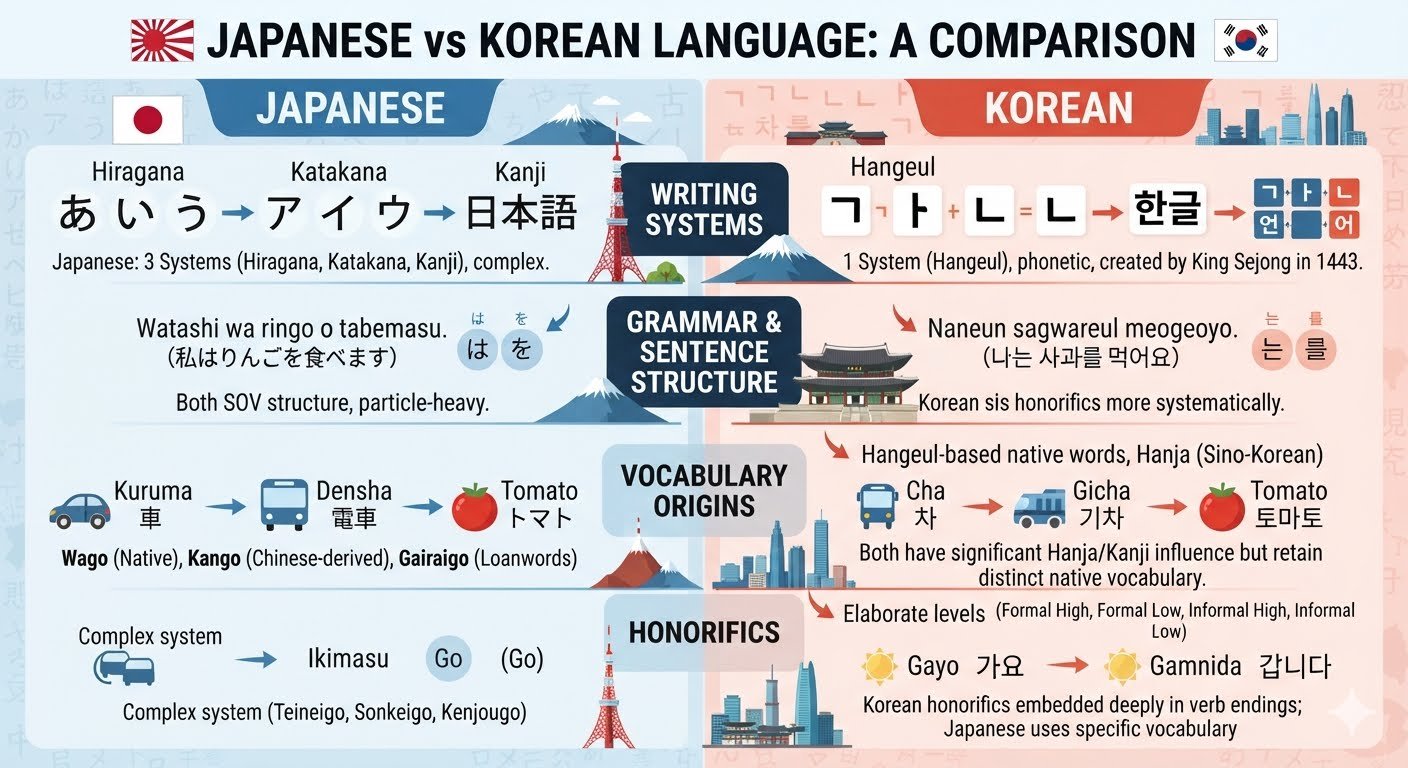
Japanese vs Korean Language: A Side-by-Side Comparison
| Feature | Japanese | Korean |
|---|---|---|
| Writing System | Hiragana, Katakana, Kanji (2,000+ characters) | Hangul (28 phonetic characters) |
| Ease of Learning Script | Difficult (Kanji takes years) | Easy (learnable in days) |
| Grammar | Subject-Object-Verb, complex honorifics | Subject-Object-Verb, formality levels |
| Pronunciation | Moderate, limited sounds | Moderate, more consonant sounds |
| Global Demand | High (Japan is 3rd largest economy) | Growing rapidly (K-pop, K-drama boom) |
| Career Scope in India | Strong IT, automobile, manufacturing | Growing gaming, entertainment, trade |
| JLPT/TOPIK Exams | JLPT (N5–N1) | TOPIK (Level 1–6) |
Japanese Language: Pros and Cons
Advantages of Learning Japanese
- High demand from Japanese companies operating in India (automobile, IT, robotics)
- Strong ties with Indian government skill-development programs
- Access to Japanese literature, anime, manga, and technology
- JLPT certification is globally recognized and boosts job prospects
Challenges of Learning Japanese
- Three writing systems, including thousands of Kanji characters
- Complex honorific speech levels (formal vs casual)
- Takes longer to reach fluency compared to Korean
Korean Language: Pros and Cons
Advantages of Learning Korean
- Hangul is scientifically designed and easy to learn quickly
- Massive rise in interest due to K-pop, K-dramas, and Korean cinema
- Growing trade and business relations between India and South Korea
- TOPIK certification opens doors to study and work visas in Korea
Challenges of Learning Korean
- Grammar structure and sentence formality can be tricky for beginners
- Fewer established institutes in India compared to Japanese language programs
- Vocabulary has fewer overlaps with English than Japanese in some technical fields
Career Opportunities: Japanese vs Korean Language in India
India has strong economic ties with both Japan and Korea, but the job landscape differs slightly:
- Japanese speakers are highly sought after in automobile manufacturing (Suzuki, Honda, Toyota), IT outsourcing, and translation services. Many companies prefer candidates with JLPT N3 or higher.
- Korean speakers are increasingly needed in gaming, animation, K-beauty, electronics (Samsung, LG), and tourism sectors.
If your goal is a stable corporate career, Japanese currently has an edge in India due to decades of established business relationships. If you’re aiming for creative industries or Korea-based opportunities, Korean is the smarter bet.
How to Start Learning: Japanese Language School in India
If you’ve decided Japanese is the right fit, enrolling in a proper institute makes a huge difference. A good Japanese language school in India provides structured JLPT-based courses, certified instructors, and speaking practice something self-study apps often lack.
What to Look for in a Japanese Language School in India
- JLPT-aligned curriculum – Ensures your learning matches official exam levels (N5 to N1)
- Native or certified trainers – Improves pronunciation and cultural understanding
- Placement assistance – Many schools connect students with Japanese companies
- Flexible batches – Weekend or online classes for working professionals and students
Cities like Delhi, Pune, Bangalore, and Chennai have several reputed Japanese language institutes offering beginner to advanced-level courses, often with placement tie-ups with Japanese firms.
Which One Should You Choose?
Ask yourself these questions before deciding:
- Do you enjoy anime, manga, or Japanese tech culture? → Choose Japanese
- Are you passionate about K-dramas, K-pop, or Korean cinema? → Choose Korean
- Are you looking for stronger corporate job opportunities in India? → Japanese may offer more options
- Do you want a language that’s quicker to read and write initially? → Korean’s Hangul is easier
- Are you planning to study or work specifically in Korea? → Choose Korean
- Are you targeting Japanese MNCs or manufacturing sector jobs? → Choose Japanese
There’s no universally “better” language it truly depends on your personal interest, career goals, and the industry you want to enter.
(FAQs)
1. Is Japanese or Korean easier to learn?
Korean is generally easier at the start because Hangul is a simple phonetic alphabet, while Japanese requires learning Kanji, which takes years to master fully.
2. Which language has better job opportunities in India? Japanese currently has more established job opportunities in India, especially in manufacturing, IT, and automobile sectors, due to long-standing India-Japan business ties.
3. How long does it take to become fluent in Japanese? On average, reaching conversational fluency (JLPT N3 level) takes 1.5 to 2 years of consistent study, while full fluency (N1) can take 3-4 years.
4. How long does it take to become fluent in Korean? Basic conversational fluency in Korean can be achieved in about 1 to 1.5 years, though advanced fluency for professional use takes longer.
5. Can I learn both Japanese and Korean together? It’s possible but not recommended for beginners, as both languages have distinct grammar patterns and scripts that can cause confusion early on.
6. Where can I find a good Japanese language school in India? Major cities like Delhi, Mumbai, Pune, and Bangalore have certified Japanese language schools offering JLPT-based courses with experienced instructors and placement support.
7. Is JLPT or TOPIK certification necessary for jobs? Yes, most companies hiring Japanese or Korean language speakers require JLPT (for Japanese) or TOPIK (for Korean) certification as proof of proficiency.
8. Which language is more useful for studying abroad? Korean is popular for students seeking scholarships in South Korea, while Japanese is preferred for those aiming for Japan’s MEXT scholarship or technical training programs.
9. Does knowing English help in learning Japanese or Korean? English doesn’t directly overlap with either language’s grammar, but many modern teaching methods use English as a bridge language for explanations.
10. Which language should a beginner start with if unsure? If undecided, try free introductory lessons in both languages for a few weeks and choose based on which one feels more natural and enjoyable to you.
About the Author
This article is written by a language education content specialist with experience researching East Asian language learning trends, curriculum structures, and career pathways for Indian students. All information has been compiled from publicly available data on JLPT, TOPIK, and India-Japan/Korea trade relations.
About Us
We are dedicated to providing accurate, well-researched, and helpful content on language learning, career development, and study-abroad guidance for students and professionals across India.
Contact Us
For queries, corrections, or collaboration opportunities, feel free to reach out through our official contact page or email us directly we’re happy to help you on your language learning journey.