
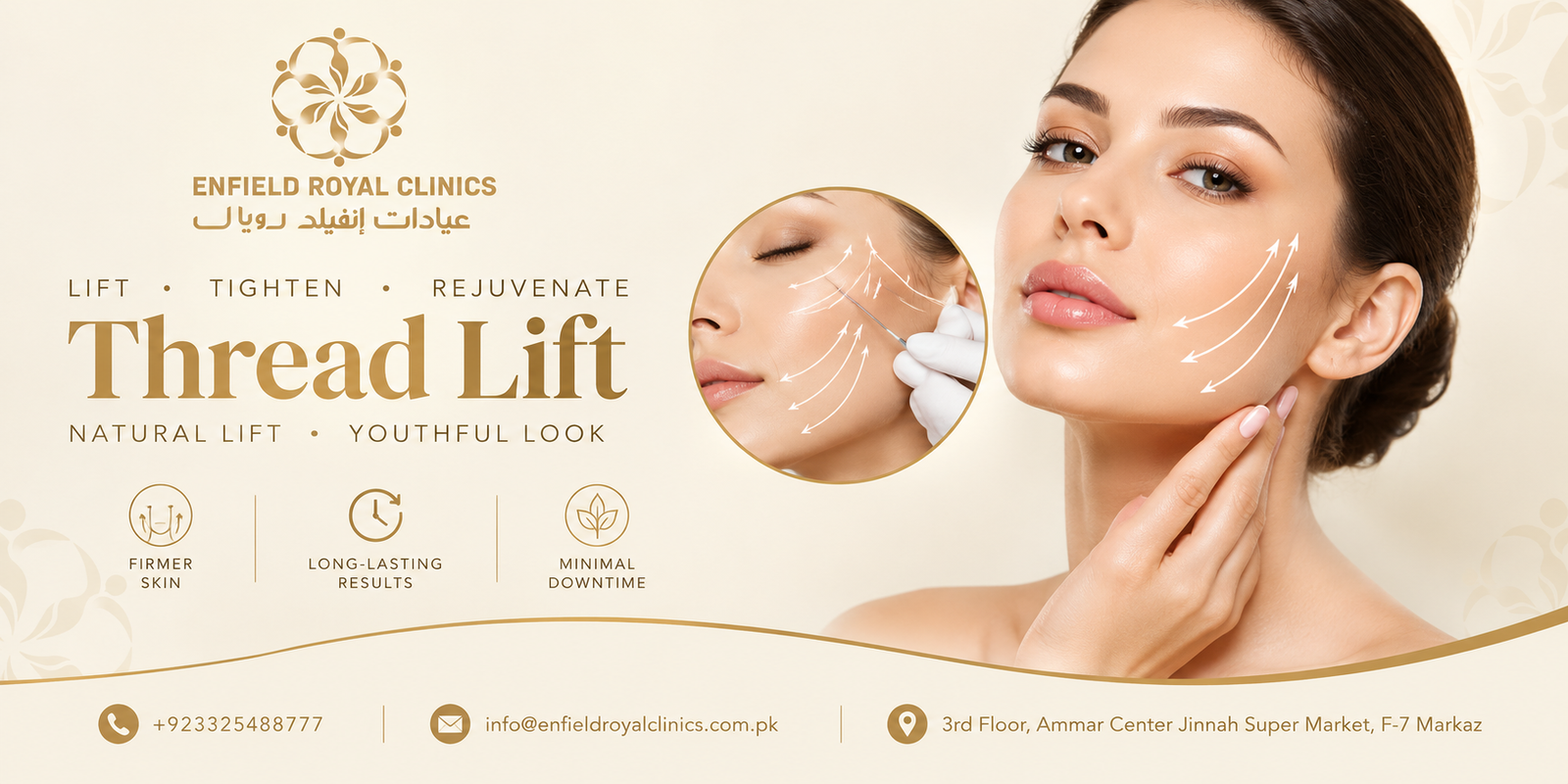
Loose skin is a common concern as the face gradually loses collagen, elasticity, and natural tissue support. These changes can make the cheeks appear lower, soften the jawline, and create sagging around the lower face. Many people look for non-surgical ways to improve skin firmness while avoiding the recovery associated with cosmetic surgery. Thread lift treatment is one option that may help address mild skin laxity in carefully selected individuals.
For people considering Thread Lift Treatment in Islamabad, understanding how the procedure works, which types of loose skin it can improve, and what results to expect is essential. A thread lift uses specialized threads placed beneath the skin to support targeted tissues and create a subtle lifting effect. It may improve facial definition, but its effectiveness depends on the severity of skin laxity, skin quality, and individual treatment goals.
1. How Does Thread Lift Treatment Work for Loose Skin?
Thread lift treatment is a minimally invasive cosmetic procedure designed to lift and support selected areas of the face. During the procedure, a qualified practitioner inserts specialized threads beneath the skin using an appropriate technique. The threads provide support to targeted tissues, helping create a firmer and more lifted appearance.
Many commonly used threads are dissolvable. As the body gradually absorbs them, the surrounding tissues may respond by producing collagen, a protein that helps maintain skin structure and firmness. This response may contribute to some improvement after the initial lifting effect begins to decrease.
The treatment may be used for areas such as the cheeks, jawline, and lower face when sagging is relatively mild. However, it does not remove excess skin, and it cannot reproduce the degree of correction achieved through a surgical facelift.
The main goal is to provide a subtle improvement rather than a dramatic transformation. A professional assessment helps determine whether a thread lift is likely to address the patient’s concerns or whether another treatment would be more appropriate.
2. Is Thread Lift Treatment Effective for Mild or Moderate Skin Laxity?
The effectiveness of a thread lift depends largely on how much loose skin is present. People with mild sagging and relatively good skin elasticity may be more suitable candidates than those with substantial excess skin.
For mild skin laxity, a thread lift may help lift the cheeks, improve the appearance of early jowls, and make the jawline look more defined. The results are generally intended to enhance existing facial features rather than change the overall facial structure.
Some people with moderate laxity may also be considered, depending on their anatomy and treatment goals. However, the improvement may be limited, particularly when the skin has lost considerable elasticity or the underlying tissues have shifted significantly.
A thread lift is less likely to meet expectations when loose skin is extensive. In such cases, a practitioner may discuss other options, including energy-based treatments or surgery, depending on the cause and severity of the concern.
Patients researching Thread Lift Treatment in Islamabad should understand that the procedure is not equally effective for everyone. The best results depend on appropriate patient selection, realistic expectations, and a treatment plan tailored to individual needs.
3. Which Areas of Loose Skin Can a Thread Lift Improve?
Thread lift treatment can target selected facial areas where mild sagging affects appearance. The most suitable areas depend on the technique used and the patient’s skin condition.
- Cheeks: A thread lift may provide subtle support to mildly sagging cheeks, helping the midface appear more lifted.
- Jawline: The treatment may improve definition when early skin laxity softens the boundary of the jaw.
- Jowls: In selected cases, it may reduce the appearance of mild sagging near the lower cheeks and jaw.
- Eyebrows: Certain techniques can provide a modest lift to the brow area.
- Neck: Some approaches may address mild laxity around selected areas of the neck, depending on the method and the patient’s suitability.
The results vary by treatment area. For example, sagging caused mainly by excess fat or changes in the underlying bone structure may not respond well to a thread lift alone. Similarly, significant loose skin around the neck may require a different approach.
A consultation allows the practitioner to assess the skin, facial proportions, and underlying causes of sagging before recommending treatment. This helps ensure that the procedure is chosen for an appropriate reason.
4. What Results Can Patients Expect After a Thread Lift?
Some lifting may be noticeable soon after a thread lift because the threads provide immediate support to targeted tissues. However, swelling, bruising, tightness, and tenderness can affect the early appearance. The result during the first few days may not represent the final outcome.
As recovery progresses, these temporary effects usually improve, making the treated contours easier to assess. Collagen-related changes may develop gradually, although the amount of improvement differs between individuals.
Patients should expect a modest lift rather than completely tight or smooth skin. Fine lines, deeper wrinkles, and significant excess skin may remain because a thread lift does not address every aspect of facial aging.
Results are also temporary. Many patients experience improvement for several months to around a year or longer, but the duration varies according to the thread material, technique, skin condition, and individual healing response. The natural aging process continues after treatment.
It is important to discuss the likely benefits and limitations before proceeding. A qualified practitioner should explain what the treatment can realistically achieve for the specific area being considered.
5. How Does Recovery Affect the Appearance of Loose Skin?
Recovery is generally shorter than after a surgical facelift, but patients still need time for the treated tissues to settle. Common temporary effects include swelling, bruising, tenderness, tightness, and mild discomfort.
Some patients may notice slight unevenness or dimpling during early healing. These changes may improve as the tissues settle, but persistent or worsening symptoms should be assessed by a qualified practitioner.
Aftercare instructions may include:
- Avoiding strenuous exercise for the recommended period.
- Avoiding unnecessary pressure, rubbing, or massage over treated areas.
- Following guidance about sleeping positions and facial movements.
- Keeping the skin clean and following recommended skincare instructions.
- Attending follow-up appointments when advised.
The recovery period depends on the technique used and the individual’s healing response. Patients should not assume that minimal downtime means the procedure is risk-free.
Severe or worsening pain, increasing redness, unusual discharge, fever, or unexpected skin discoloration requires prompt medical assessment. Early evaluation can help identify complications and determine whether treatment is needed.
6. What Factors Influence the Effectiveness of a Thread Lift?
Several factors can influence how well a thread lift works for loose skin. Understanding these factors can help patients develop realistic expectations before treatment.
Skin elasticity: Skin that retains some natural elasticity may respond differently from skin with advanced laxity.
Severity of sagging: A thread lift is generally more suitable for mild sagging than for extensive excess skin.
Treatment technique: Thread type, placement, and the practitioner’s experience can influence the outcome. Treatment should be planned according to the patient’s anatomy rather than using the same approach for everyone.
Age and individual healing: Age alone does not determine suitability, but natural changes in collagen and tissue support may affect results. Individual healing responses also vary.
Lifestyle habits: Smoking, excessive sun exposure, and significant weight fluctuations can influence skin health and facial appearance. Healthy habits support general skin care, although they cannot guarantee a better or longer-lasting lift.
Expectations: Patients seeking a subtle improvement may be satisfied with a result that would not meet the expectations of someone wanting a dramatic surgical-style lift.
An experienced, appropriately trained practitioner should explain these factors during the consultation and help the patient compare the potential benefits with the risks and limitations.
7. Is a Thread Lift Better Than Other Treatments for Loose Skin?
A thread lift is one of several options for addressing skin laxity, but it is not always the most effective choice. The best approach depends on the severity of sagging, the treatment area, and the patient’s preferences.
Some non-surgical treatments use energy-based technologies to target skin firmness. These may be considered for selected patients, although their results and suitability differ from those of thread lifts. Dermal fillers can restore volume in specific areas but do not directly remove excess skin. A surgical facelift may provide a more substantial correction for significant sagging, but it involves greater procedural and recovery considerations.
A thread lift may be appropriate for someone seeking a modest lifting effect with less downtime than surgery. It may be less suitable for a person with extensive loose skin who expects a dramatic or permanent change.
Potential risks include bruising, swelling, infection, asymmetry, dimpling, visible or palpable threads, and unsatisfactory results. A consultation should cover these risks, the expected duration of improvement, alternative options, and the practitioner’s qualifications.
Ultimately, thread lift treatment can be effective for selected cases of mild facial skin laxity, but it cannot eliminate all loose skin. A personalized assessment is the most reliable way to determine whether the procedure matches the patient’s needs.
Frequently Asked Questions
1. Can a thread lift remove loose skin completely?
No. A thread lift supports and lifts selected tissues but does not remove excess skin. It may improve mild sagging, while significant skin laxity may require a different treatment approach.
2. How long do thread lift results last for loose skin?
Results commonly last several months to around a year or longer, depending on the thread type, technique, skin quality, and individual response. The results are temporary and cannot be guaranteed to last for a specific period.
3. Is a thread lift suitable for older adults with sagging skin?
Age alone does not determine suitability. The severity of skin laxity, overall health, skin quality, and treatment goals are more important considerations. A qualified practitioner should assess whether the expected improvement is realistic.
4. Can thread lift treatment tighten loose skin on the neck?
Certain thread lift techniques may improve mild neck laxity in selected patients. However, substantial loose skin may not respond sufficiently, so a professional assessment is necessary before choosing a treatment.
Meta Description: Discover whether thread lift treatment in Islamabad can improve loose skin, including benefits, suitable areas, recovery, results, and treatment alternatives.
Is Thread Lift Treatment Effective for Loose Skin?
Loose skin is a common concern as the face gradually loses collagen, elasticity, and natural tissue support. These changes can make the cheeks appear lower, soften the jawline, and create sagging around the lower face. Many people look for non-surgical ways to improve skin firmness while avoiding the recovery associated with cosmetic surgery. Thread lift treatment is one option that may help address mild skin laxity in carefully selected individuals.
For people considering Thread Lift Treatment in Islamabad, understanding how the procedure works, which types of loose skin it can improve, and what results to expect is essential. A thread lift uses specialized threads placed beneath the skin to support targeted tissues and create a subtle lifting effect. It may improve facial definition, but its effectiveness depends on the severity of skin laxity, skin quality, and individual treatment goals.
1. How Does Thread Lift Treatment Work for Loose Skin?
Thread lift treatment is a minimally invasive cosmetic procedure designed to lift and support selected areas of the face. During the procedure, a qualified practitioner inserts specialized threads beneath the skin using an appropriate technique. The threads provide support to targeted tissues, helping create a firmer and more lifted appearance.
Many commonly used threads are dissolvable. As the body gradually absorbs them, the surrounding tissues may respond by producing collagen, a protein that helps maintain skin structure and firmness. This response may contribute to some improvement after the initial lifting effect begins to decrease.
The treatment may be used for areas such as the cheeks, jawline, and lower face when sagging is relatively mild. However, it does not remove excess skin, and it cannot reproduce the degree of correction achieved through a surgical facelift.
The main goal is to provide a subtle improvement rather than a dramatic transformation. A professional assessment helps determine whether a thread lift is likely to address the patient’s concerns or whether another treatment would be more appropriate.
2. Is Thread Lift Treatment Effective for Mild or Moderate Skin Laxity?
The effectiveness of a thread lift depends largely on how much loose skin is present. People with mild sagging and relatively good skin elasticity may be more suitable candidates than those with substantial excess skin.
For mild skin laxity, a thread lift may help lift the cheeks, improve the appearance of early jowls, and make the jawline look more defined. The results are generally intended to enhance existing facial features rather than change the overall facial structure.
Some people with moderate laxity may also be considered, depending on their anatomy and treatment goals. However, the improvement may be limited, particularly when the skin has lost considerable elasticity or the underlying tissues have shifted significantly.
A thread lift is less likely to meet expectations when loose skin is extensive. In such cases, a practitioner may discuss other options, including energy-based treatments or surgery, depending on the cause and severity of the concern.
Patients researching Thread Lift Treatment in Islamabad should understand that the procedure is not equally effective for everyone. The best results depend on appropriate patient selection, realistic expectations, and a treatment plan tailored to individual needs.
3. Which Areas of Loose Skin Can a Thread Lift Improve?
Thread lift treatment can target selected facial areas where mild sagging affects appearance. The most suitable areas depend on the technique used and the patient’s skin condition.
- Cheeks: A thread lift may provide subtle support to mildly sagging cheeks, helping the midface appear more lifted.
- Jawline: The treatment may improve definition when early skin laxity softens the boundary of the jaw.
- Jowls: In selected cases, it may reduce the appearance of mild sagging near the lower cheeks and jaw.
- Eyebrows: Certain techniques can provide a modest lift to the brow area.
- Neck: Some approaches may address mild laxity around selected areas of the neck, depending on the method and the patient’s suitability.
The results vary by treatment area. For example, sagging caused mainly by excess fat or changes in the underlying bone structure may not respond well to a thread lift alone. Similarly, significant loose skin around the neck may require a different approach.
A consultation allows the practitioner to assess the skin, facial proportions, and underlying causes of sagging before recommending treatment. This helps ensure that the procedure is chosen for an appropriate reason.
4. What Results Can Patients Expect After a Thread Lift?
Some lifting may be noticeable soon after a thread lift because the threads provide immediate support to targeted tissues. However, swelling, bruising, tightness, and tenderness can affect the early appearance. The result during the first few days may not represent the final outcome.
As recovery progresses, these temporary effects usually improve, making the treated contours easier to assess. Collagen-related changes may develop gradually, although the amount of improvement differs between individuals.
Patients should expect a modest lift rather than completely tight or smooth skin. Fine lines, deeper wrinkles, and significant excess skin may remain because a thread lift does not address every aspect of facial aging.
Results are also temporary. Many patients experience improvement for several months to around a year or longer, but the duration varies according to the thread material, technique, skin condition, and individual healing response. The natural aging process continues after treatment.
It is important to discuss the likely benefits and limitations before proceeding. A qualified practitioner should explain what the treatment can realistically achieve for the specific area being considered.
5. How Does Recovery Affect the Appearance of Loose Skin?
Recovery is generally shorter than after a surgical facelift, but patients still need time for the treated tissues to settle. Common temporary effects include swelling, bruising, tenderness, tightness, and mild discomfort.
Some patients may notice slight unevenness or dimpling during early healing. These changes may improve as the tissues settle, but persistent or worsening symptoms should be assessed by a qualified practitioner.
Aftercare instructions may include:
- Avoiding strenuous exercise for the recommended period.
- Avoiding unnecessary pressure, rubbing, or massage over treated areas.
- Following guidance about sleeping positions and facial movements.
- Keeping the skin clean and following recommended skincare instructions.
- Attending follow-up appointments when advised.
The recovery period depends on the technique used and the individual’s healing response. Patients should not assume that minimal downtime means the procedure is risk-free.
Severe or worsening pain, increasing redness, unusual discharge, fever, or unexpected skin discoloration requires prompt medical assessment. Early evaluation can help identify complications and determine whether treatment is needed.
6. What Factors Influence the Effectiveness of a Thread Lift?
Several factors can influence how well a thread lift works for loose skin. Understanding these factors can help patients develop realistic expectations before treatment.
Skin elasticity: Skin that retains some natural elasticity may respond differently from skin with advanced laxity.
Severity of sagging: A thread lift is generally more suitable for mild sagging than for extensive excess skin.
Treatment technique: Thread type, placement, and the practitioner’s experience can influence the outcome. Treatment should be planned according to the patient’s anatomy rather than using the same approach for everyone.
Age and individual healing: Age alone does not determine suitability, but natural changes in collagen and tissue support may affect results. Individual healing responses also vary.
Lifestyle habits: Smoking, excessive sun exposure, and significant weight fluctuations can influence skin health and facial appearance. Healthy habits support general skin care, although they cannot guarantee a better or longer-lasting lift.
Expectations: Patients seeking a subtle improvement may be satisfied with a result that would not meet the expectations of someone wanting a dramatic surgical-style lift.
An experienced, appropriately trained practitioner should explain these factors during the consultation and help the patient compare the potential benefits with the risks and limitations.
7. Is a Thread Lift Better Than Other Treatments for Loose Skin?
A thread lift is one of several options for addressing skin laxity, but it is not always the most effective choice. The best approach depends on the severity of sagging, the treatment area, and the patient’s preferences.
Some non-surgical treatments use energy-based technologies to target skin firmness. These may be considered for selected patients, although their results and suitability differ from those of thread lifts. Dermal fillers can restore volume in specific areas but do not directly remove excess skin. A surgical facelift may provide a more substantial correction for significant sagging, but it involves greater procedural and recovery considerations.
A thread lift may be appropriate for someone seeking a modest lifting effect with less downtime than surgery. It may be less suitable for a person with extensive loose skin who expects a dramatic or permanent change.
Potential risks include bruising, swelling, infection, asymmetry, dimpling, visible or palpable threads, and unsatisfactory results. A consultation should cover these risks, the expected duration of improvement, alternative options, and the practitioner’s qualifications.
Ultimately, thread lift treatment can be effective for selected cases of mild facial skin laxity, but it cannot eliminate all loose skin. A personalized assessment is the most reliable way to determine whether the procedure matches the patient’s needs.
Frequently Asked Questions
1. Can a thread lift remove loose skin completely?
No. A thread lift supports and lifts selected tissues but does not remove excess skin. It may improve mild sagging, while significant skin laxity may require a different treatment approach.
2. How long do thread lift results last for loose skin?
Results commonly last several months to around a year or longer, depending on the thread type, technique, skin quality, and individual response. The results are temporary and cannot be guaranteed to last for a specific period.
3. Is a thread lift suitable for older adults with sagging skin?
Age alone does not determine suitability. The severity of skin laxity, overall health, skin quality, and treatment goals are more important considerations. A qualified practitioner should assess whether the expected improvement is realistic.
4. Can thread lift treatment tighten loose skin on the neck?
Certain thread lift techniques may improve mild neck laxity in selected patients. However, substantial loose skin may not respond sufficiently, so a professional assessment is necessary before choosing a treatment.