

To shift an office in India, start planning 60 to 90 days ahead. Form a relocation team, audit and tag your assets, finalise the new layout, hire a professional corporate moving company, plan the IT and network cutover, pack and label everything, move over a weekend, then set up and test every workstation. A structured plan keeps business downtime to a minimum.
An office move is one of the most disruptive projects a company runs. It touches IT, HR, admin, finance and every employee at once. Done well, teams log in on Monday as if nothing happened. Done badly, it means lost equipment, damaged servers, missed deadlines and weeks of lost productivity.
This guide covers how corporate relocations work in India, step by step, and how to choose the right corporate movers for the job.
What Is Corporate Office Relocation?
Corporate office relocation is the planned movement of an organisation’s workplace from one location to another. It covers IT equipment, workstations, furniture, records, networks and infrastructure, along with the compliance, permissions and coordination around them.
It differs from household moving. Corporate relocations involve asset registers, server migrations, phased moves, building NOCs and strict downtime limits. That is why businesses use specialised corporate relocation services rather than general packers and movers.
Hybrid Shifting is India’s Corporate Services Solutions company, offering commercial moving, asset management, asset buyback and reinstatement, digitization and relocation services through one integrated partner.
How Do You Shift an Office in India? (10 Steps)
1. Build a relocation team and set the budget
Appoint one project lead and representatives from IT, admin, HR and finance. Set a budget that covers moving, new-space fit-out, IT downtime, insurance and contingency. Early ownership prevents most delays later.
2. Audit and tag all assets
List every IT and non-IT asset: laptops, desktops, servers, furniture, printers, phones and records. Tag each one with a barcode or RFID label. A tagged asset register lets you verify everything that left the old office arrived at the new one.
3. Finalise the new space and floor plan3. Finalise the new space and floor plan
Confirm seating capacity, workstation layout, meeting rooms, server room and power and network points before moving day. Share the seating plan with employees in advance.
4. Check lease terms and building permissions
Review your exit obligations at the old premises and the move-in rules at the new one. Check goods-lift timings, loading-bay access, security clearances and any building or society NOC. Many Indian commercial buildings restrict movement to nights or weekends.
5. Shortlist and hire a corporate moving company
Compare corporate movers on enterprise experience, IT handling capability, insurance, transit tracking and single-point accountability. Get a site survey done before you accept any quote. Our section on choosing corporate movers and packers below covers the criteria.
6. Plan the IT, network and telecom cutover6. Plan the IT, network and telecom cutover
Coordinate internet, leased lines, telephony and server migration with your IT team and vendors. Take full backups. Where possible, set up the new network before the physical move so teams can connect on day one.
7. Communicate the plan to employees and vendors
Send a timeline, packing instructions, seating plan and a single point of contact. Inform clients, couriers and key vendors about the address change and any service disruption.
8. Pack, label and document8. Pack, label and document
Pack workstations by team and label each unit with the owner, destination and asset tag. Fragile and sensitive equipment needs specialised packing. Document handover and condition for high-value assets.
9. Execute the move
Schedule the move for a weekend or off-hours. Use a phased approach for large offices, moving one department or floor at a time. Keep a supervisor at both ends to check items off against the asset register.
10. Set up, test and reinstate10. Set up, test and reinstate
Install and test every workstation, network port and meeting room before staff return. Then handle reinstatement of the old premises, including clearing the space and restoring it to the condition the lease requires.
How Long Does a Corporate Office Shift Take?
Planning takes longer than the move itself. As a general guide:

These are indicative planning windows. Actual timelines depend on IT complexity, building restrictions and fit-out readiness.
What Should a Corporate Relocation Checklist Include?
- Approved budget and project lead
- Complete, tagged asset register
- Lease exit and move-in documentation
- Building NOC and lift or loading-bay approvals
- IT backup, server and network migration plan
- Final floor plan and seating chart
- Insurance for goods in transit
- Employee communication and packing instructions
- Vendor and client address-change notifications
- Post-move testing checklist
- Reinstatement plan for the old premises
How Do You Minimise Downtime During an Office Move?How Do You Minimise Downtime During an Office Move?
Move over a weekend or off-hours, and set up the new network and IT infrastructure before staff arrive. Use pre-tagged, labelled assets so unpacking is fast. Run a dry run for critical systems and phase large moves department by department. These steps are what separate a smooth corporate relocation from a disruptive one.
How Much Does Corporate Relocation Cost in India?
There is no flat rate. Corporate relocation cost depends on:
- Number of seats and volume of assets
- Distance between old and new locations
- Amount of IT equipment, servers and sensitive items
- Packing material and specialised handling
- Building restrictions such as night-only movement
- Insurance cover
- Reinstatement and exit requirements
The most reliable way to budget is a site survey from your corporate moving company, followed by an itemised quote.
Should You Hire Corporate Movers or Move In-House?
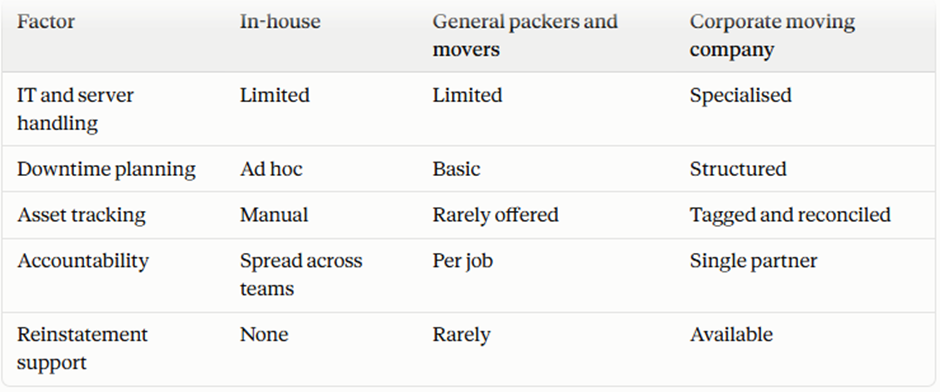
Corporate movers and packers manage the risk, sequencing and documentation that internal teams rarely have bandwidth for. For anything beyond a small office, a professional partner usually costs less than the downtime and damage of a poorly run DIY move.
How Do You Choose the Right Corporate Moving Company?
Look for these in corporate moving companies:
- Enterprise experience. Ask for relevant case studies and references.
- Integrated capabilities. One partner for moving, asset tagging, storage and reinstatement means fewer hand-offs.
- Technology-enabled tracking. Asset-level visibility from pickup to setup.
- Network and fleet. Reach across cities and enough vehicles for phased moves.
- Specialised handling. Data centre, lab and high-value asset experience.
- Insurance and documentation. Clear liability terms and chain-of-custody records.
What Are Common Office Shifting Mistakes?
- Starting planning too late
- Moving without a tagged asset register
- Ignoring IT and network cutover timelines
- Skipping building permissions and NOCs
- Underinsuring equipment in transit
- Poor communication with employees
- Forgetting lease exit and reinstatement obligations
Why Choose Hybrid Shifting for Corporate Relocations?
Hybrid Shifting is built for complex corporate relocations. One partner handles the entire project, from asset tagging and packing to transit, setup and reinstatement.
- Scale: a track record of 10M+ sq. ft. of offices relocated, with 100+ corporate clients
- Reach: 15,000+ PIN codes covered across India, with 200+ vehicles supporting movement
- Asset visibility: RFID and barcode tagging with reconciliation against enterprise records
- Specialised handling: office, factory, warehouse, data centre and lab shifting
- Single accountability: moving, asset management, buyback, digitization and relocation under one roof
Whether you need corporate movers for a 30-seat office or a multi-floor corporate relocation across cities, Hybrid Shifting’s corporate relocation services are planned around business continuity.
Planning an office move? Talk to Hybrid Shifting for a site survey and itemised plan.
FAQs
How early should I start planning an office shift?
Start 60 to 90 days ahead for most offices. Large corporate relocations, especially across cities or involving data centres, need 10 to 12 weeks. Early planning secures building permissions, vendor slots and IT cutover windows.
Can an office be shifted without business downtime?
Near-zero downtime is possible with a phased move, pre-built network at the new site and weekend execution. Experienced corporate movers plan the sequence so teams can work at the old or new location without a gap.
Who handles IT equipment and servers during an office move?
Your IT team plans the cutover, while a corporate moving company physically handles equipment with specialised packing and documentation. For servers, chain-of-custody records track each unit from the old site to the new one.
Is insurance included in corporate relocation services?
It depends on the provider and contract. Always confirm that goods-in-transit insurance is covered, what the liability limits are and how damage claims are handled before you sign.
What documents are needed to shift an office in India?
Typically a lease or exit agreement, building NOC, asset register, vendor and address-change records, and any permissions for goods-lift or loading-bay use. Requirements vary by building and city.
What is office reinstatement and when is it required?
Reinstatement means restoring vacated premises to the condition specified in the lease. It usually includes clearing furniture and fixtures and repairing partitions or flooring. It is often a condition for getting your security deposit back.