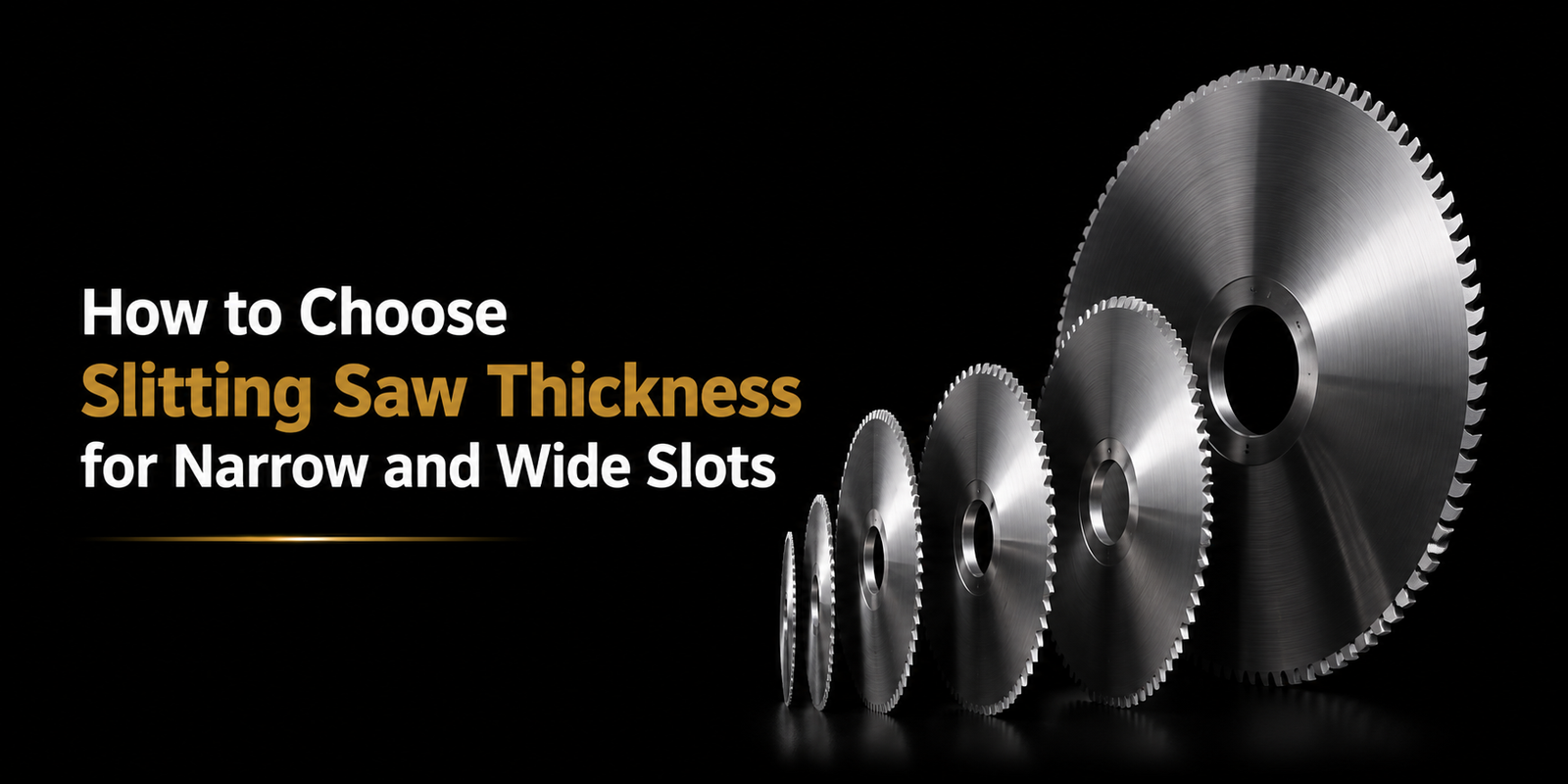
Selecting the correct Slitting Saw thickness is one of the most important decisions in precision machining. The thickness of the saw directly determines the slot width, cutting stability, material removal rate, and overall machining efficiency. Choosing a blade that is too thin can lead to deflection and breakage, while a blade that is too thick removes unnecessary material, increases cutting forces, and wastes both time and resources.
Whether you are machining narrow grooves in precision components or producing wide slots in heavy-duty metal parts, understanding how blade thickness affects cutting performance will help you achieve cleaner finishes, tighter tolerances, and longer tool life. Modern manufacturers offer Slitting Saw blades in a wide range of thicknesses, allowing machinists to select the ideal option for virtually every application.
What Slitting Saw Thickness Actually Means
A slitting saw is designed to produce narrow, accurate cuts with minimal material waste. However, its performance depends heavily on choosing the right thickness for the specific machining operation. The correct thickness not only determines the final slot width but also influences how smoothly the blade cuts through the material.
A properly selected blade improves cutting stability, reduces chatter, minimizes heat generation, and extends tool life. On the other hand, an incorrect thickness can lead to poor dimensional accuracy, faster wear, and higher operating costs. Since different industries work with various materials and slot sizes, there is no single blade thickness that fits every application.
Key Factors That Decide the Right Thickness
Before you land on a number, run through these variables:
- Finished slot width – The thickness of the saw is the slot width, minus a small allowance for tool wander on longer or deeper cuts.
- Material hardness – Soft metals like aluminium and copper tolerate thinner blades; hardened steel and stainless demand more body to resist heat and deflection.
- Depth of cut – The deeper the slot relative to its width, the more the blade needs thickness and rigidity to stay straight.
- Machine rigidity and arbor overhang – A thin saw on a long, unsupported arbor will flex and chatter regardless of how good the tool is.
- Tooth form – Plain, staggered, or side-and-face geometry is matched to thickness; you can’t pair a very thin blade with a coarse, deep-gullet tooth form and expect a clean cut.
Choosing Slitting Saw Thickness for Narrow Slots
Narrow-slot work – typically 0.3 mm to 1.5 mm – requires a thin, fine-tooth blade with a high tooth count. This range is ideal for screw slotting, electronic components, precision grooves, and other applications where maintaining an accurate slot width is critical.
A thin slitting saw creates a narrow kerf and removes minimal material, making it an excellent choice for expensive alloys and small precision parts where reducing material loss is important. However, thinner blades have lower rigidity and are more prone to deflection. To achieve the best cutting performance, reduce feed rates, apply sufficient coolant, and keep arbor overhang as short as possible. A plain, fine-tooth design with 28 to 100+ teeth is commonly used because it delivers a smooth finish and minimizes blade wander during shallow, narrow cuts.
If burrs, chatter marks, or slightly uneven slot walls appear during machining, they are often caused by excessive arbor overhang or feed rates that are too high for the selected blade thickness. Adjusting the machine setup and cutting parameters can significantly improve cutting accuracy and surface finish.
Choosing Slitting Saw Thickness for Wide Slots
Wide or deep slots – generally 3 mm to 6 mm and up – need a thicker, more rigid blade, usually paired with a staggered-tooth or side-and-face form. This category covers keyway cutting, deep grooving, tube and pipe cut-off, and heavy stock removal in tougher materials like stainless and alloy steel.
Here, the extra body in the slitting saw resists dishing and deflection under the higher cutting forces that come with a deeper pass. Staggered teeth, bevelled alternately left and right, give the side clearance and chip flow that a thicker blade needs to avoid overheating and rubbing. For the widest, most heavily loaded cuts, a side-and-face design with a keyed bore adds a positive drive that a plain bore can’t provide at that thickness.
Going thicker than necessary isn’t free, though — it means more material removed, more heat generated, slower cutting speeds, and a bigger investment per tool. The goal is the minimum thickness that still gives you the rigidity the depth of cut demands, not the thickest option available.
Quick Reference: Narrow vs Wide Slot Thickness
| Slot type | Typical thickness | Tooth form | Common applications |
| Very narrow | 0.3–1 mm | Plain, fine (28–100+ teeth) | Screw slots, electronics, thin precision grooves |
| Narrow | 1–2 mm | Plain or light staggered | General slotting, sheet & strip work |
| Medium | 2–3 mm | Staggered | Alloy and stainless steel, moderate depth |
| Wide | 3–4 mm | Staggered / side-and-face | Deep grooving, tube cut-off |
| Very wide | 4–6 mm+ | Side-and-face, keyed bore | Keyway cutting, heavy stock removal |
Step-by-Step: Selecting Your Slitting Saw Thickness
- Confirm the finished slot width from the drawing – This is your target thickness before any tolerance allowance.
- Identify the material and its hardness – Harder, tougher materials push you toward a thicker blade and a more heat-resistant grade like cobalt (M35) or carbide.
- Check the depth-to-width ratio of the cut – A slot much deeper than it is wide needs the extra rigidity of a thicker saw, even if the width alone suggests a thinner one.
- Assess your machine and arbor setup – Long overhang or an older, less rigid machine argues for a thicker, more forgiving blade and a lighter feed.
- Match tooth form to thickness and material – Fine teeth for thin, shallow, precise slots; staggered or side-and-face teeth for wide, deep, or tougher cuts.
If the numbers fall between standard sizes, a custom-ground blade is usually worth it – a slightly wrong stock thickness causes more scrap and downtime than the cost difference of ordering to spec.
Common Mistakes to Avoid
- Sizing purely on slot width and ignoring depth – A narrow but deep slot often needs more thickness than the width alone suggests.
- Using a thin saw with excessive arbor overhang – This is the single most common cause of wander and chatter.
- Overcompensating with a blade too thick “to be safe” – It wastes material, slows the cut, and increases tool cost for no real gain in most jobs.
- Ignoring tooth form – Thickness and tooth geometry work together; the wrong pairing causes poor chip clearance and premature edge wear.
- Not accounting for material toughness – Stainless and hardened steels need thicker, staggered-tooth blades in tougher grades, not just a scaled-up version of a mild-steel setup.
Conclusion
Choosing the right slitting saw thickness comes down to balancing slot width, material, depth of cut, and machine rigidity – go too thin, and you risk wander and chatter; go too thick, and you waste material and cutting time. When the job falls outside standard stock sizes, working with a manufacturer that grinds to your exact spec makes the difference between a cutter that fights the job and one that’s built for it. Maxwell Slitters has been manufacturing precision HSS, cobalt, and carbide slitting saws since 1976, custom-ground to slot width, material, and machine setup, so it’s worth sending your drawing or a worn sample rather than guessing from a catalogue size.
Frequently Asked Questions
1. What is the standard thickness range for metal slitting saws?
Most slitting saws are made from around 0.3 mm up to 6 mm thick, with larger-diameter or specialised cutters sometimes going beyond that. The right thickness within this range depends on the slot width required and the depth of the cut.
2. Can I use a thinner slitting saw to save material on a wide slot?
Not safely. A blade that’s too thin for the depth of cut will flex, wander, and likely break under load. Thickness needs to match the depth and rigidity the job demands, not just the narrowest kerf you can get away with.
3. Does slitting saw thickness affect cutting speed and feed rate?
Yes. Thinner blades need lighter feed per tooth and more conservative speeds to avoid deflection, while thicker blades can generally handle higher feeds but require more spindle power and better chip clearance to manage heat.
4. How does material hardness influence thickness selection?
Harder materials like stainless or tool steel generate more cutting force and heat, so they typically call for a thicker, staggered-tooth blade in a tougher grade such as cobalt or carbide, rather than a thin fine-tooth saw suited to mild steel or aluminium.
5. What happens if I pick the wrong slitting saw thickness?
Too thin for the job and you’ll see chatter, wander, or blade breakage; too thick and you waste material, run slower, and spend more per tool than necessary. In both cases, tool life drops and finish quality suffers, which is why matching thickness to slot width, depth, and material is worth getting right up front.