
Many business-to-business companies treat brand as a logo refresh or a new tagline. Good B2B branding is something more useful: it makes the right buyers remember you when a need appears, trust you enough to shortlist you, and feel safe defending the choice to colleagues.
That last part matters. B2B purchases are rarely made by one person. A brand has to work for the finance head, the technical evaluator and the end user at the same time.
This article sets out a step-by-step method that marketing and leadership teams can follow without a large agency budget.
Step 1: Get clear on the category and the buyer
Start by defining the category you compete in and the problem buyers are trying to solve when they enter it. If buyers would struggle to say what category you belong to, they will struggle to remember you.
List the roles involved in a typical purchase and what each one worries about. A finance lead fears cost overruns, an IT lead fears integration risk, and a business user fears disruption. Your brand needs an answer for each.
Talk to recent customers and lost prospects rather than relying on internal assumptions. Ask what nearly stopped them buying and which other options they considered. Their answers show the real competitive set and the language buyers actually use.
Step 2: Choose a B2B branding position you can own
Positioning is the single idea you want buyers to associate with you. It should be specific, true, and hard for a competitor to claim without changing their business.
Avoid generic claims such as quality, innovation or customer focus. Instead, anchor the position in something concrete: a segment you know deeply, a method you use, or an outcome you deliver reliably. This is the core of B2B branding that lasts, because it gives every later asset a clear job.
Test the position with sales before rolling it out. If the team cannot use it naturally in a first call, or prospects do not react to it, refine it until it sounds both credible and specific.
Step 3: Build distinctive, consistent brand assets
Buyers notice far less of your marketing than you think. Distinctive assets, such as a consistent colour, a recognisable visual style, a recurring phrase, help them link scattered exposures back to you.
Pick a small set and use them everywhere for a long time. Consistency across the website, sales decks, proposals and social posts does more for memory than frequent creative changes.
Write simple brand guidelines that cover these assets, your tone of voice and a few examples of right and wrong use. Keep the document short enough that sales staff, partners and freelancers will actually read and follow it.
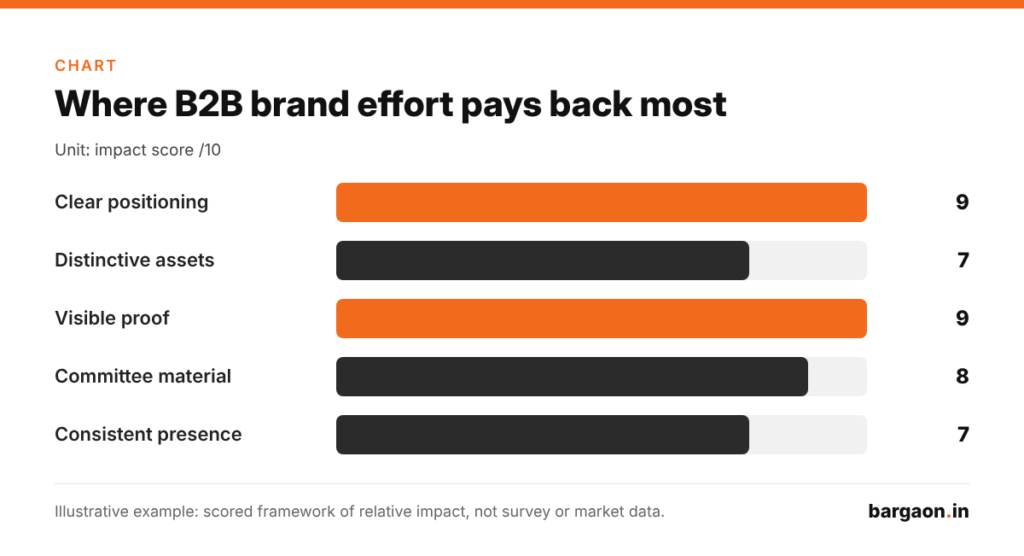
Step 4: Turn credibility into visible proof
B2B buyers look for evidence that you have solved their problem before. Claims without proof are ignored. Thinking on how buyers assess risk, widely covered in Harvard Business Review, shows why reassurance often matters as much as features in complex purchases.
Build a library of proof that sales and marketing can both use:
- Case studies with a clear before-and-after story
- Named client logos, with permission
- Expert content written by real people in your team
- Certifications, partnerships and process documentation
- Short video or written testimonials from named client contacts
Step 5: Equip the buying committee
Your champion inside the client company has to sell you internally. Make that easy. Create short, role-specific material: a one-page business case for finance, a technical overview for IT, and a rollout summary for operations.
When each stakeholder finds answers to their own questions, the decision moves faster and your brand becomes the safe choice rather than the risky one.
Ask your sales team which questions come up repeatedly in late-stage deals. Those questions point directly to the material that is missing, and answering them in advance removes friction at the moment it matters most.
Step 6: Show up consistently where buyers learn
Brand is built through repeated, useful presence, not one-off campaigns. Identify where your buyers learn about the category: industry events, newsletters, communities, search and professional networks.
For many B2B firms, LinkedIn is central, and the LinkedIn Marketing Solutions resources are a good starting point for planning reach among specific job roles. Pair paid reach with regular, valuable posts from company leaders. Over time this steady B2B brand building creates familiarity long before a buyer is ready to talk to sales.
Set a realistic rhythm you can maintain for a year rather than an ambitious plan that fades after a quarter. Consistency over time is what turns occasional exposure into genuine recognition.
Where to go next
A strong brand in B2B is not decoration. It can shorten sales cycles, support pricing, and give the buying committee confidence to say yes. It also makes other marketing work harder, because buyers already recognise the name when an ad, email or salesperson reaches them. The method above gives you a starting structure: category, position, assets, proof, committee support and consistent presence. Work through the steps in order, and revisit them once a year as your market and offer evolve.
For a deeper look at how memory, credibility and committee confidence work together, and how to measure brand progress, the full Bargaon guide is a useful next step.