
Introduction
Most people meet Oracle Fusion for the first time through a screen, a worklist, a hold reason code, a payables dashboard. But the screen is only the surface, and this is where Tech Leads IT approaches things differently: the real skill an accounts payable professional needs is understanding how people, data, approvals, controls, and evidence move through a business process long before a report ever gets generated. This is exactly the gap that good Oracle Fusion Financials Training is meant to close: it takes a learner from “I know where the button is” to “I know why the invoice stopped moving.”
This guide walks through a practical way to trace invoice holds, understand supplier terms, reconcile purchase order matching, interpret tax lines, verify approval evidence, and judge close readiness using the kind of scenario-based thinking, built through structured Oracle Fusion Financials Online Training and a well-designed Oracle Fusion Financials Course, that separates a confident payables analyst from someone who is simply clicking through a checklist.
The Real Problem: Invoices Don’t Fail at Month-End, They Fail Earlier
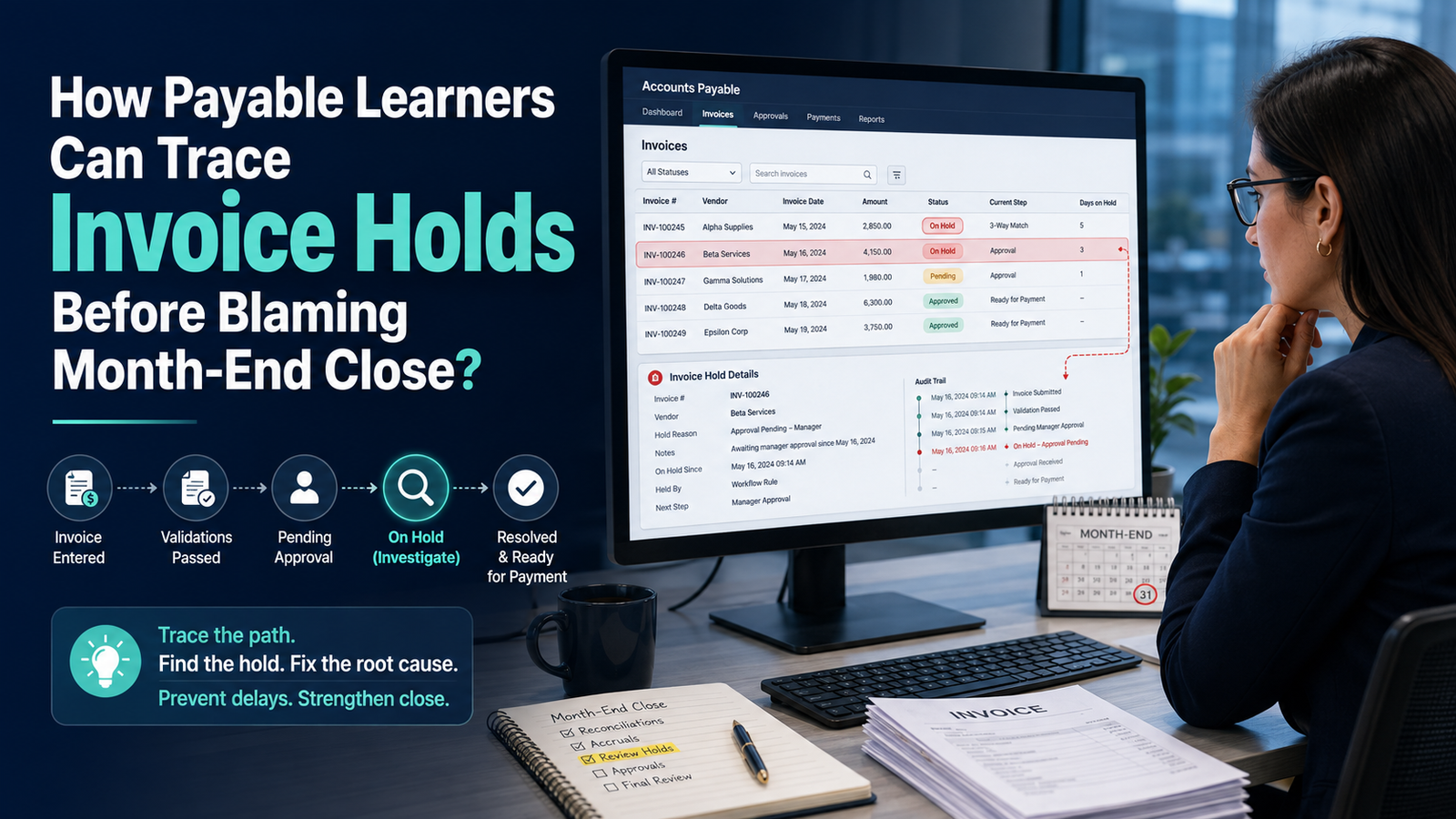
Here’s the pattern that catches most beginners off guard: an invoice misses the payment run, and the instinctive reaction is to blame the close process, the batch job, or “the system.” In reality, the invoice usually stalled days or weeks earlier, a hold reason was never investigated, a receipt didn’t match quantity or price, a tax line was calculated against the wrong rate, or an approval sat untouched in someone’s queue.
By the time month-end pressure sets in, the team is no longer solving a data problem; they’re trying to solve a timing problem under stress. That’s a much harder position to be in. The fastest fix in the moment often looks like a navigation step (“just release the hold” or “just resubmit for approval”), but the durable fix comes from tracing four things:
- Ownership: who was responsible for acting on this invoice at each stage?
- Timing: how long did it actually sit, and where?
- Access: did the right person even have visibility or permission to act?
- Downstream impact: what did this delay affect: cash flow, supplier relationship, reporting accuracy, audit evidence?
Learners who build this habit early can explain a transaction in plain business language first, and only then map that explanation onto the specific screens and setup inside the cloud application. That ordering matters. Memorizing configuration labels without understanding the underlying process just produces someone who can recite field names but can’t diagnose a stuck invoice.
Reading Invoice Holds as a Story, Not a Code
Every hold in Oracle Fusion Payables is really shorthand for a business condition. A “quantity” hold means the system detected a mismatch between what was ordered, what was received, and what was billed. A “price” hold means the invoiced price disagrees with the purchase order or supplier agreement. A “tax variance” hold usually means the tax engine calculated something different from what the supplier billed. None of these are system failures; they’re the system doing exactly what it’s configured to do: stop the invoice until a human resolves a discrepancy.
The mistake many beginners make is treating the hold as an obstacle to clear rather than as evidence to read. A well-trained payables analyst asks:
- Does this hold reflect a genuine business exception, or a data-entry error upstream?
- Was the purchase order matched correctly at receipt, or was the receipt itself late or incomplete?
- Is this a recurring hold type for this supplier, suggesting a structural issue with terms or catalog pricing?
- Has this invoice been sitting long enough that it’s now a control issue, not just a processing issue?
This is the kind of judgment that a structured Oracle Fusion Financials Course should be building not just “here’s how you release a hold,” but “here’s how you decide whether releasing it is even the right action.”
Supplier Terms and Purchase Order Matching: Where Most Friction Starts
Supplier terms and PO matching are where a huge share of invoice friction originates, and they’re also where beginners tend to underinvest their attention because the setup screens feel administrative rather than analytical.
Payment terms drive due dates, discount eligibility, and cash flow timing. If a supplier’s terms were set up incorrectly, or if terms were changed mid-relationship without updating open purchase orders, invoices will consistently generate exceptions that look like isolated errors but are actually a single root cause repeating itself.
Purchase order matching (2-way, 3-way, or 4-way, depending on configuration) ties the invoice back to the order and the receipt, and sometimes to inspection. When matching fails, it’s tempting to treat each failure as its own case. A more useful approach and one that separates someone who has completed real Oracle Fusion Financials Online Training from someone who has only watched a demo is to look across a batch of failures for a shared supplier, a shared buyer, or a shared category, because that pattern usually points to a setup or process issue rather than a one-off mistake.
Tax Lines: Small Numbers, Big Consequences
Tax treatment is one of the most quietly consequential parts of invoice processing. A tax line that’s off by a small percentage rarely blocks a payment outright, but it creates downstream reconciliation problems: reporting balances stop tying out, audit evidence becomes harder to defend, and month-end teams spend hours chasing pennies that trace back to a single misconfigured tax rule applied weeks earlier.
Learners should get comfortable asking:
- Was the tax calculated based on the correct ship-to, ship-from, or point-of-sale determination?
- Does the tax treatment match the classification used elsewhere for this supplier or item category?
- If a manual tax override was applied, is there documented justification, and does it match policy?
None of this is exotic. It’s the same discipline applied consistently: don’t accept the number, trace where it came from.
Approval Evidence: The Difference Between “Approved” and “Approved Correctly”
An invoice showing an “Approved” status tells you almost nothing on its own. What matters is whether the approval trail is complete, whether it followed the correct hierarchy or delegation rules, and whether the timing of the approval is defensible if questioned later by an auditor, a controller, or a supplier disputing a late payment.
This is where a lot of self-taught users fall short, because approval workflows are configured behind the scenes and rarely explained in day-to-day training. A learner who has gone through a proper Oracle Fusion Financials Training program will know how to pull the approval history, interpret delegation and escalation rules, and recognize when an approval was technically valid but practically meaningless for example, an automatic approval triggered by a timeout rule rather than genuine human review.
Close Readiness: Stop Treating It as a Deadline and Start Treating It as a Test
Month-end close should function as a test of everything that happened earlier in the cycle, not as the moment those issues get discovered for the first time. When a team scrambles at close, it’s almost always because invoice holds, tax discrepancies, or incomplete approvals were left unresolved and only became visible once the close checklist forced someone to look.
A more mature approach treats close readiness as an ongoing state, not a deadline:
- Are open holds reviewed on a rolling basis, not just before close?
- Is there a standing view of invoices aging past a threshold, regardless of where they are in the workflow?
- Does the currency conversion and ledger calendar alignment get checked continuously, especially for multi-currency operations, rather than assumed to be correct?
- Is reconciliation between subledger and control account balances performed frequently enough that a discrepancy is caught early rather than discovered under time pressure?
Teams that operate this way rarely experience “close surprises,” because the close process is simply confirming what was already known.
Why Structured Training Beats Ad Hoc Screen Learning
It’s entirely possible to learn Oracle Fusion by clicking around a sandbox environment, and many people do exactly that. But this approach tends to produce narrow, brittle knowledge of someone who can perform a specific task they’ve done before but freezes when a slightly different scenario appears, because they never learned the underlying logic.
This is the real value of a structured Oracle Fusion Financials Course: it sequences learning around scenarios, not screens. Instead of “here is the invoice entry page,” a well-designed course asks “here is a supplier with a pattern of price holds, what do you check first, and why?” That framing builds transferable judgment rather than memorized steps.
For learners choosing between options, Oracle Fusion Financials Online Training becomes genuinely valuable when it’s built around realistic scenarios rather than marketing claims about “hands-on labs” that turn out to be scripted click-throughs. The test of good training isn’t whether you can follow a demo, it’s whether you can look at an unfamiliar invoice exception six months later and reason through it methodically.
Practical Habits Worth Building Early
A few habits consistently separate confident payables professionals from people who are still guessing:
Trace before you release. Before clearing any hold, understand what triggered it and whether the underlying condition has actually been resolved, not just the symptom.
Look for patterns across suppliers. A single hold is a data point. Ten holds from the same supplier in a month are a signal about setup, terms, or process investigation at that level, not invoice by invoice.
Treat documentation as a tool, not a fallback. Official Oracle Financials documentation is useful precisely because it gives you a stable, neutral reference point to compare against workplace assumptions. When a team disagrees about whether an issue is a setup problem, a user error, a security restriction, or a technical defect, documentation is often the fastest way to settle the argument with evidence rather than opinion.
Separate the question “is this approved” from “was this approved correctly.” Status fields answer the first question. Reading the actual approval history and hierarchy answers the second, and only the second one holds up under scrutiny.
Treat close as a checkpoint, not a discovery process. If close consistently surfaces “surprises,” that’s evidence the review cadence earlier in the cycle needs to tighten, not that close itself is the problem.
The Learning Takeaway
The underlying lesson here isn’t really about Oracle Fusion specifically it applies to any complex financial system. Study the process before the feature. Study the evidence before forming an opinion. Study ownership before reaching for a workaround.
A beginner doesn’t need to master every configuration option on day one. What they need is a repeatable way of connecting system activity to real business decisions: who approved what, why a hold exists, whether a tax line is defensible, and whether the numbers at close actually reflect what happened during the period. That foundation built through deliberate, scenario-based Oracle Fusion Financials Training, reinforced through a well-structured Oracle Fusion Financials Online Training path, and sharpened by a course that treats judgment as seriously as navigation is what makes everything that comes afterward faster, safer, and genuinely useful in real accounts payable work.