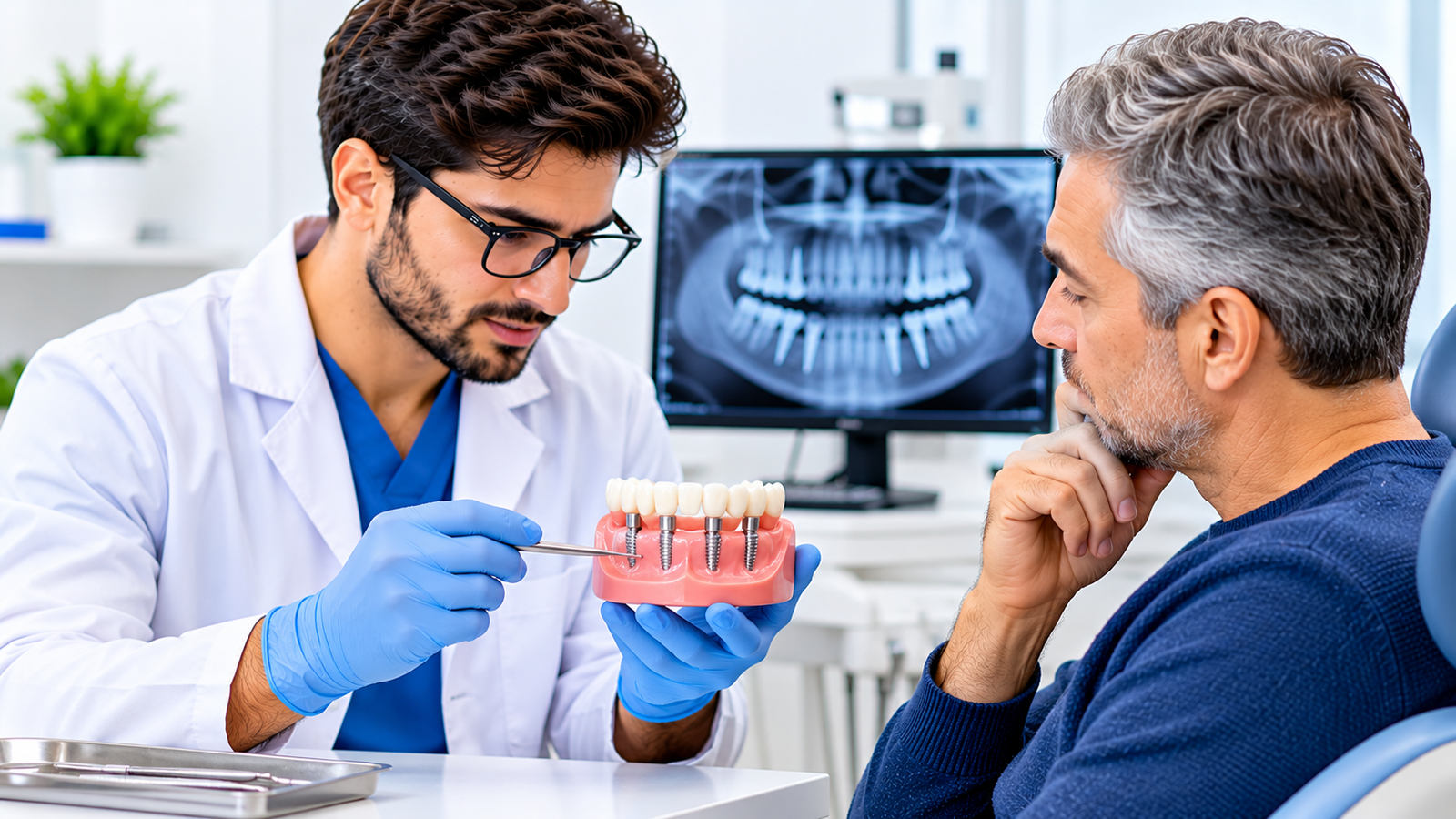
Ask five people how many implants replace a full set of teeth and you’ll get five numbers. Four. Six. Eight. Ten. Everyone’s right, sort of. The count depends on the design, your bone and how you chew. If you’re researching full mouth dental implants, this guide shows how that number gets decided and why a bigger one isn’t always better. We’ll also cover full arch dental implants, a design that holds a whole jaw of teeth on fewer posts than you’d expect.
Before You Count Anything
1. Know What “Full Set” Means
Nobody uses the phrase the same way. Some offices say full mouth dental implants and mean both jaws. Others mean a single jaw. A full adult set is 28 to 32 teeth, depending on wisdom teeth, but nobody needs 32 implants to replace them. Before you compare quotes, ask one question: one jaw or two?
2. Prepare a Simple Questions List
Consultations go fast, and it’s easy to leave with half your questions unasked. Write them down first. Split the list into three groups: how it feels, what it costs and how long it takes.
What to Bring to Your Consultation
- A list of medications and supplements
- Old dental X-rays or records, if you have them
- Your insurance card and a rough budget
- Notes on which teeth are missing, loose or failing
- A friend or family member who can listen and take notes
The Numbers by Design
1. Four Implants Per Jaw
One popular design places four implants in each jaw, with the back two tilted to use whatever bone is available. Full arch dental implants on four posts often avoid bone grafts, thanks to that tilt, and that’s the main selling point. The trade-off is that each post carries more of the chewing load, so your bone quality and bite plan matter a great deal.
2. Six Implants Per Jaw
Six posts spread the chewing force more evenly. Full arch dental implants on six posts suit people with strong bone who want an extra margin of safety, and some dentists lean toward six for the upper jaw, where the bone is softer. It costs more than four and involves a bit more surgery.
3. Two to Four for a Removable Denture
A denture that clicks onto implants needs fewer of them. In the lower jaw, two can be enough for some patients. The upper jaw often needs four or more, because it has softer bone and less natural grip. This option costs less than a fixed set, though the attachments wear and the denture still comes out for cleaning.
4. One Implant Per Tooth
Technically possible, rarely chosen. Replacing every tooth individually can take eight to ten or more posts per jaw, along with more surgery and a much bigger bill. A few patients with strong bone and a generous budget go this route. Most don’t need to.
Same-Day Teeth or Delayed Teeth
Some patients leave surgery with a temporary set of teeth the same day, if the bone grips the posts firmly enough. Others heal first and get teeth later. Your scan decides which path is safe, not your calendar.
What Decides Your Number
1. Bone Quantity and Density
Think of a table. It doesn’t need a leg under every inch of the top, but each leg needs solid ground. Bone is the ground. Thick, dense bone lets fewer posts do the work. Thin or soft bone may need more posts, a graft or a different design. A three-dimensional scan shows what you have, and nobody can honestly quote a number without one. Full arch dental implants depend on that scan more than almost any other plan.
2. Upper Jaw or Lower Jaw
The lower jaw is denser and often grips implants well. The upper jaw is softer and sits under the sinus cavities, which limits where posts can go. That’s why upper plans sometimes need more posts, a sinus lift or angled placement.
3. Bite Force and Habits
Grinding or clenching puts extra stress on every post and every tooth in the set. Tell your dentist if you wake up with a sore jaw. A night guard is often part of the plan, and it costs far less than a cracked set of teeth.
Why More Isn’t Always Better
Extra implants mean extra surgery, extra cleaning spots and extra cost. A well-placed set of four or six can outperform a crowded set of eight. Ask your dentist why they chose their number and what would change it.
Cost, Recovery and Risks
1. How the Count Affects Price
Each post adds hardware, surgery time and lab work, so price rises with the count. But it isn’t the only factor. Materials for the teeth, grafts, sedation and temporary sets all move the bill too. When you compare quotes for full mouth dental implants, make sure each office is pricing the same design for the same number of jaws. Two quotes can look far apart simply because one covers two jaws and the other covers one.
2. Healing Timeline
Swelling and soreness usually ease within one to two weeks. The bone needs roughly three to six months to bond with the posts. Think of fresh concrete. The surface looks dry in a day, but it keeps curing underneath. Recovery from full arch dental implants follows that schedule whether you got temporary teeth on day one or not, and chewing hard too early can disturb the bond.
3. What Can Go Wrong
Infection, posts that fail to bond, chipped or worn teeth and gum problems around the implants are all possible. Honest dentists tell you this before surgery. Ask what happens, and who pays, if something fails.
When Fewer Implants or Dentures Make Sense
Heavy smoking, poorly controlled diabetes, very thin bone or a plain dislike of surgery can tip the choice toward a removable implant denture or a traditional denture. A well-made denture beats a badly placed implant set every time, and choosing one is a sound decision.
Malibu and Los Angeles Specifics Worth Checking
1. Choosing a Local Practice
Ask any office how many full mouth dental implants cases it has handled and whether it will show real before and after photos. Dr. David Sturgeon has more than 25 years of experience and handles implants, dentures, bridges and full mouth reconstruction at Sturgeon Dental, 24955 Pacific Coast Hwy, Suite C100. The practice keeps a patient results page where you can see finished cases. Quotes around Los Angeles can land far apart because rent, lab partners and experience differ, so compare what’s included, not only the total.
2. Insurance and Financing
Dental insurance often pays only part of full mouth dental implants treatment, and annual maximums can be small next to a multi-implant case. Original Medicare generally doesn’t cover implants, though some Medicare Advantage plans cover part. Sturgeon Dental accepts some dental insurance plans and offers financing, which can spread payments over time. Ask for a pre-treatment estimate so you know what your plan pays.
3. Appointments and Scheduling
The office is open Monday to Thursday from 9 AM to 5 PM and Friday from 9 AM to 4 PM, closed on weekends. Treatment involves several visits over months, so check that those hours fit your work and your drive along Pacific Coast Highway. The practice lists Calabasas, Thousand Oaks, Pacific Palisades, Santa Monica, Agoura Hills and Westlake Village among its service areas.
After the Consultation
1. Get the Plan in Writing
A solid plan states how many implants go in each jaw, which design is used, which materials, the price per stage and the timeline. If your dentist only describes the number out loud, ask for it on paper before you leave. This guide gives general information only, so rely on your own exam and your dentist’s advice for decisions about your mouth. Take a few days to read it at home.
2. Red Flags in a Quote
Be wary of any flat price in an ad that sounds too good to be true, and ask what’s excluded. Walk away from offices that quote without an exam or scan, rush you to sign or won’t write anything down. A real quote needs a real look at your mouth.
Questions for the Dentist
- How many implants do you recommend for each jaw, and why that number?
- What would change that number?
- Do I need a graft or a sinus lift?
- Will I get temporary teeth, and when?
- What happens if an implant fails, and who covers it?
Conclusion
Most whole-jaw plans use four to six implants per jaw, a removable denture can get by on two to four and one post per tooth is rarely needed. Your bone, your jaw and your bite decide where in that range you land, and a scan beats any rule of thumb. Get an exam, ask why your dentist picked their number and compare a couple of offices line by line. If full mouth dental implants look right for you, ask for the plan in writing. And if full arch dental implants are on the table, ask what happens if one post doesn’t bond. A good dentist answers that without flinching.
FAQs
1. How many implants do I need for full mouth dental implants?
Most fixed plans use four to six implants per jaw, so a two-jaw case might use eight to twelve. Removable implant dentures use fewer. Your scan and bone decide the exact number.
2. Are four implants enough for a full jaw?
For many patients, yes, especially when the back posts are tilted and the bone is healthy. Some people need six for extra support, particularly in the upper jaw or with strong chewing force.
3. Do full arch dental implants require bone grafts?
Not always. Tilted placement can avoid grafts in some cases. If your bone is very thin, a graft or sinus lift may still be recommended first, which adds months to treatment.
4. How long does it take to get a full set of implant teeth?
Some patients get temporary teeth the same day, with final teeth after three to six months of healing. Grafts or health conditions can add time.
5. Does insurance cover implants for a full set of teeth?
Sometimes in part, rarely in full. Plans vary, annual maximums are often small and Original Medicare generally doesn’t cover implants. Ask the office for a pre-treatment estimate before you start.