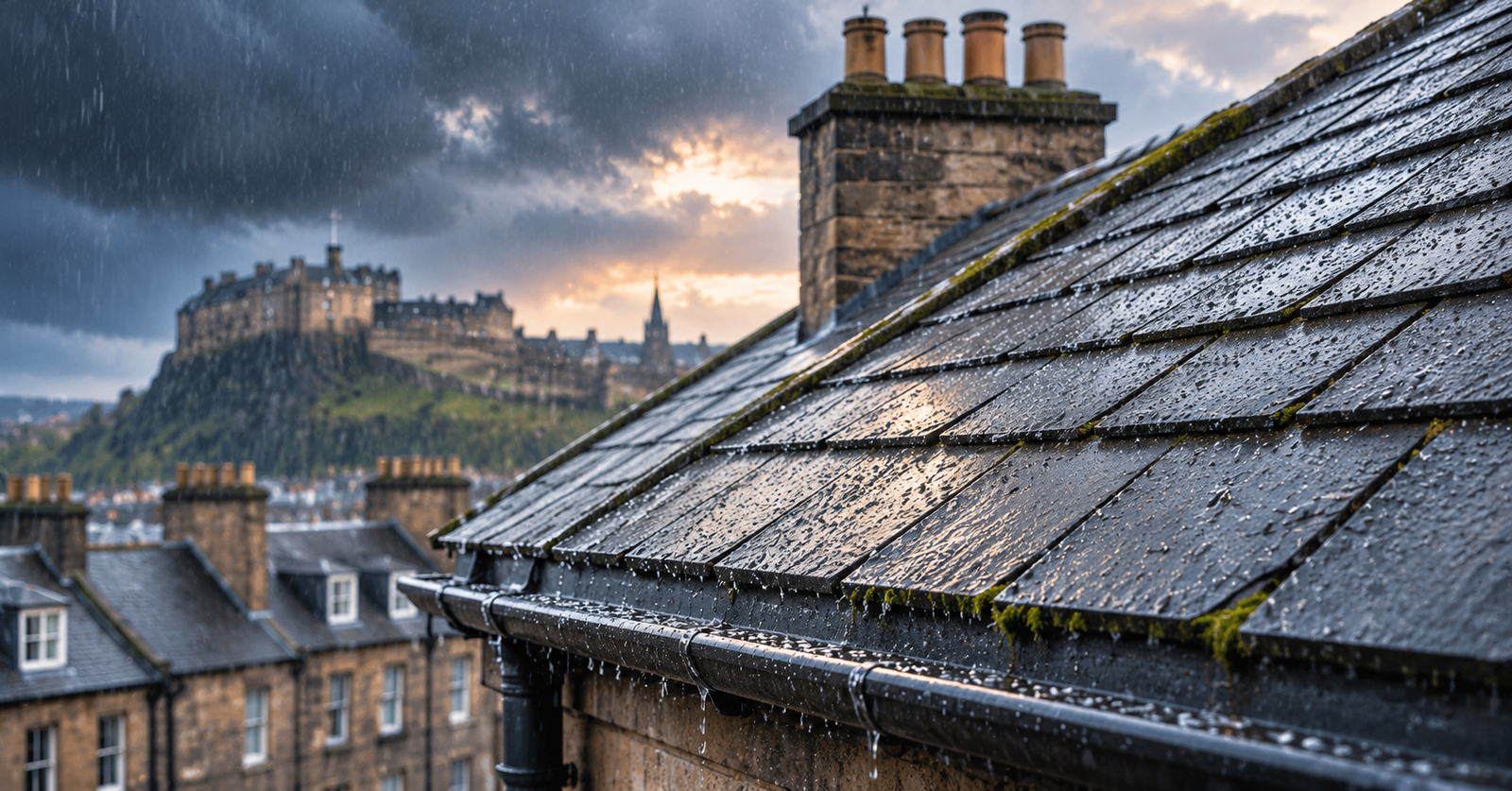
Edinburgh roofs have to cope with changing weather throughout the year.
Heavy rain, strong winds, frost, cold temperatures, and repeated wet-and-dry cycles can affect different roofing components in different ways. A problem may begin with one loose slate, a blocked gutter, deteriorated flashing, or a small crack around a chimney.
These defects can appear minor at first. Continued exposure can eventually allow water to reach timber, insulation, ceilings, walls, or other parts of the building.
Understanding how weather affects the complete roofing system can help property owners recognise warning signs earlier and arrange repairs before small defects become larger problems.
Rain Often Reveals Existing Roof Weaknesses
Rain does not normally create a defect in a sound roof overnight. Instead, it exposes weaknesses that already exist.
Water may enter around damaged slates, cracked tiles, failed flashing, chimney junctions, roof penetrations, or flat-roof edges.
The location of an internal damp patch does not always show where the water entered.
Moisture can travel along timber, insulation, roofing membranes, or other surfaces before becoming visible inside.
This is why inspection should consider the complete route water may have taken rather than only the area directly above a ceiling stain.
Wind Can Move Slates and Tiles
Strong winds can place significant pressure on pitched roofs. A slate or tile does not have to fall completely before it becomes a problem.
It may shift slightly, crack, or become partially loose. That movement can expose the roof beneath and create a route for wind-driven rain.
Older roofs may become more vulnerable as fixings and surrounding materials age.
After severe weather, property owners can safely look from ground level for fallen slate fragments, visible gaps, or displaced materials.
If the condition is unclear, an experienced roofer in Edinburgh can inspect the roof covering and surrounding junctions without relying only on what is visible from below.
Traditional Slate Roofs Need Careful Maintenance
Slate roofing is common across many older Edinburgh properties. When installed and maintained correctly, natural slate can provide a long service life.
However, individual slates can crack, slip, or loosen over time. The fixings holding them in place may also deteriorate.
A few damaged slates do not automatically mean the whole roof needs replacing. The condition of the surrounding roof should first be assessed.
Replacement materials should also be selected carefully so they remain compatible with the existing roof in size, thickness, appearance, and performance.
Roof Tiles Can Develop Similar Problems
Tiled roofs face many of the same weather pressures. Wind can move tiles. Impact can crack them.
Age can weaken fixings and surrounding components. Water may then reach the underlay and structural materials beneath.
A roof inspection should not look only at individual tiles. Ridges, valleys, flashings, underlay, roof edges, and junctions all contribute to the weather resistance of the roof.
Roofing works best when these components function together as one system.
Freeze-Thaw Conditions Can Worsen Small Cracks
Cold conditions can gradually enlarge existing defects. Water can enter small cracks in masonry, mortar, render, or other porous materials.
When temperatures fall, that moisture can freeze and expand. Repeated freeze-thaw cycles may gradually increase deterioration.
This is particularly relevant around chimney stacks, parapets, exposed stonework, and roof-level walls.
A crack that appears stable during warmer weather may become more significant after repeated winter exposure.
Chimneys Are Among the Most Exposed Roof Features
Chimneys receive direct exposure to wind, rain, frost, and temperature changes. Mortar joints can deteriorate.
Stone or brick can become weathered. Chimney pots, cowls, flashings, and surrounding roof materials may also develop faults.
Water entering near a chimney can sometimes be mistaken for a problem with the main roof covering. The actual cause may be failing flashing or deteriorated masonry.
For this reason, chimney areas should be inspected as complete junctions rather than treating the surrounding slates or tiles separately.
Leadwork Protects Important Roof Junctions
Leadwork is commonly used around roof junctions because it can provide durable weather protection when installed correctly.
It may be found around chimneys, valleys, walls, dormers, and other places where roof surfaces meet.
Over time, lead can move, split, become displaced, or develop problems around its fixings. Previous repairs can also create weak points.
Applying sealant over failing leadwork may temporarily cover a visible gap without correcting the underlying problem.
A proper repair should address the complete junction.
Gutters Are Part of the Roofing System
Gutters may sit at the edge of the roof, but they are an important part of weather management. They collect rainwater and direct it towards downpipes.
When gutters become blocked, cracked, disconnected, or poorly aligned, water may overflow onto walls and roof edges.
Leaves, moss, roofing debris, and sediment can all restrict drainage. Overflowing during heavy rain is often one of the clearest signs that attention is required.
A company such as Edinburgh Borders Roofing may therefore need to assess more than the main roof surface when investigating recurring water problems.
Roof coverings, gutters, downpipes, flashing, and surrounding exterior materials can all influence where moisture eventually appears.
Downpipes Need to Discharge Water Properly
A clear gutter is only useful if the downpipe can carry water away effectively. Blockages may cause water to back up.
Damaged joints can allow water to escape against the building. The discharge point also needs to be suitable.
Water should not repeatedly saturate the base of an exterior wall. Roof drainage should be considered as one continuous route, from rainfall on the roof to final discharge at ground level.
A restriction anywhere along that path can create problems elsewhere.
Flat Roofs Behave Differently in Wet Weather
Flat roofs require a different approach from slate or tiled pitched roofs. They are designed with falls that encourage water towards outlets.
However, blocked outlets, surface changes, or deterioration can affect drainage. Persistent ponding water deserves attention.
The membrane itself may also be affected by age, movement, poor detailing, or previous patch repairs.
Edges, joints, outlets, upstands, and roof penetrations should all be checked when investigating water entry.
Flashing Problems Can Be Mistaken for Roof-Covering Damage
Some leaks occur even when the visible slates or tiles appear sound. Flashing protects junctions where the roof meets walls, chimneys, dormers, extensions, or other structures.
If these details deteriorate, moisture can enter without any obvious damage to the main roof covering.
Replacing nearby tiles would not solve that type of problem.
Inspection should therefore identify how water is intended to move across the junction and where that protection has failed.
Stonework Can Influence Roof Performance
Traditional Edinburgh properties often combine roofing with exposed stone masonry.
Weathered pointing or damaged stone near chimneys, parapets, and roof-level walls can allow moisture into areas that appear to have a roofing problem.
The junction between masonry and the roof is particularly important.
Repairing only the roofing material may not solve the issue if water is actually entering through deteriorated stonework.
Both elements should be considered when investigating recurring dampness.
Exterior Render Can Also Develop Weather Damage
Rendered areas close to the roofline can deteriorate through age, movement, impact, and repeated weather exposure.
Cracks can allow moisture behind the finished surface. This can sometimes resemble a leaking gutter or roof defect.
The source should be identified before repairs are completed. Simply covering a crack without understanding why it developed may only provide a temporary improvement.
Storm Debris Can Block Drainage
Strong winds can carry leaves, branches, and loose debris onto roofs. Material can collect in gutters, valleys, and outlets.
Larger branches can damage slates, tiles, gutters, or other components directly. After severe weather, property owners should check accessible ground-level areas for fallen roofing materials or debris.
Difficult roof areas should not be investigated by climbing without appropriate access equipment.
High or awkward buildings may require professional roof access or specialist inspection methods.
Solar Panels Add More Areas to Consider
Solar panels change how parts of a roof can be accessed and inspected. The roof covering beneath the panels still needs to remain weather resistant.
Mounting systems should also be compatible with the roof construction. Drainage paths must remain clear.
Before solar panels are installed, the condition of the existing roof should ideally be considered. Repairing a roof after panels are fitted can make access more complicated.
Older Repairs May Become the Weakest Point
Many roofs contain several generations of repairs. There may be replacement slates, patched mortar, sealants, modified flashings, or previous gutter work.
Some repairs remain effective for years. Others can deteriorate faster than the original surrounding materials.
When a weather-related problem appears, previous repairs should form part of the inspection. The defect may not be in the oldest section of the roof.
It may be a newer repair that was poorly detailed or has reached the end of its useful life.
Internal Damp Does Not Always Confirm a Roof Leak
Ceiling staining, peeling decoration, musty odours, and damp upper walls can indicate water entry.
However, they do not prove that the roof is responsible. Plumbing, condensation, masonry defects, and other building issues can produce similar symptoms.
A proper investigation should connect the internal evidence with exterior findings before repairs are recommended.
This reduces the risk of carrying out roofing work that does not address the actual cause.
Regular Roof Inspections Can Identify Problems Earlier
Waiting for visible water inside the building is not the only way to discover roof defects.
Periodic inspection can identify loose slates, cracked tiles, damaged flashing, deteriorating mortar, blocked gutters, or developing chimney problems.
Photographic surveys can be useful where property owners cannot safely see the roof. They also provide a visual record for future comparison.
Photos alone do not diagnose a defect, but they can make professional findings easier to understand.
Temporary Repairs Should Not Become Permanent
Severe weather can sometimes require immediate action.Temporary protection may reduce further water entry until conditions are safe for permanent repair.
However, temporary work serves a different purpose.
A temporary covering, patch, or seal should eventually be reviewed and replaced with an appropriate long-term solution.
Property owners should ask what further work will still be needed once the immediate problem has been controlled.
Weather Can Affect Repair Timing
Roof repairs are carried out in an exposed environment. Strong wind, heavy rain, ice, and other conditions can make some work unsafe or unsuitable.
An urgent leak does not always mean permanent repair can begin immediately. Temporary protection may be required until suitable working conditions return.
Safety should remain part of the repair decision, particularly on steep, high, or difficult-access roofs.
Check the Whole Roofing System
A visible leak naturally draws attention to one location. However, weather affects the entire roof.
If one slate has failed because fixings are deteriorating, nearby materials may also deserve inspection.
If one gutter is overflowing, other outlets may be partially blocked. If chimney mortar has deteriorated, surrounding flashing may also need checking.
This does not mean every small defect requires major work. It means each problem should be understood in context.
Roofing Maintenance Should Be Based on Condition
There is no single maintenance schedule that works for every property. A newer roof may require only routine observation.
An older slate roof with chimneys, stonework, valleys, and previous repairs may need closer monitoring. Exposure also matters. A highly exposed roof can experience different wind and rain pressures from a sheltered property.
Professional Edinburgh Roofing assessment can therefore focus on the actual condition of the building rather than assuming every Edinburgh roof needs the same type of work.
Keep Records of Roofing Work
Property owners should keep photographs, quotations, invoices, guarantees, and notes relating to previous repairs.
Record when leaks appeared and what weather conditions were present. This information can help if symptoms return.
For older properties, maintenance records can also help contractors understand what has already been changed and which materials were previously used.
Good records make future repair decisions easier.
Final Thoughts
Edinburgh weather can affect almost every part of a roofing system. Wind can move slates and tiles.
Rain can reveal weaknesses around flashing and junctions. Cold weather can worsen cracks in masonry and exposed materials.
Gutters and downpipes must manage repeated rainfall, while chimneys, leadwork, flat roofs, stonework, and render all have their own vulnerabilities. The important point is not to assume that every visible symptom has an obvious cause.
A damp ceiling may begin at a chimney junction. Wall staining may result from overflowing gutters. A small slate defect may be part of a broader fixing problem.
Looking at the roof as a complete weather-protection system makes it easier to identify what actually needs repair, what requires monitoring, and where preventative maintenance may reduce future damage.