
Introduction
Running a business across multiple countries, currencies, and regulatory environments gets messy fast. At Tech Leads IT, we talk to finance teams every week juggling five different systems just to close the books on time mismatched ledgers, shaky tax rules, currency conversions done by hand. That’s exactly the mess Oracle Fusion Financials was built to clean up, giving multinational companies one platform for accounting, reporting, tax, payments, and receivables. It’s also why so many professionals are turning to Oracle Cloud Financials Online Training and Oracle Cloud Financials Training Online to get hands-on before configuring it in production.
Why Global Organizations Need a Unified Financial Platform
Before getting into the specifics, it helps to understand the problem Fusion Financials is actually solving. Most large companies operating across borders didn’t design their finance systems on purpose; they grew into them. A ledger here, an acquisition’s legacy system there, a tax engine nobody remembers installing. By the time quarter-end rolls around, someone’s stitching it all together in Excel and hoping the numbers tie out. That’s not an exaggeration; it’s how a lot of global finance teams still operate.
A unified cloud platform gets rid of that patchwork. Instead of running separate systems for every subsidiary, a company can operate one financial system that pulls in transactions from every business unit, applies local rules where they’re needed, and rolls everything up into a single consolidated view. That’s really the whole pitch behind Oracle Fusion Financials, and it’s why it’s become such a common choice for companies with a real international footprint.
Core Capabilities That Make Oracle Fusion Financials Global-Ready
A Flexible, Multi-Ledger Architecture
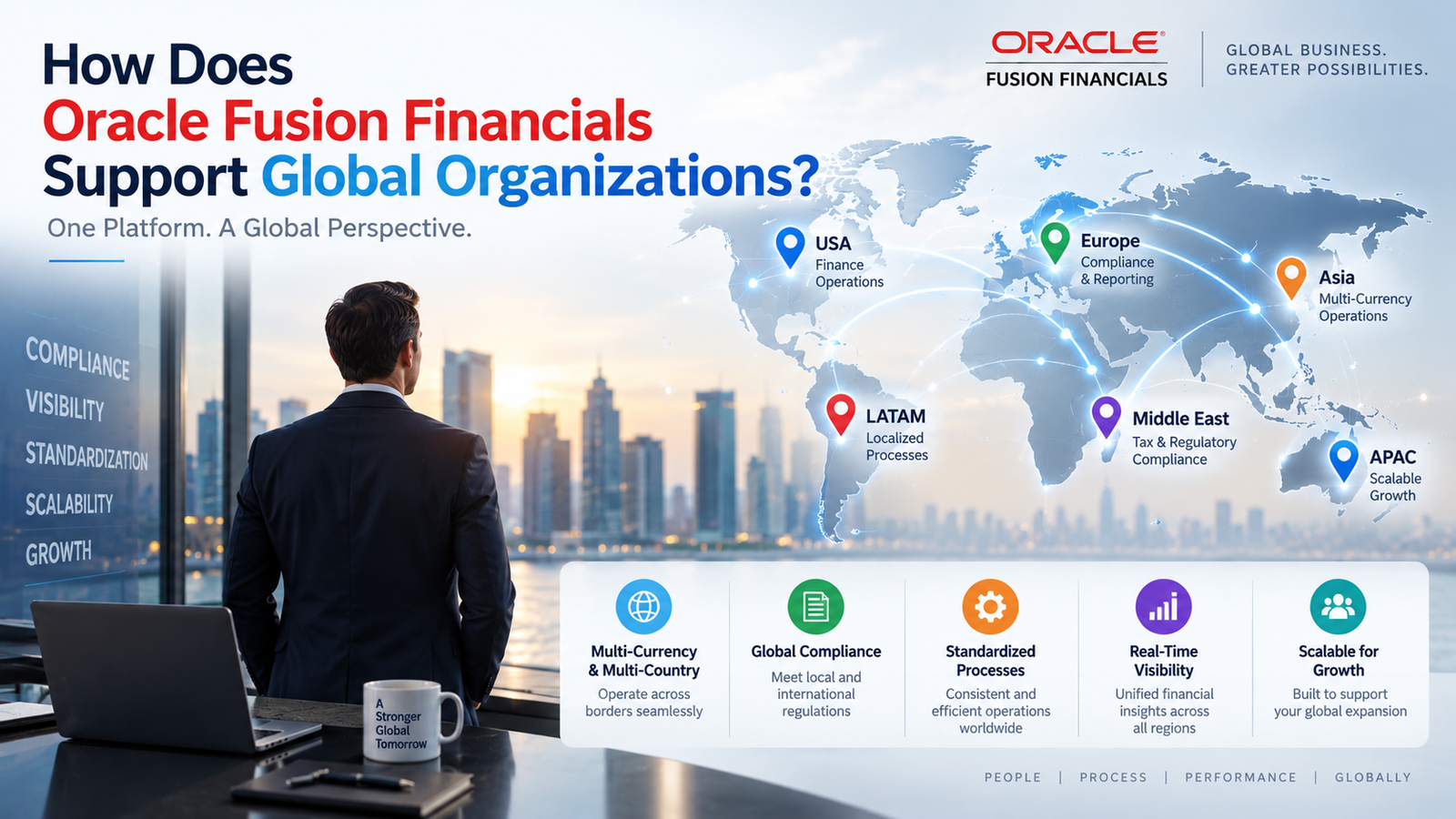
The ledger architecture is really the backbone of the whole thing. It’s built to support multiple legal entities, currencies, and accounting standards inside a single instance, rather than forcing you to spin up a separate system for every country. You can configure primary ledgers, secondary ledgers, and reporting currencies to meet statutory requirements wherever you operate, while still keeping one corporate chart of accounts for group reporting. So a company running plants in the U.S., Germany, India, and Singapore can stay compliant with local GAAP or IFRS in each of those countries and still pull a consolidated number in minutes, not weeks.
Multi-Currency Management
Anyone who’s dealt with currency swings knows how quickly they can throw off a forecast. Fusion Financials handles this natively transaction-level currency capture, automatic exchange rate updates, and revaluation that keeps the books accurate as rates move. Nobody’s manually converting figures or trying to reconcile currency gaps between two systems that don’t talk to each other. The platform applies the right rate based on rate types and effective dates you’ve already configured, and it just works, quietly, in the background.
Global Tax and Regulatory Compliance
Tax is where a lot of global finance teams get burned. Every country has its own VAT, GST, withholding tax, and reporting rules, and getting even one of them wrong can mean penalties or a very uncomfortable audit. Oracle Fusion Tax, which lives inside Fusion Financials, lets you configure tax rules by jurisdiction, calculate tax automatically on transactions, and generate the statutory reports local authorities actually want to see. It takes a huge amount of pressure off regional finance teams who’d otherwise be tracking this manually, country by country.
Localizations for Country-Specific Requirements
Tax isn’t the only thing that varies by country e-invoicing mandates, chart-of-accounts quirks, statutory reporting formats, they’re all different depending on where you’re operating. Oracle ships pre-built localizations for a long list of countries, so a lot of that compliance work is already done before you even start configuring. That’s a real time-saver when a company is entering a new market and doesn’t want to build custom tax logic from scratch.
Centralized Reporting and Real-Time Visibility
Probably the single biggest win here is real-time visibility. Because everything runs on the same cloud platform, executives and finance leaders can pull up consolidated dashboards without waiting for someone to manually stitch reports together at month-end. Oracle Transactional Business Intelligence (OTBI) and Financial Reporting Studio let users build custom reports off live data, so the numbers on the screen actually reflect what’s happening right now, not what happened three weeks ago when the last export ran.
This matters a lot for companies running shared services centers or regional finance hubs. Instead of every region operating in its own bubble, leadership can drill from a global summary all the way down to a single transaction, all in the same interface. When something looks off, you can actually find out why fast instead of waiting for next quarter’s report to notice a problem that’s been sitting there for months.
Streamlined Intercompany Transactions
Intercompany transactions are one of those things that sound simple until you’re the one reconciling them. Goods, services, or funds moving between subsidiaries generate a surprising amount of manual work when systems aren’t connected mismatched balances, missing eliminations, the whole thing. Fusion Financials automates most of it: balancing journal entries, elimination entries for consolidation, intercompany reconciliation. It’s not glamorous work, but getting it right matters a lot for companies reporting to shareholders, boards, or regulators across multiple countries.
Scalable Procure-to-Pay and Order-to-Cash Processes
Financial systems don’t operate in a vacuum they need to plug into the rest of the business. Fusion Financials ties directly into procurement and order management, so procure-to-pay and order-to-cash run as full cycles across regions rather than as separate steps someone has to manually connect. Invoice processing is automated, approval workflows respect regional authority limits, and receivables account for local payment methods and banking norms instead of assuming everyone pays the same way.
For companies running shared services or global business services models, this is genuinely useful. A centralized team can process transactions for dozens of entities using standardized workflows, while the system still respects the local details that matter for compliance and for keeping vendor and customer relationships intact.
Supporting Mergers, Acquisitions, and Business Expansion
Companies don’t just grow organically they acquire other companies, enter new markets, restructure. Fusion Financials was built with that reality in mind. New legal entities, business units, or ledgers can be configured within the existing setup fairly quickly, which means an acquired company can be folded into group reporting without ripping out and rebuilding the whole finance stack. That flexibility saves real time and money during integrations, which is usually the point in an acquisition when things start to go sideways if the systems don’t cooperate.
Security, Controls, and Audit Readiness Across Regions
Operating in multiple countries means dealing with a stack of different regulatory and audit expectations, and Fusion Financials bakes security and controls into the platform rather than leaving it up to each region to figure out on its own. Role-based access, segregation of duties, detailed audit trails all centrally managed. That consistency matters for things like SOX compliance in the U.S., and for whatever the local equivalent is wherever else you operate. It’s a lot easier to pass an audit when every region is playing by the same rulebook instead of inventing its own.
Why Skilled Professionals Are Essential to Realizing These Benefits
Here’s the thing nobody likes to admit: none of this works well on its own. Fusion Financials is powerful, but the value only shows up if the people configuring it actually know what they’re doing. Ledger structures, tax setups, localization settings, reporting hierarchies all of it has to be built correctly around the company’s actual global footprint. Get it wrong, and you’re not saving time, you’re creating a compliance headache that surfaces six months later.
That’s really why structured learning has become such a big deal in this space. A lot of finance and IT professionals are going through Oracle Cloud Financials Training Online specifically to get comfortable with ledger configuration, multi-currency setups, intercompany processing, and consolidated reporting before they’re the ones responsible for it in a live environment. Learning this on the job, through trial and error, is expensive both in time and in the mistakes that tend to happen along the way. A good online training program lets you make those mistakes in a sandbox instead.
Companies that invest in building this skill set internally through certifications, guided coursework, whatever combination of Oracle Cloud Financials Online Training fits their team tend to have noticeably smoother implementations. Fewer surprises, fewer re-dos. Given how much rides on the finance system, that investment in people ends up mattering just as much as the software license itself.
Getting Started: Building the Right Skill Set
If you’re looking to actually work with Oracle Fusion Financials as a finance analyst, functional consultant, or systems admin you’ll want a solid grasp of the platform’s architecture and configuration options before you touch a live environment. That means understanding ledger setup, tax configuration, intercompany accounting, reporting tools, and how Financials connects to other Fusion Cloud modules like Procurement and Supply Chain Management.
The platform’s deep enough that self-directed learning alone usually isn’t enough to get job-ready fast. Programs like Oracle Cloud Financials Training Online typically pair concept instruction with hands-on practice in sandbox environments, walking learners through real global scenarios multi-currency transactions, intercompany eliminations, statutory reporting under someone who’s actually done it before. That kind of practical, scenario-based learning gets people implementation-ready in a way that reading documentation on its own just doesn’t.
Conclusion
Oracle Fusion Financials has become a go-to platform for companies operating across borders. The unified architecture, multi-currency support, tax compliance, and real-time visibility give global finance teams a way to operate with a lot more confidence than they had with the old patchwork of systems. At Tech Leads IT, we’ve watched this play out firsthand: the right mix of platform capability and skilled implementation talent can take a finance function from fragmented and manual to streamlined and transparent. As more companies recognize what this platform can actually do, demand keeps growing for people with real Oracle Cloud Financials Online Training under their belt. If you’re a finance or IT professional thinking about where to put your energy next, this is a pretty good place to start.