Introduction
Say your Pune entity does some work for a sister company in another legal entity. At Soft Online Training, this is one of the first scenarios we walk through in our Oracle Fusion Financials Training Pune program, because recording the service feels like the end of the job, but it isn’t. Your books now need to show that the other company owes you money, and theirs need to show that they owe it. Someone has to pick the accounts for both sides, every single time.
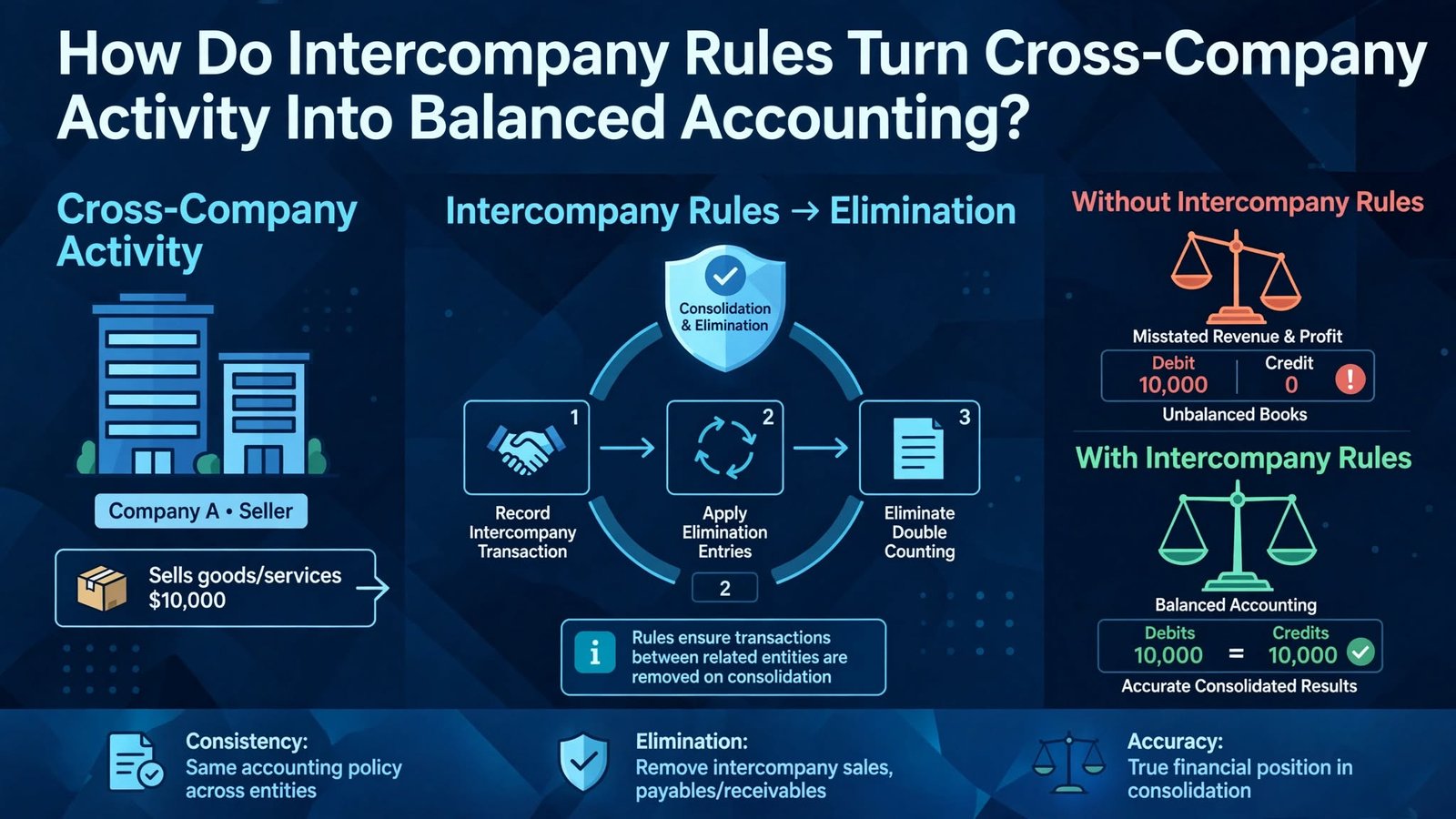
That’s the problem intercompany rules solve. Instead of asking users to work out the right receivable and payable accounts for every transaction, the rules look at who the parties are, what kind of transaction it is, and what the accounting context looks like, then fill in the accounts for you.
Why Balance Matters in Oracle Fusion Financials Training in Pune
When people first learn this topic, they tend to think “balanced” means debits equal credits across the whole enterprise. That’s true, but it’s not enough. The provider and receiver are often separate legal entities with their own balancing segment values, and each one needs a complete set of books on its own. Each entity has to show what it gave or received, and what the other side owes.
Oracle Fusion Intercompany handles this through transaction processing and balancing rules you configure. If you’re taking an Oracle Fusion Financials Training in Pune course, one habit will save you a lot of grief later: keep three things apart in your head. First, the original distributions. Second, the due-from and due-to lines the system generates. Third, whatever clearing or settlement happens down the road. Blur them together and troubleshooting gets messy fast.
The Transaction Gives You Two Points of View
Every intercompany transaction has a provider and a receiver. The provider records what it expects to collect, and the receiver records what it has to pay. A manual transaction also carries a type, a date, a currency, and distributions that describe what actually happened. The application uses all of that to derive the accounting and send the transaction through processing or workflow.
Here’s the catch: the rules only solve the transaction you entered. If the organizations or distributions are wrong, even flawless rules will give you a wrong result.
So start your review with the counterparties. Which legal entities and balancing values are involved? Who created the transaction, and did the receiver accept or process it the way your setup expects? Then look at the provider and receiver distributions separately. One side might show revenue, the other an expense, and the generated lines sit in between as the reciprocal balance. If you squash everything into one net journal, you lose that picture, and it gets much harder to tell whether the problem started in the source distribution or in the balancing derivation.
How the Rules Pick the Accounts
Intercompany balancing rules supply the account combinations for receivables and payables. In the simplest case, the provider’s books get an intercompany receivable and the receiver’s books get an intercompany payable. They’re two views of one claim between the companies. Because the rules generate them, two entities that trade with each other regularly end up with consistent accounting instead of whatever each user happened to choose that day.
Specificity is where things get interesting. You can define detailed rules for particular legal-entity or balancing-segment relationships and broader rules to catch everything else. A broad default is handy, but it can quietly hide a policy that really calls for counterparty-specific accounts. On the other hand, piling up overlapping detailed rules with no clear ownership makes results hard to predict. It helps to write down which rules should win, who’s allowed to change them, and then test a handful of realistic provider-receiver pairs before you rely on the setup at volume.
Walking Through a Manual Example in Oracle Fusion Financials Training in Pune
Suppose a provider records a 25,000 service distribution involving a receiver in another company. The distribution explains the service, but it doesn’t create both sides’ balances on its own. During processing, the rules derive the provider’s receivable from the receiver and the receiver’s payable to the provider. Oracle’s documentation describes exactly this: for manual intercompany transactions, the receivables and payables accounts are generated from the distributions you enter and the balancing-rule setup. The takeaway isn’t a fixed set of account numbers. It’s that the accounts come from a governed setup rather than from someone’s guess.
When you review the result, go one company at a time:
- Provider: find the original distribution and the generated receivable, and check that debits and credits balance for its balancing value.
- Receiver: do the same with its distribution and generate payable.
- Both together: compare the reciprocal amounts, the transaction currency, any conversion details, and the counterparty references.
This catches a mistake that’s easy to make: seeing a zero difference at the enterprise level and moving on, while one company’s balancing value is incomplete or points at the wrong counterparty account.
Balanced Doesn’t Mean Settled
Once the receivable and payable lines exist, the accounting is complete. That doesn’t mean any cash has moved. Those due-from and due-to balances stay open until your settlement process deals with them. So when you reconcile, treat creation, accounting, transfer to General Ledger, and settlement as separate steps. A journal can be balanced and posted while an old intercompany balance is still waiting for someone to chase it. And if settlement is the problem, don’t go editing the original account derivation unless you have real evidence the rule was wrong.
Currency is its own wrinkle. Provider and receiver may work in different transaction and ledger currencies, with conversion rates and later revaluation or settlement effects on top. Two equal transaction-currency amounts can still land as different ledger-currency values if the entities sit in different ledgers. Before you blame a rule, look at the currencies and conversion dates on each side. The rule decides which accounts get used. Currency processing decides the translated values. Keeping that straight tells you whether to fix configuration, transaction entry, rate management, or settlement, instead of tweaking three things at once and hoping.
When Lines Are Missing or Look Wrong
If the balancing lines never show up, start with the transaction status and processing history. Check the provider, receiver, type, date, distributions, and balancing values. Then confirm there’s an applicable rule for that relationship and that its account combinations are valid for the date and ledger. An invalid segment, a disabled combination, a missing mapping, or a relationship that no rule matches can all stop the derivation. Read the actual error before you resubmit. Running it again without fixing the setup just adds noise.
If the lines are there but use accounts you didn’t expect, look at which rule was actually in effect. Maybe a more specific rule kicked in, maybe the rule you had in mind wasn’t effective yet, or maybe the source balancing values weren’t what you assumed. Save screenshots or reports of the transaction, the generated distributions, the rule context, process IDs, and the error text. After the fix is approved, retest with one small, focused transaction and confirm both companies balance. And resist the urge to book a manual journal first. It’ll balance the ledger, sure, but it skips the reciprocal references and leaves the intercompany transaction itself unresolved.
Conclusion
Intercompany rules turn cross-company activity into balanced accounting by deriving receivable and payable accounts for each provider-receiver pair and adding the reciprocal lines both sides need. A good review starts with the parties and the original distributions, follows the rule that applied, checks balance company by company, and treats currency and settlement as related but separate issues. If you build that habit through Oracle Fusion Financials Training in Pune, you’ll be able to explain what each company gave or received, what it owes or is owed, how the accounts were derived, and what evidence backs it all up.