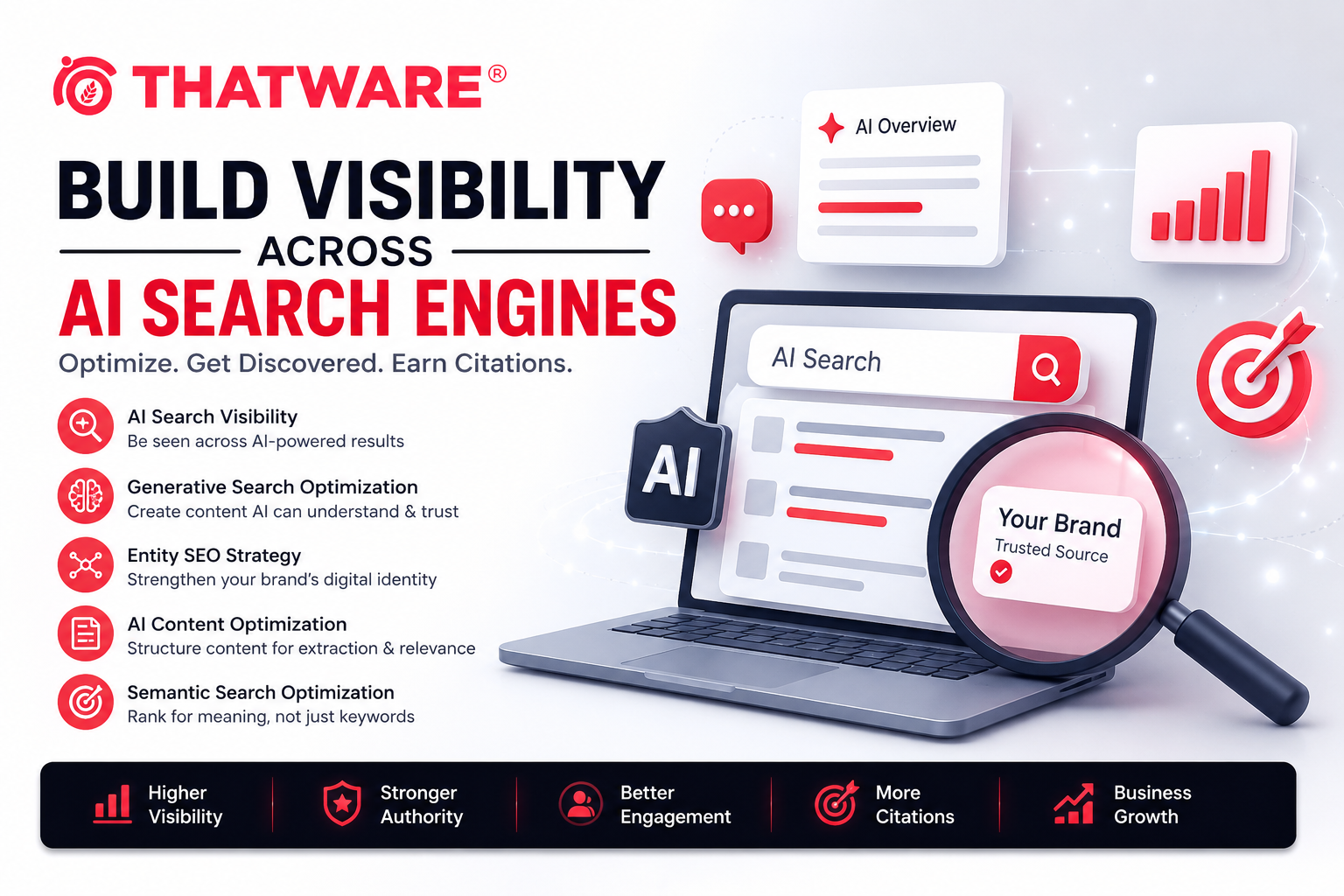
Search is changing from a list of blue links into an experience where users increasingly receive summarized answers, recommendations, comparisons, and sources directly from AI-powered platforms. For businesses, this means traditional rankings are no longer the only measure of search visibility. Thatware LLP helps businesses adapt their search strategies by combining strong SEO foundations with emerging approaches designed for AI-driven discovery.
The opportunity is not simply to “rank in AI.” Businesses need to become credible, understandable, retrievable, and reference-worthy across different search environments. That requires a strategic approach that connects technical SEO, content quality, brand authority, structured information, and semantic relevance.
Why AI Search Requires a New SEO Mindset
Traditional SEO generally focuses on helping search engines discover, interpret, and rank web pages. AI-powered search adds another layer: systems must understand information well enough to retrieve, synthesize, and potentially reference it in generated responses.
This creates a broader question for marketers:
Is your website only optimized to rank, or is it also optimized to be understood and referenced?
A modern strategy should address both.
From Rankings to Search Visibility
A page can receive impressions without becoming part of an AI-generated answer. Likewise, a business may become part of an AI response because information about its expertise, services, products, or reputation is distributed across several trustworthy sources.
This makes search visibility increasingly multidimensional.
Important areas include:
- Organic rankings
- AI-generated answer citations
- Brand mentions
- Entity recognition
- Topical authority
- Content retrieval
- Semantic relevance
- Third-party authority
- User engagement
5 Emerging SEO Keywords Businesses Should Target
The following five concepts represent important areas for businesses developing an AI-ready search strategy.
1. AI search visibility
AI search visibility focuses on increasing the likelihood that a brand, website, product, or service is discovered within AI-powered search experiences.
Rather than targeting one platform, businesses should build a broad information ecosystem. This includes useful website content, authoritative references, structured information, consistent brand details, and content that directly answers meaningful user questions.
The objective is to make the brand easier for intelligent systems to identify and connect with relevant search intents.
2. Generative search optimization
Generative search optimization focuses on creating content that can be efficiently understood, retrieved, summarized, and referenced by AI-powered search systems.
This does not mean writing robotic content or stuffing pages with keywords. Instead, content should be organized around clear questions, factual explanations, meaningful context, and strong topical relationships.
Businesses can improve their generative search readiness by:
- Answering questions directly
- Using descriptive headings
- Supporting claims with credible information
- Maintaining strong topical coverage
- Connecting related pages logically
- Demonstrating first-hand expertise
3. Entity SEO strategy
An effective entity SEO strategy helps search systems understand exactly what a business represents.
For example, a company should have consistent information about its name, services, locations, industry, expertise, authors, products, and relationships with relevant topics.
Entity clarity can be strengthened through:
- Consistent brand information
- Organization and service schema
- Author profiles
- About pages
- Expert content
- Relevant third-party mentions
- Clear internal relationships between topics
When a brand is consistently represented across its digital ecosystem, it becomes easier for search systems to associate the business with specific subjects and search intents.
4. AI content optimization
AI content optimization is about making valuable information easier for both people and intelligent retrieval systems to understand.
Good AI-ready content should not sacrifice human readability for machine processing. Instead, the two goals should support each other.
A strong page might begin with a concise answer, expand into supporting explanations, provide examples, address related questions, and finish with actionable insights.
This structure allows readers to quickly find what they need while giving search systems clearly organized information to interpret.
5. Semantic search optimization
Semantic search optimization moves beyond individual keywords and focuses on the meaning, relationships, entities, and context surrounding a topic.
For example, a page targeting a commercial SEO service should not repeatedly use one keyword. It should naturally discuss related concepts such as technical optimization, content strategy, search intent, authority, analytics, conversion performance, and topical relevance.
This creates a stronger contextual environment around the primary subject.
Build an AI-Ready Content Architecture
One of the biggest opportunities for businesses is improving how their content works as a connected knowledge system.
Instead of publishing isolated articles, create topic clusters that establish relationships between:
- Core service pages
- Supporting educational guides
- Industry-specific content
- Comparison pages
- Frequently asked questions
- Case studies
- Research-based articles
Create Clear Information Hierarchies
Every important topic should have a logical place within the website.
For example:
Main service → Sub-service → Supporting topic → Question → Detailed answer
This architecture helps users navigate information while giving search systems additional context about how individual pages relate to one another.
Strengthen Internal Connections
Internal links should not be added simply to distribute authority.
They should help explain relationships between concepts.
A technical SEO guide can connect to crawl optimization, indexing, structured data, site architecture, and technical audits. Those relationships create a richer semantic environment around the broader subject.
Make Content Easier to Retrieve
AI-powered search experiences depend heavily on retrieving useful information before generating an answer. Businesses should therefore think about how individual sections of their content can stand independently.
A useful section should ideally communicate:
Question → Direct answer → Explanation → Evidence or example → Related context
This approach makes content easier to scan and easier to understand.
Use Precise Language
Avoid unnecessary ambiguity.
Instead of:
“Businesses can benefit significantly from modern optimization techniques.”
Use:
“AI search optimization helps businesses improve how their content is discovered, interpreted, and potentially referenced in AI-powered search experiences.”
The second version communicates a clearer meaning.
Answer Important Questions Directly
Question-focused sections can address informational search intent while supporting broader commercial topics.
Consider questions such as:
- How does AI search discover business information?
- How can a website become more understandable to AI systems?
- What makes content more likely to be referenced?
- Does traditional SEO still matter for AI search?
- How should businesses measure AI search visibility?
Technical SEO Still Matters
AI search does not eliminate the importance of technical SEO.
If search systems cannot efficiently discover, crawl, render, or interpret a website, content optimization alone cannot solve every visibility problem.
Businesses should continue monitoring:
Crawlability
Make important pages accessible to search crawlers and avoid unnecessary technical barriers.
Indexability
Ensure valuable pages can be properly discovered and indexed where appropriate.
Structured Data
Use relevant structured data to provide additional context about organizations, products, services, articles, authors, and other supported entities.
Page Experience
Fast, accessible, mobile-friendly websites remain important because technical quality contributes to a better overall search experience.
Build Authority Beyond Your Own Website
AI search visibility is not necessarily determined by what appears on one website.
Search systems can encounter information through multiple sources, including business websites, industry publications, directories, reviews, expert articles, interviews, research, and other authoritative references.
This makes digital authority increasingly interconnected.
Keep Brand Information Consistent
Your business name, services, descriptions, expertise, locations, and other important information should remain consistent across credible digital properties.
Inconsistent information can create unnecessary ambiguity.
Publish Evidence of Expertise
Instead of simply claiming expertise, demonstrate it.
Useful formats include:
- Original research
- Expert commentary
- Detailed case studies
- Industry analysis
- Data-driven articles
- Expert interviews
- Practical guides
- Technical resources
The strongest authority signals are often created when expertise is demonstrated rather than repeatedly advertised.
How to Measure AI Search Performance
AI-driven search requires broader reporting than traditional keyword positions alone.
Businesses should monitor a combination of qualitative and quantitative indicators.
Traditional SEO Metrics
Continue tracking:
- Organic traffic
- Keyword rankings
- Impressions
- Click-through rate
- Indexed pages
- Backlinks
- Conversions
Emerging AI Search Signals
Where reliable measurement is available, also evaluate:
- AI-generated brand mentions
- Citation frequency
- Visibility for conversational queries
- Source inclusion
- Brand representation
- Competitor mentions
- Entity associations
- Referral traffic from AI platforms
Because AI search measurement is still developing, businesses should avoid treating a single metric as the complete picture.
Don’t Abandon Traditional SEO
AI search optimization should complement—not replace—fundamental SEO.
Strong technical foundations, valuable content, authoritative references, good internal linking, clear information architecture, and excellent user experience remain valuable.
The smarter approach is to build on these foundations.
Think of modern search optimization as a layered system:
Technical SEO → Content Quality → Topical Authority → Entity Clarity → AI Search Readiness
Each layer supports the next.
Common Mistakes Businesses Should Avoid
Chasing Every New AI Platform
Not every emerging platform deserves a separate SEO strategy.
Focus first on the search behaviors and audiences that matter to your business.
Publishing AI-Generated Content at Scale
Producing large quantities of generic content does not automatically create authority.
Content should provide useful information, original insight, strong organization, and genuine value.
Measuring Only Traffic
A brand can gain meaningful visibility without an immediate proportional increase in website visits, particularly when users receive answers directly within search interfaces.
That is why visibility, citations, mentions, engagement, and conversions should be evaluated together.
Treating AI SEO as a Completely Separate Discipline
Businesses do not necessarily need to discard their existing SEO strategy.
Instead, identify where AI search introduces additional requirements and strengthen those areas.
A Practical AI Search Optimization Framework
Businesses can approach the transition through five stages.
Stage 1: Establish the SEO Foundation
Audit technical SEO, indexability, content quality, internal linking, site architecture, and user experience.
Stage 2: Map Topics and Entities
Identify important services, products, audiences, entities, questions, and relationships associated with the brand.
Stage 3: Improve Content Depth
Develop useful topic clusters instead of isolated keyword-targeted pages.
Stage 4: Strengthen Authority
Build credible digital references, expert content, original research, and consistent brand information.
Stage 5: Monitor Search Visibility
Track traditional search performance alongside emerging AI visibility signals and refine the strategy based on evidence.
Conclusion
The future of search is not simply about achieving a higher position on a results page. Businesses increasingly need to become recognizable sources of reliable, relevant, and well-structured information across multiple search experiences.
A successful strategy combines technical SEO, content quality, semantic relevance, entity clarity, digital authority, and AI-focused optimization rather than relying on one isolated tactic.
The businesses that prepare early can build a stronger digital foundation for a search environment where being understood, discovered, trusted, and referenced matters just as much as ranking.
Frequently Asked Questions
1. What is AI search optimization?
AI search optimization is the process of improving a website and brand’s ability to be discovered, understood, retrieved, and potentially referenced within AI-powered search experiences. It combines traditional SEO principles with content structure, semantic relevance, entity optimization, and authority-building techniques.
2. Is traditional SEO still important for AI search?
Yes. Technical SEO, quality content, internal linking, authoritative references, crawlability, and strong user experience continue to provide an important foundation. AI search optimization should generally build upon these fundamentals rather than replace them.
3. How can a business improve its visibility in AI-generated answers?
Businesses can improve their potential visibility by publishing authoritative content, answering relevant questions clearly, strengthening topical coverage, maintaining consistent brand information, implementing appropriate structured data, developing strong internal linking, and earning credible references from relevant external sources.
4. How long does AI search optimization take to produce results?
There is no universal timeframe because visibility depends on the website’s existing authority, technical condition, content depth, competition, industry, and search behavior. AI search optimization should be treated as a long-term visibility strategy rather than a guaranteed short-term ranking tactic.