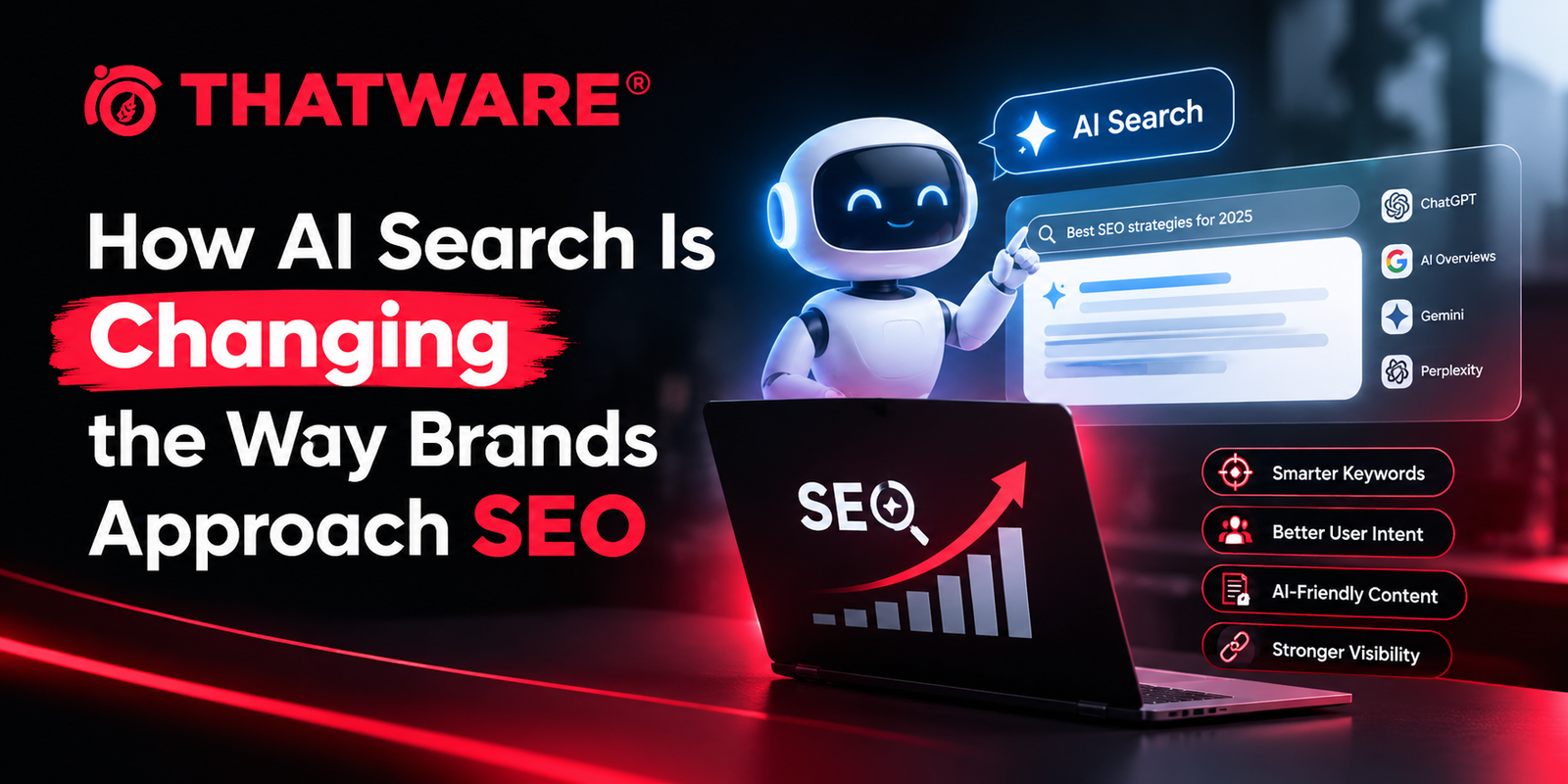
Search has changed dramatically in a short time. People are no longer relying only on traditional search results to find a company, compare services, or decide what to buy. A potential customer might now ask Google, ChatGPT, or another AI-powered platform for recommendations and expect a useful shortlist within seconds.
For brands, this creates a bigger question than simply where a website ranks on Google. The real question is whether the brand can be discovered, understood, and trusted when customers use AI to research their options.
Search Is Becoming Part of the Buying Conversation
Traditional SEO still matters. Technical performance, useful content, internal linking, authority, page experience, and search intent continue to influence how websites perform in organic search.
However, the way people discover information is becoming more conversational.
Someone looking for an SEO provider might previously search for:
“SEO agency India”
Today, that same person could ask an AI assistant:
“Which SEO companies in India work with international businesses and have experience with AEO, GEO, and AI search?”
The difference is important. The second question asks the system to understand several factors at once and identify businesses that appear relevant to the request.
This is where an AI SEO company needs to think beyond rankings. A brand needs clear information across its website and other trusted sources so that AI systems can understand its services, expertise, location, experience, and areas of specialization.
SEO Is Not Being Replaced
The rise of AI search does not make traditional SEO irrelevant. Instead, it adds another layer to the discovery process.
SEO provides the foundation. It helps search engines crawl, index, understand, and rank a website. Technical health, content quality, site architecture, authority, and user experience remain important.
AEO focuses on making information easier to understand when users ask direct questions. Clear answers, useful explanations, structured information, and well-organized content can make a brand easier to interpret.
GEO takes this further into generative search environments, where systems may combine information from different websites and sources before producing an answer.
LLM SEO focuses on how brands, services, products, and expertise are represented within large language model-driven discovery.
These approaches work better when they are connected rather than treated as separate marketing activities.
What Makes a Brand Easier for AI Systems to Understand?
One of the biggest changes in search is the growing importance of context.
A company is not simply a website or a collection of keywords. It has people behind it, specific services, locations, areas of expertise, publications, awards, research, customers, and other relationships that help establish its identity.
This is why entity optimization matters.
For example, if a company describes itself as an expert in several specialized areas, those claims should be supported by relevant content and credible information across the wider web. Consistency also matters. The company’s name, services, expertise, and other important details should be represented accurately across relevant sources.
An AI search optimization company should therefore look at the entire digital presence rather than focusing only on individual keywords.
What Should Businesses Expect From an AI-Focused SEO Strategy?
Businesses considering AI-focused search services should still start with the fundamentals.
A technically accessible website is essential. Pages should be crawlable and indexable, internal links should create useful pathways, structured data should be implemented where appropriate, and important information should be easy to find.
The next step is understanding the questions customers actually ask.
Instead of creating content simply because a keyword has search volume, businesses can examine the problems, comparisons, questions, and decision-making concerns that appear throughout the customer journey.
For example, a potential customer may want to know:
- Which provider is suitable for a particular business size?
- What services does the company actually specialize in?
- How does one provider differ from another?
- What evidence supports the company’s expertise?
- What should a buyer consider before choosing a service?
Answering these questions clearly can make content more useful to both people and search systems.
Businesses can also explore dedicated AEO services when they need to improve how important questions and answers are presented across search environments.
At the same time, an LLM SEO company should be transparent about what optimization can and cannot achieve. No responsible agency can guarantee that ChatGPT or another AI platform will recommend a particular business.
The practical goal is to strengthen the information and signals that AI systems may use when evaluating a brand.
Why Independent Evidence Matters
A brand’s own website is only one part of its digital identity.
Third-party publications, industry resources, expert contributions, research, reviews, citations, and other credible references can provide additional context.
This does not mean businesses should create artificial mentions simply to influence AI systems. The stronger approach is to build genuinely useful information and earn recognition through credible sources.
For businesses operating in competitive industries, this wider presence can help reinforce expertise and make important claims easier to verify.
The same principle applies to enterprise brands. Large organizations often have multiple services, products, locations, and audiences. Keeping these relationships clear across thousands of pages can become a significant search optimization task.
Measuring Visibility Beyond Traditional Rankings
Rankings and organic traffic remain useful measurements. They tell businesses whether their website is gaining visibility through conventional search.
But AI-driven discovery introduces additional questions.
Is the brand appearing when potential customers ask commercially relevant questions?
Are competitors being mentioned more frequently?
Is the company being cited as a source?
Are AI systems describing its services accurately?
Does the brand appear consistently across different AI search environments?
These questions provide a different view of search performance.
ThatWare has developed proprietary research frameworks, including AI Visibility Metrics (AVM) and the Vector Entity Model (VEM), to study brand performance within AI-driven discovery environments. The broader objective is to make AI visibility more measurable instead of treating it as another vague marketing trend.
For an enterprise investing in SEO, this perspective can be particularly useful. A business may have strong Google rankings while still being less visible when customers use conversational or generative search to compare providers.
From Search Rankings to Customer Discovery
The reason businesses invest in SEO has not really changed.
They want to be found when someone needs what they offer.
What has changed is where that discovery can happen.
A buyer may find a company through a traditional Google result, an AI-generated answer, a conversational recommendation, a comparison, or a source cited during an AI research process.
That makes search visibility broader than a position on a results page.
For businesses, the opportunity is to build a digital presence that communicates expertise clearly, answers genuine customer questions, maintains strong technical foundations, and provides enough credible evidence for people and machines to understand the brand.
For more context on how these developments are affecting businesses, read Improving Business Visibility in AI Search, which explores the broader shift toward AEO, GEO, and LLM optimization.
The Next Question for Brands
AI search is not eliminating SEO. It is changing what visibility means.
A strong search strategy now needs to consider traditional rankings alongside conversational discovery, generative answers, entity understanding, citations, and AI visibility.
For businesses choosing an SEO partner, the question is therefore becoming broader.
Instead of asking only whether an agency can improve Google rankings, businesses should consider whether the agency understands how customers are discovering information across the wider search ecosystem.
The brands that prepare for this shift will be better positioned to remain visible as search continues to evolve.