Introduction
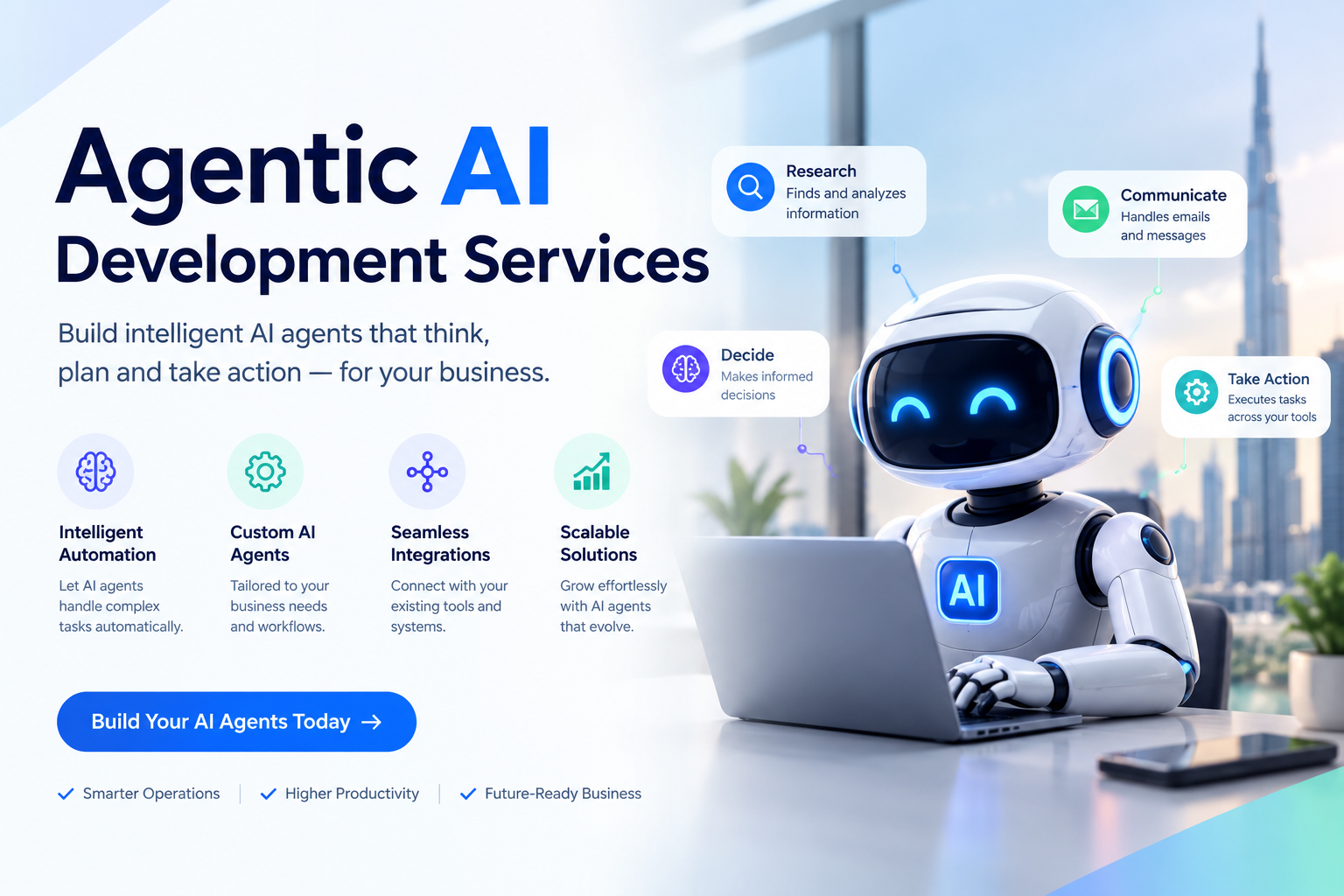
Business automation is entering a new era. For years, companies have used software to handle repetitive tasks, manage information, and improve productivity. However, traditional automation usually follows fixed instructions and struggles when something unexpected happens. Today, a more advanced approach is changing the way businesses operate. Agentic artificial intelligence (AI) can understand goals, plan tasks, use available tools, and take action with limited human guidance. This is where agentic ai development services are becoming increasingly important. They help businesses build intelligent systems that do more than follow commands. These systems can support decisions, adapt to changing situations, and coordinate complex workflows. But what does this mean for everyday businesses, employees, and customers Let’s explore how agentic AI is shaping the future of business automation and why it deserves attention.
Understanding Agentic AI and Business Automation
Business automation means using technology to complete tasks with less manual effort. Companies already automate activities such as sending emails, generating invoices, updating customer records, and processing orders. Traditional automation is useful, but it generally works best when tasks follow predictable rules.
Agentic AI takes automation a step further. Instead of simply completing one predefined action, an AI agent can work toward a specific goal, break that goal into smaller tasks, gather relevant information, and select suitable actions. Depending on its design, it may also check results and adjust its approach when circumstances change.
Imagine a traditional calculator compared with a personal assistant. A calculator gives you an answer when you enter numbers. A personal assistant can understand that you need to prepare for a meeting, gather the required documents, organize the schedule, and remind you about important details. Agentic AI aims to bring some of that goal-oriented behavior into business software.
However, agentic AI is not magic. Its abilities depend on the underlying models, available tools, quality of information, permissions, and safeguards. Human oversight remains important, especially when decisions involve money, personal data, legal responsibilities, or customer relationships.
How Agentic AI Development Services Work
Agentic AI development services help organizations design, build, integrate, test, and maintain AI agents that address specific business needs. Rather than introducing technology without a clear purpose, professional developers identify existing problems and determine where intelligent automation can provide measurable value.
The process usually begins by understanding the company’s goals. A business might want to respond to customer inquiries faster, reduce delays in order processing, improve lead qualification, or help employees find information across different systems. Developers then design an AI agent around the selected workflow and define the tools it can access.
The agent may connect with customer relationship management software, email platforms, inventory systems, internal databases, or business applications through approved integrations. When a request arrives, the system interprets the task, determines the next steps, uses its permitted tools, and evaluates the results.
For example, an agent supporting a sales team might review an incoming inquiry, identify the customer’s needs, collect relevant product information, and prepare a personalized response for approval. More advanced implementations may update records or schedule meetings automatically when the necessary permissions and safeguards are in place.
Testing is equally important. Developers need to evaluate accuracy, reliability, security, and performance before an agent is trusted with important business activities. After deployment, monitoring and regular improvements help the system remain useful as business requirements change.
The Difference Between Traditional Automation and Agentic AI
Traditional automation and agentic AI both help businesses save time, but they approach work differently. Rule-based automation follows instructions such as, “When an order arrives, send a confirmation email.” This works extremely well when the process is predictable and the rules are clear.
Agentic AI can handle workflows that require more interpretation. Consider a customer who contacts a company because an order is late, a product is unavailable, and an alternative delivery option is needed. A basic automated system might send a standard message or transfer the issue to an employee. An appropriately configured AI agent could review the order, check inventory, compare permitted delivery options, and prepare a suitable solution.
The main difference is flexibility. Traditional automation follows established paths, while agentic AI can select actions based on context and an intended outcome. Nevertheless, neither approach is automatically better in every situation. Simple, stable processes often work perfectly well with traditional automation, which may be cheaper and easier to maintain.
Many businesses will benefit most from combining both technologies. Traditional workflows can handle predictable steps, while AI agents manage tasks that involve changing information, multiple systems, or more complicated decisions.
Why Businesses Are Investing in Agentic AI
Modern businesses face increasing pressure to respond quickly, control expenses, and deliver better customer experiences. At the same time, employees spend considerable time switching between applications, searching for information, preparing reports, and completing administrative work.
Agentic AI offers a way to reduce some of these burdens. An AI agent can coordinate several related activities instead of requiring an employee to manage every step manually. For example, an operations team could use an agent to collect information from different departments, identify missing details, and prepare a daily summary.
Another reason businesses are exploring this technology is the growing complexity of digital operations. Companies often use many separate applications, and information can become scattered across different systems. AI agents can help connect these activities through approved tools and integrations.
The strongest reason to invest is not simply that AI is popular. It is that a well-designed system can solve a real business problem. Organizations should focus on measurable outcomes, such as reduced processing time, fewer errors, improved response rates, and better employee productivity.
Businesses that approach implementation strategically can explore new capabilities without replacing every existing system or changing all their processes at once.
Key Benefits of Agentic AI Development Services
One major benefit of agentic AI is the ability to coordinate multiple steps within a single workflow. Instead of asking employees to collect information, compare records, draft responses, and update several applications separately, a properly configured agent can assist with these connected activities.
Improved productivity is another important advantage. Employees can spend less time on repetitive administrative tasks and more time on creative thinking, customer relationships, planning, and problem-solving. This does not mean every task should be automated. Rather, businesses can identify work where automation provides clear value while keeping people involved where judgment matters most.
Better operational consistency can also result from carefully designed AI workflows. An agent can follow approved procedures, apply the same validation checks, and document important actions. This may reduce certain types of human error, although AI systems can introduce their own mistakes and must be monitored.
Another potential benefit is faster access to information. AI agents can gather relevant details from authorized business systems and present them in a useful format. Managers may receive reports more quickly, while customer support employees can find answers without searching through numerous documents.
Finally, agentic AI can support business growth. When transaction volumes increase, companies may be able to handle more routine work without expanding every team at the same rate. The actual savings depend on implementation costs, usage expenses, workflow complexity, and the amount of human review still required.
Real-World Applications Across Industries
Agentic AI is not limited to technology companies. Its ability to support connected workflows makes it relevant to several industries, although each application requires suitable testing and safeguards.
In e-commerce, an AI agent could help monitor order status, answer routine product questions, identify inventory discrepancies, and prepare responses to delivery concerns. Refunds, unusual orders, and sensitive complaints can be routed to human employees when approval is necessary.
In healthcare, AI agents may assist with administrative scheduling, organize nonclinical information, and help staff retrieve relevant documents. Any system involved in clinical decisions or patient care requires much stricter oversight, privacy protections, and professional accountability.
In finance, agents can support document collection, transaction review workflows, internal reporting, and customer service. They should not be allowed to make unrestricted financial decisions or bypass established compliance controls.
In manufacturing, AI agents may help coordinate maintenance requests, summarize production information, and flag possible supply chain disruptions. Their recommendations can help teams investigate problems before those problems cause larger delays.
In marketing and sales, agents can research approved information sources, organize leads, summarize customer interactions, and prepare campaign drafts. Human review remains valuable for brand messaging, sensitive communications, and strategic decisions.
These examples demonstrate that agentic AI is most useful when it addresses a specific workflow. The goal is not to introduce an AI agent into every department, but to identify tasks where better coordination can make a meaningful difference.
How Agentic AI Improves Customer Experience
Customers increasingly expect businesses to provide quick, relevant, and consistent support. Waiting for simple answers or explaining the same problem to several employees can create frustration. Agentic AI can help companies address these challenges by assisting with routine inquiries and coordinating information across approved systems.
For example, a customer asking about an order may receive an answer based on the latest available tracking information rather than a generic response. If the order is delayed, an AI agent might check the company’s delivery policy, identify available options, and explain the next steps.
Personalization is another potential advantage. With appropriate permissions, an agent can use relevant customer preferences, previous interactions, and account details to provide more useful responses. Businesses must ensure that this information is handled lawfully and securely.
Agentic AI can also support customer service teams by summarizing long conversations, recommending responses, and identifying issues that need human attention. Employees can then focus on complicated cases that require empathy, negotiation, or discretion.
Still, speed should not come at the expense of trust. Customers need a clear way to reach a human representative when an AI system cannot resolve their concerns. Reliable information, transparent communication, and easy escalation are essential to a positive customer experience.
The Role of Agentic AI in Employee Productivity
One common misconception is that business AI exists only to replace workers. In practice, many valuable applications focus on helping employees complete their work more effectively.
Consider an employee preparing a weekly performance report. They may need to collect figures from different applications, identify changes, organize the information, and write a summary. An AI agent could assist with collecting approved data, highlighting unusual changes, and preparing an initial report for review.
Similarly, a project manager might use an agent to organize meeting notes, identify outstanding tasks, draft follow-up messages, and summarize project updates. The employee remains responsible for checking important details and deciding what action to take.
This creates a different relationship between people and software. Instead of manually managing every small task, employees can delegate suitable activities while concentrating on higher-value work.
The future of productivity is likely to involve collaboration between people and intelligent systems. Human judgment, creativity, empathy, and accountability remain important, while AI agents can help with research, coordination, and repetitive work.
Businesses should also invest in employee training. Workers need to understand what AI tools can do, where they may fail, how to verify outputs, and when to request human assistance. A successful implementation improves both technology and the way people use it.
Challenges and Risks Businesses Must Consider
Despite its potential, agentic AI comes with challenges that businesses should understand before implementation. One important concern is inaccurate information. AI systems can misunderstand instructions, produce incorrect answers, or select an unsuitable action. If an agent can modify business records or communicate with customers, even a small error may have consequences.
Another challenge is controlling complex workflows. When an agent uses several tools or passes tasks to other agents, it may become difficult to understand why a particular decision was made. Poorly designed systems can repeat actions, overlook important conditions, or consume more resources than expected.
Unrestricted autonomy is a significant risk. Giving an AI agent access to every application, customer record, or payment function is rarely a sensible starting point. Permissions should be limited to the tasks the system actually needs to perform.
Cost is another consideration. Development, model usage, system integration, monitoring, and maintenance can create ongoing expenses. Businesses should compare these costs with the time saved, errors avoided, and improvements achieved.
Finally, employees and customers may resist systems that seem confusing or unreliable. Companies can address this by explaining how the technology works, introducing it gradually, and creating clear processes for human review and feedback.
A thoughtful implementation recognizes these limitations instead of assuming AI will automatically deliver better results.
Security, Privacy, and Responsible AI
Security must be part of agentic AI development from the beginning. Because agents may access multiple applications and take actions on behalf of users, businesses need strong controls over what information the system can view and what changes it can make.
The principle of least privilege is a useful starting point. An agent should receive only the permissions required for its assigned responsibilities. A customer support agent, for example, may need access to order status but not unrestricted access to payment credentials or unrelated employee records.
Businesses should also protect sensitive information through appropriate access controls, encryption, secure integrations, and data retention policies. Logs can help teams review what an agent did, which tools it used, and whether its actions followed established rules.
Another concern is prompt injection, where malicious or misleading content attempts to manipulate an AI system into ignoring its intended instructions. Developers should treat external content as untrusted, validate tool inputs, separate instructions from retrieved information, and prevent unauthorized actions through independent controls.
Human approval should be required for high-impact activities, such as significant financial transfers, sensitive account changes, or decisions with serious legal or personal consequences.
Responsible AI also requires regular evaluation for bias, reliability, transparency, and unintended outcomes. A trustworthy AI agent is not simply one that can act independently; it is one that operates within clear boundaries and remains accountable to people.
How to Implement Agentic AI Successfully
A successful implementation begins with a clear business objective. Rather than asking where AI can be used, companies should ask which existing problem is expensive, repetitive, time-consuming, or difficult to manage. This approach helps prevent unnecessary investment in technology that does not address a meaningful need.
The next step is to select a suitable workflow. Tasks with clear goals, measurable results, accessible information, and manageable risks are often good starting points. A system that summarizes internal documents or prepares customer support drafts may be a safer first project than an agent authorized to approve payments.
Businesses should then define the agent’s responsibilities, available tools, permissions, and escalation rules. Developers can build a prototype, test it against realistic scenarios, and compare its performance with the current process.
A practical implementation strategy includes the following stages:
Start with a focused pilot. Choose one workflow and establish baseline measurements before introducing the agent. These measurements may include completion time, error frequency, employee effort, and customer satisfaction.
Integrate carefully. Connect only the systems required for the workflow and verify that information is accurate, current, and properly authorized.
Test unusual situations. Evaluate how the agent responds to missing data, conflicting instructions, unavailable systems, and unexpected requests. Test security controls as well as normal functionality.
Keep humans involved. Define which actions the agent may perform independently and which require approval. Establish a straightforward process for transferring difficult cases to an employee.
Measure and improve. Track performance, operating costs, failure rates, and user feedback. Use these results to refine the system before expanding it to additional workflows.
This gradual approach gives businesses an opportunity to learn, reduce risk, and build confidence before relying on more advanced automation.
The Future of Agentic AI and Business Automation
The future of business automation is likely to involve systems that can coordinate increasingly complex tasks across different applications. Instead of using separate tools for research, customer service, reporting, and operations, businesses may deploy connected AI agents that collaborate within defined workflows.
For example, a supply chain system could use one agent to monitor inventory, another to analyze supplier information, and another to prepare purchasing recommendations. A central workflow could coordinate their findings and request human approval before placing an order.
These capabilities may make business processes more responsive. When demand changes or a supplier experiences a delay, connected systems could identify the issue, evaluate available information, and recommend suitable actions more quickly than a manual process.
However, greater autonomy will not eliminate the need for human oversight. As agents become more capable, businesses will need stronger testing methods, better monitoring, clearer accountability, and reliable ways to stop or reverse inappropriate actions.
Another likely development is more specialized AI. Instead of relying on a single general-purpose agent for every task, companies may use systems designed for particular industries, workflows, or internal requirements.
The future is not necessarily a workplace without people. It is a workplace where people can direct more of their attention toward decisions, relationships, and ideas while intelligent systems handle suitable operational tasks. Companies that balance innovation with responsible implementation will be better positioned to benefit from these developments.
Why Choose Professional Agentic AI Development Services
Building a useful AI agent involves much more than connecting a language model to a business application. Companies must understand their processes, prepare reliable data, design suitable workflows, integrate software securely, and establish safeguards that prevent inappropriate actions.
Professional agentic ai development services can help businesses manage these requirements. Experienced development teams can assess business needs, select appropriate technologies, create custom agents, integrate existing applications, and establish testing and monitoring procedures.
Customization matters because every business has different goals and constraints. A retail company may need help coordinating inventory and customer support, while a software company may want agents that assist with internal knowledge management or technical support. A generic solution may not fit either organization’s workflows without modification.
A capable development partner should also explain the limitations of the proposed system. Businesses should understand which tasks can be automated, which actions need human approval, how information is protected, and how success will be measured.
Look for practical expertise, secure development practices, transparent costs, and ongoing support. Ask potential providers how they test agent reliability, control tool access, monitor performance, and handle failures. Request a pilot with measurable objectives before committing to a large-scale deployment.
The right partner does not simply deliver an AI product. It helps the business build a dependable automation strategy that supports long-term goals.
Conclusion
Agentic AI is changing how businesses think about automation. Instead of limiting software to fixed instructions, companies can explore systems that understand goals, coordinate tasks, and adapt to changing information within defined boundaries. From customer support and sales to operations and reporting, the possibilities are significant. However, success depends on thoughtful planning, reliable integrations, strong security, and human oversight. Agentic AI development services give businesses a way to turn these possibilities into practical solutions tailored to their needs. Organizations that start with clear objectives, measure real outcomes, and expand responsibly can use agentic AI to improve productivity and build more flexible operations. The real opportunity is not simply to automate more tasks, but to help people and technology work together more effectively.
FAQs
1. What are agentic AI development services?
Agentic AI development services help businesses design, build, integrate, and maintain AI agents that can pursue defined goals, use approved tools, and coordinate multi-step workflows. These services can support applications such as customer service, sales operations, reporting, and internal knowledge management.
2. How is agentic AI different from traditional automation?
Traditional automation generally follows predefined rules and fixed workflows. Agentic AI can interpret a goal, choose from available actions, and adjust its approach based on context. Traditional automation remains useful for predictable tasks, while agentic AI can support more flexible workflows.
3. Which businesses can benefit from agentic AI development services?
Businesses of different sizes and industries can benefit, including e-commerce companies, healthcare organizations, financial services firms, manufacturers, marketing agencies, and software companies. The best opportunities usually involve repetitive or multi-step tasks that can be improved without introducing unacceptable risks.
4. Is agentic AI safe for business automation?
Agentic AI can be used responsibly when it has limited permissions, secure integrations, appropriate testing, activity monitoring, and clear escalation procedures. Sensitive or high-impact actions should require human approval where appropriate. No AI system is completely risk-free, so ongoing evaluation is essential.
5. How much do agentic AI development services cost?
The cost depends on the complexity of the project, the number of integrations, the AI models used, data requirements, security needs, and ongoing maintenance. A small pilot may require substantially less investment than a multi-agent enterprise platform. Businesses should request a project-specific estimate and compare the expected benefits with the total cost of ownership.