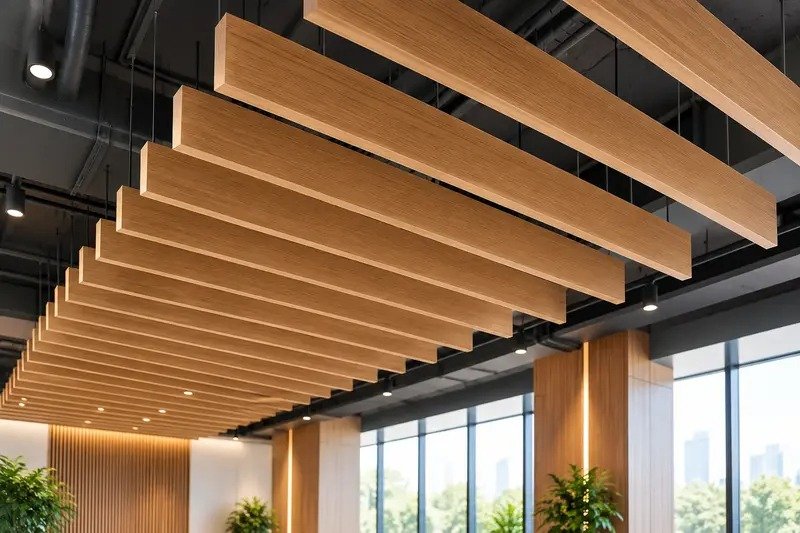
Walk into a warehouse, a gym, or an open-plan office with high ceilings, and you’ll notice something right away — sound just bounces around endlessly. Voices echo, machinery hums louder than it should, and conversations turn into noise soup. This is exactly the kind of problem Hanging Baffles were designed to solve, and once you understand how they work, it’s easy to see why so many facilities are adding them overhead instead of relying only on wall treatments.
What Are Hanging Baffles, Exactly?
Hanging Baffles are vertical or horizontal acoustic panels suspended from the ceiling, typically made from sound-absorbing materials like polyester fiber or foam. Unlike wall panels, which only manage sound hitting flat vertical surfaces, they target the open airspace above a room — where sound waves travel freely and reflect off hard ceilings and structural elements.
Because they hang rather than mount flush, they expose more surface area to sound waves from multiple directions, making them particularly effective in spaces with high ceilings or large open volumes.
Why Ceiling-Level Acoustic Treatment Matters
A lot of facilities focus entirely on walls and flooring, forgetting that sound doesn’t stay at eye level. In large open spaces, ceilings often become the biggest source of unwanted reverberation. Hanging Baffles address this directly by:
- Reducing echo and reverberation in large open-plan areas
- Improving speech clarity in offices, classrooms, and auditoriums
- Cutting down on cumulative machinery noise in warehouses and factories
- Offering a lightweight alternative to full ceiling tile replacement
- Allowing airflow and lighting systems to remain largely unobstructed
This last point matters more than people expect. Since they’re suspended with gaps between panels, HVAC systems, sprinklers, and lighting fixtures can often stay exactly where they are during installation.
Where Hanging Baffles Get Used Most
They show up in a wide variety of settings, including:
- Warehouses and distribution centers with constant equipment noise
- Open-plan offices struggling with speech intelligibility
- Gyms and fitness studios where sound bounces off hard floors and high ceilings
- School auditoriums and multipurpose halls
- Restaurants and cafes aiming for a quieter dining experience
- Manufacturing floors where machinery noise compounds throughout the day
Each of these spaces has a different ceiling height, layout, and noise profile, which affects how many baffles are needed and how they should be arranged for the best acoustic outcome.
What Makes a Hanging Baffle Actually Effective
Not every baffle performs the same way. Several factors influence real-world results:
- Material density — denser cores absorb a wider range of frequencies
- Panel orientation — vertical baffles often work best for reverberation control, while horizontal ones can double as visual ceiling elements
- Spacing and coverage — too few panels spread too thin won’t meaningfully reduce echo
- Mounting height — placement relative to the noise source affects absorption efficiency
SomNandi Industries designs its baffle systems around these exact variables, tailoring density, spacing, and orientation to the specific acoustic challenge a space presents rather than offering a single generic layout.
Installation Considerations
Installing these panels is generally far less disruptive than wall-mounted acoustic treatment. Most systems use track-based or cable suspension methods that don’t require major ceiling modifications. That said, getting the layout right still depends on an accurate read of the room’s dimensions, existing noise sources, and how the space is actually used day to day.
Final Thoughts
If your space still echoes despite wall treatments, the ceiling is probably the missing piece. They offer a practical, lower-disruption way to tackle reverberation without ripping out existing infrastructure.
SomNandi Industries has worked on acoustic treatment projects where adding a properly planned Hanging Baffles layout made a noticeably bigger difference than any additional wall panel could have — proof that sometimes the real fix is right above your head.