
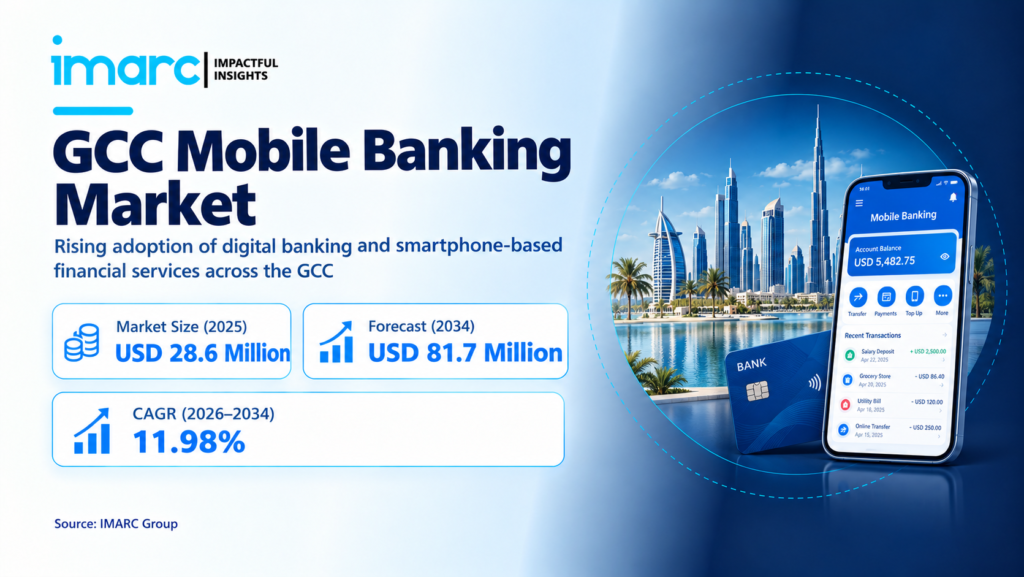
IMARC Group, a leading global market research and management consulting firm, has published its latest market intelligence report on the GCC Mobile Banking Market. The GCC mobile banking market size reached USD 28.6 Million in 2025 and is projected to reach USD 81.7 Million by 2034, exhibiting a CAGR of 11.98% during 2026-2034. Growth is being driven by high internet connectivity, rising smart device penetration, the expanding BFSI industry, the integration of AI and other advanced technologies into banking solutions, and government initiatives promoting digital financial services.
Mobile banking lets customers carry out transactions, check account information, make investments, pay bills, and reach support remotely through smartphones and tablets, and it has become a core channel for GCC banks serving a highly connected population. As Gulf regulators push ahead with instant payments, open finance, and digital bank licensing, demand for secure, convenient, and personalized mobile services is climbing steadily across Saudi Arabia, the UAE, Qatar, Bahrain, Oman, and Kuwait. At the same time, banks are embedding AI assistants, personalized insights, and real-time customer support into their apps, while FinTech competition raises expectations for speed and customization. Combined with strong government backing through national payment platforms, central bank law reform, and anti-money laundering oversight, these forces are reshaping the competitive landscape and setting the stage for steady, long-term growth across the region.
GCC Mobile Banking Market at a Glance:
- Market Size (2025): USD 28.6 Million
- Market Forecast (2034): USD 81.7 Million
- Growth Rate (2026-2034): CAGR of 11.98%
- Base Year: 2025 | Historical Period: 2020-2025 | Forecast Period: 2026-2034
How AI is Reshaping the Future of the GCC Mobile Banking Market
- AI Maturity Leaders in the Gulf: In the inaugural Evident AI Index for Banks for the Middle East and Africa, published on June 2, 2026, Emirates NBD ranked first among 25 banks and First Abu Dhabi Bank third, with Saudi Arabia’s Al Rajhi Bank ninth and Mashreq tenth. Emirates NBD and FAB are advancing smart customer onboarding, AI-powered customer engagement platforms, and enhanced risk analytics.
- AI-Personalized Digital Banking: Mashreq was named the world’s best Islamic digital bank for 2026 by Euromoney. Through its Mashreq NEO platform, new customers can open an account in minutes, and AI-powered features such as Money Insights analyze transaction behavior and give personalized recommendations, as the bank uses AI, automation, and embedded finance for real-time engagement.
- Localized AI and Talent Gap: Gulf banks are focusing on customer data, governance frameworks, and localized AI applications rather than competing with frontier AI laboratories. Evident research found that banks in the region employ an average of 316 AI professionals, against 1,763 at global peers, so building talent is the next priority for scaling AI in mobile apps.
Grab a sample PDF of this report: https://www.imarcgroup.com/gcc-mobile-banking-market/requestsample
GCC Mobile Banking Market Trends and Drivers:
Demand for mobile banking across the GCC is being underpinned by high internet connectivity and rising penetration of smart devices such as smartphones and tablets. The expanding BFSI industry in the region has increased demand for convenient and prompt financial services, and several banks are introducing instant and real-time customer assistance to promote self-service banking.
The region’s structural differentiator is the integration of advanced technologies with banking solutions. Artificial intelligence, blockchain, and wireless application protocol are being combined to deliver user-friendly interfaces, while national infrastructure is raising the ceiling: the UAE’s Aani platform now connects more than 70 financial institutions for instant transfers using only a mobile number, and the Central Bank’s Open Finance framework lets customers consent to share data between licensed providers.
A third driver is government support and FinTech competition. Several government bodies across the region are introducing initiatives to promote mobile banking services for tracking financial transactions and mitigating the risks of money laundering, while the emergence of FinTech technologies is leading banks to upgrade their mobile applications for customized product offerings and a more streamlined customer experience, a dynamic that is set to intensify over the coming decade.
Government Schemes and National Digitalization Programs Driving Demand:
- CBUAE Financial Infrastructure Transformation Programme and Aani: The Central Bank of the UAE’s FIT programme underpins Aani, the national 24/7 instant payments platform launched by Al Etihad Payments in October 2023, which lets customers split bills and transfer money using just a phone number and lets businesses accept payments by QR code, with more than 70 financial institutions now connected.
- CBUAE Open Finance Regulation: The regulation requires licensed institutions to participate in an API-driven data-sharing ecosystem under customer consent controls, delivered through the Nebras platform, and was introduced as the world’s first open finance regulation.
- Federal Decree-Law No. 6 of 2025: The UAE’s new Central Bank law, effective September 16, 2025, consolidates supervision of banks, payment providers, and insurers in one statute, adds explicit consumer protections around fraud, and gives the Central Bank a legal basis to create a deposit guarantee scheme.
- Saudi Open Banking and Digital Bank Licensing: The Saudi Central Bank’s Open Banking Framework mandates API-based banking infrastructure, and new digital banks such as D360 Bank and Vision Bank have been licensed and become operational, adding competition in mobile-first banking.
- Qatar FinTech Strategy: Qatar Central Bank published its Regulatory Framework for Digital Banks in the fourth quarter of 2024 under its financial sector strategy and is moving open banking from sandbox testing toward production, with QNB launching live account information and payment initiation APIs.
GCC Mobile Banking Market Industry Segmentation:
The report has segmented the market into the following categories:
Breakup By Type:
- Wireless Application Protocol (WAP)
- Standalone Mobile Application
- SMS Banking
- Unstructured Supplementary Service Data (USSD)
- Others
The report provides a detailed breakup and analysis of the market by type, covering WAP, standalone mobile applications, SMS banking, USSD, and others. Standalone apps are where innovation is concentrated, as with the Al Rajhi app, which offers QR code beneficiary setup, instant financing without a branch visit, card management, and bill settlement.
Breakup By Service:
- Transactions
- Customer to Customer
- Customer to Business
- Account Information
- Investments
- Support Services
- Others
The report provides a detailed breakup and analysis of the market by service. Transaction services are being sped up by Aani instant transfers and QR payments, investment features are entering apps as seen in ADCB’s May 2026 app with integrated investment trading, and support services are moving to AI, with banks such as Mashreq offering an always-on virtual assistant.
Breakup By Platform:
- Android
- iOS
- Others
The report provides a detailed breakup and analysis of the market by platform, covering Android, iOS, and others. Leading banks publish apps on both major platforms and update them frequently with new features, such as light and dark modes and faster onboarding.
Breakup By Deployment:
- On-cloud
- On-premises
The report provides a detailed breakup and analysis of the market by deployment, covering on-cloud and on-premises. New digital banks are choosing cloud-native stacks, as with Saudi Arabia’s Vision Bank, which became operational on Finastra’s cloud-native Islamic banking treasury solution.
Breakup By End User:
- Individual
- Enterprise
The report provides a detailed breakup and analysis of the market by end user, covering individuals and enterprises. Individuals dominate app usage for daily payments and transfers, while enterprise demand is growing for digital onboarding and business banking, as seen in Mashreq NEO BIZ for SMEs.
Breakup By Country:
- Saudi Arabia
- UAE
- Qatar
- Bahrain
- Oman
- Kuwait
The report provides a comprehensive analysis of all major regional markets, including Saudi Arabia, the UAE, Qatar, Bahrain, Oman, and Kuwait. The UAE leads in payments infrastructure with Aani and open finance, Saudi Arabia is adding digital banks and open banking, and Qatar is scaling open banking from its sandbox.
Competitive Landscape:
The competitive landscape of the industry has also been examined, with some of the key players being:
- Abu Dhabi Islamic Bank
- Al Baraka Banking Group B.S.C.
- Al Rajhi Banking and Investment Corporation
- Alinma Bank
- Bank Albilad
- Bank AlJazira
- Bank Dhofar SAOG
- Dubai Islamic Bank
- Kuwait Finance House
- Mashreqbank PSC
- Masraf Al Rayan (Q.P.S.C)
- Qatar Islamic Bank (Q.P.S.C.)
Competition is shifting toward AI-enabled personalization, instant payments, and digital-first propositions, with banks upgrading their apps to offer customized products and a streamlined customer experience as FinTech challengers raise expectations. The report covers market structure, key player positioning, and the degree of competition in the industry.
What Does The Full Report Cover?
- Historical, current, and forecast market size for the GCC mobile banking market from 2020 to 2034
- Market breakup by type, service, platform, deployment, end user, and country
- Country-level analysis covering Saudi Arabia, UAE, Qatar, Bahrain, Oman, and Kuwait
- Key driving factors and challenges shaping the GCC mobile banking market
- Industry value chain analysis
- Competitive landscape, market structure, and degree of competition
- Detailed profiles of major companies operating in the GCC mobile banking market
Recent News and Developments in the GCC Mobile Banking Market
- September 2025: The UAE’s Federal Decree-Law No. 6 of 2025 on the Central Bank took effect on September 16, consolidating banking, insurance, and payments regulation under a single framework and adding explicit consumer protections around fraud.
- November 2025: The UAE Ministry of Finance and the Dubai Department of Finance executed the first live government financial transaction using the Digital Dirham on the mBridge platform, completed in less than two minutes.
- May 2026: Abu Dhabi Commercial Bank launched a next-generation mobile banking app featuring an AI-powered conversational assistant and integrated investment trading, as part of a transformation strategy to embed AI across its operating model.
- June 2026: Emirates NBD was ranked first in the inaugural Evident AI Index for Banks for the Middle East and Africa on June 2, with First Abu Dhabi Bank third, Al Rajhi Bank ninth, and Mashreq tenth.
- June 2026: The Central Bank of the UAE was reported to have completed Project Aperta, which tested cross-border open finance interoperability with markets including Hong Kong, Brazil, and the United Kingdom.
Note: If you require specific details, data, or insights that are not currently included in the scope of this report, we are happy to accommodate your request. As part of our customization service, we will gather and provide the additional information you need, tailored to your specific requirements. Please let us know your exact needs, and we will ensure the report is updated accordingly to meet your expectations.
Key Questions This Report Answers
- How has the GCC mobile banking market performed so far and how will it perform in the coming years?
- What are the key regional markets?
- What is the breakup of the GCC mobile banking market by type and service?
- What is the breakup of the GCC mobile banking market by platform, deployment, and end user?
- What are the key driving factors and challenges in the industry?
- What is the structure of the GCC mobile banking market and who are the key players?
- What role are AI, instant payments, and open finance playing in the future of GCC mobile banking?
About Us
IMARC Group is a global management consulting firm that helps the world’s most ambitious changemakers to create a lasting impact. The company provides a comprehensive suite of market entry and expansion services. IMARC offerings include thorough market assessment, feasibility studies, company incorporation assistance, factory setup support, regulatory approvals and licensing navigation, branding, marketing and sales strategies, competitive landscape and benchmarking analyses, pricing and cost research, and procurement research.
Media and Sales Contact
IMARC Group
Email: sales@imarcgroup.com
United States: +1-201-971-6302
India: +91-120-433-0800
United Kingdom: +44-753-714-6104