
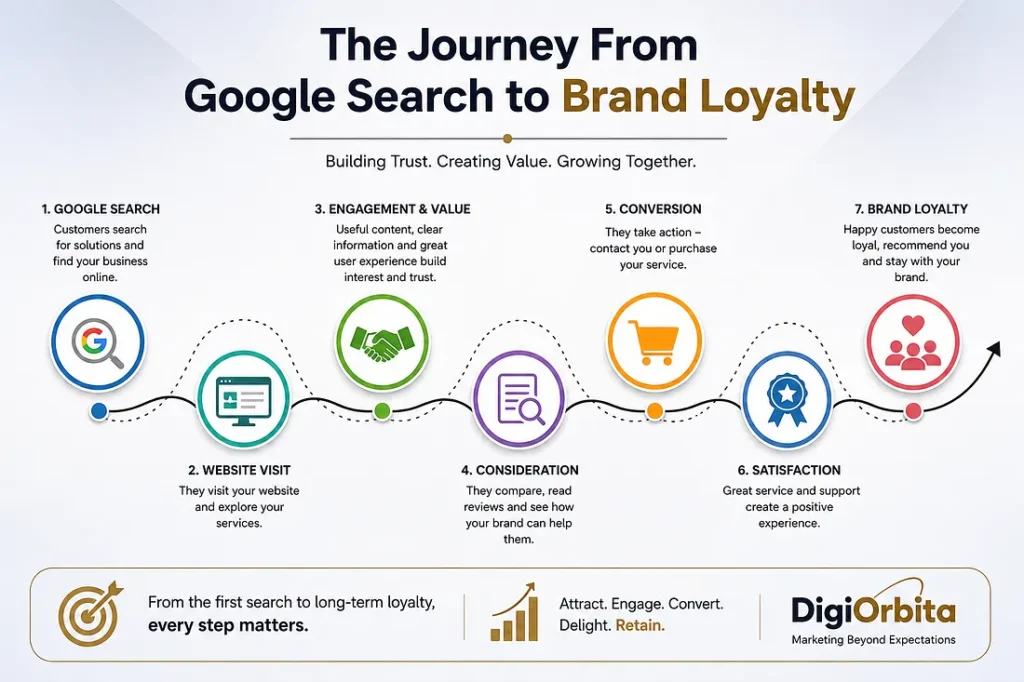
In today’s digital world, the relationship between a customer and a brand can begin with a simple Google search. A person may search for a product, service, solution, or answer to a question. From there, they may visit a website, read an article, compare different businesses, check reviews, and eventually make a purchase.
Influencing customer to make their first purchase is only one part of the journey. The bigger challenge for businesses is turning that first interaction into trust, repeat purchases, and long-term brand loyalty.
This is where digital marketing becomes more than just advertising. SEO, content marketing, Google Ads, social media, website design, and customer experience all play a role in moving a person from being a searcher to becoming a loyal customer.
1. The Journey Begins With Google Search
A customer usually starts searching because they have a need or a problem.
For example, a business owner might search for “best digital marketing agency,” while another person may search for “SEO services for small business.” At this stage, the customer may not know which company they want to choose. They are exploring their options.
This is where Search Engine Optimization (SEO) becomes important. SEO helps businesses improve their online visibility so that their website and content can appear when potential customers search for relevant terms.
But appearing on Google is only the beginning. A search result can generate attention, but it cannot automatically create trust. Businesses need to provide something valuable after the customer clicks.
2. The Website Creates the First Impression
After finding a business on Google, many users visit its website. This is often the first direct interaction between the customer and the brand.
Visitors quickly evaluate the website based on its design, content, speed, navigation, and overall professionalism. They may also look for services, pricing, testimonials, reviews, contact details, and information about the company.
A website that clearly explains what a business offers can encourage visitors to continue exploring. On the other hand, a confusing website with outdated information or difficult navigation can cause potential customers to leave.
3. Content Turns Visitors Into Informed Customers
Not everyone who visits a website is ready to buy immediately. Some people are still researching and comparing their options.This is where content marketing becomes valuable.
Businesses can create blogs, guides, videos, case studies, FAQs, and other educational resources to answer customer questions. For example, a digital marketing agency can publish content about SEO, PPC advertising, social media marketing, content marketing, and website development.
When customers repeatedly find useful information from the same business, they may begin to see a Best Digital Marketing Agency as a reliable source of information. This gradually builds credibility and trust.
4. Multiple Interactions Build Brand Familiarity
Customers rarely become loyal after seeing a brand only once.A potential customer might discover a company through Google today, see its social media post tomorrow, read one of its articles next week, and later notice one of its advertisements.
These interactions create familiarity.
The customer journey may look like this:
Google Search → Website → Content → Social Media → Advertisement → Review → Purchase
This is why businesses should maintain consistency across different digital channels. The message, visual identity, quality, and overall experience should feel connected wherever customers encounter the brand.
5. Google Ads Can Bring High-Intent Customers
SEO can help businesses gain organic visibility, but Google Ads can provide another route to potential customers.
When someone searches for a specific service, they may already have an intention to take action. For example, a person searching for “Google Ads agency” may be actively looking for a company that provides that service.
A properly planned PPC campaign can place a business in front of relevant searchers at the right moment.
However, successful advertising does not end with getting a click. The advertisement should lead to a relevant landing page that clearly communicates the offer and makes it easy for the visitor to take the next step.
6. Social Media Keeps the Brand Connected
Search engines are often where customers discover solutions, while social media can help businesses maintain visibility and relationships.
Through platforms such as Instagram, Facebook, and LinkedIn, brands can share educational information, industry insights, customer stories, company updates, and useful tips.
7. Customer Experience Influences Loyalty
Imagine that a customer finds a business through Google, likes its website, and decides to purchase its service. If the actual experience is poor, the customer is unlikely to become loyal.
Brand loyalty is strongly influenced by what happens after the sale.
Customers remember whether a company communicated clearly, delivered what it promised, responded to questions, and handled problems professionally.
A successful customer journey therefore continues beyond the first conversion.
Good Marketing + Good Product or Service + Good Customer Experience = Stronger Customer Relationships.
8. Reviews Strengthen Trust
Before making a purchase, many customers look for reviews and testimonials.
Reviews provide social proof because they show potential customers what other people experienced with a business.
Satisfied customers can also become brand advocates. They may leave reviews, recommend the business to friends, share its content, or return for additional services.
This creates a valuable cycle:
Positive Experience → Positive Review → Increased Trust → New Customer → Positive Experience
Businesses should therefore treat customer satisfaction asan important part of their marketing strategy.
9. Personalization Makes Customers Feel Valued
Modern customers expect businesses to understand their interests and needs. Digital marketing allows businesses to provide more relevant experiences through personalized content, email campaigns, recommendations, offers, and advertisements.
For example, a visitor who previously read about SEO services may be more interested in receiving information about SEO than an unrelated service.
Personalization does not mean sending customers endless promotional messages. It means providing information that is useful to them at the right stage of their journey.
10. Data Helps Businesses Improve the Customer Journey
Digital marketing provides businesses with valuable data about customer behavior.
Businesses can analyze where website visitors come from, which pages they visit, which content receives attention, which advertisements generate leads, and where potential customers leave the website.This information can reveal problems in the customer journey.
For example, if a website receives significant traffic but generates very few inquiries, simply increasing traffic may not solve the problem. The business may need to improve its landing page, content, call-to-action, or trust signals.
Data allows businesses to identify these opportunities and continuously improve their strategy.
11. Turning a Customer Into a Brand Advocate
The final stage of the journey is when customers become advocates for a brand.
A loyal customer does more than purchase repeatedly. They may actively recommend the business to others.
This is one of the most valuable outcomes of digital marketing because recommendations can bring new customers while strengthening the existing relationship.
A simple Google search can therefore start a much bigger cycle:
Search → Discovery → Engagement → Trust → Purchase → Experience → Loyalty → Recommendation
The journey does not end with a sale. It continues through every interaction the customer has with the brand.
Conclusion
The journey from Google search to brand loyalty is a gradual process built through multiple digital experiences. SEO may help a customer discover a business, content can educate them, Google Ads can capture high-intent searches, social media can maintain engagement, and a strong website can support conversions.
Businesses should therefore look beyond rankings, clicks, and impressions. The ultimate goal of digital marketing is not simply to attract visitors but to create meaningful connections that encourage customers to return.“Businesses looking to strengthen this journey can explore professional Digital Marketing Services to improve visibility, engagement, and customer relationships.”
In a competitive digital marketplace, being found is important — but being remembered and trusted is what creates loyalty.