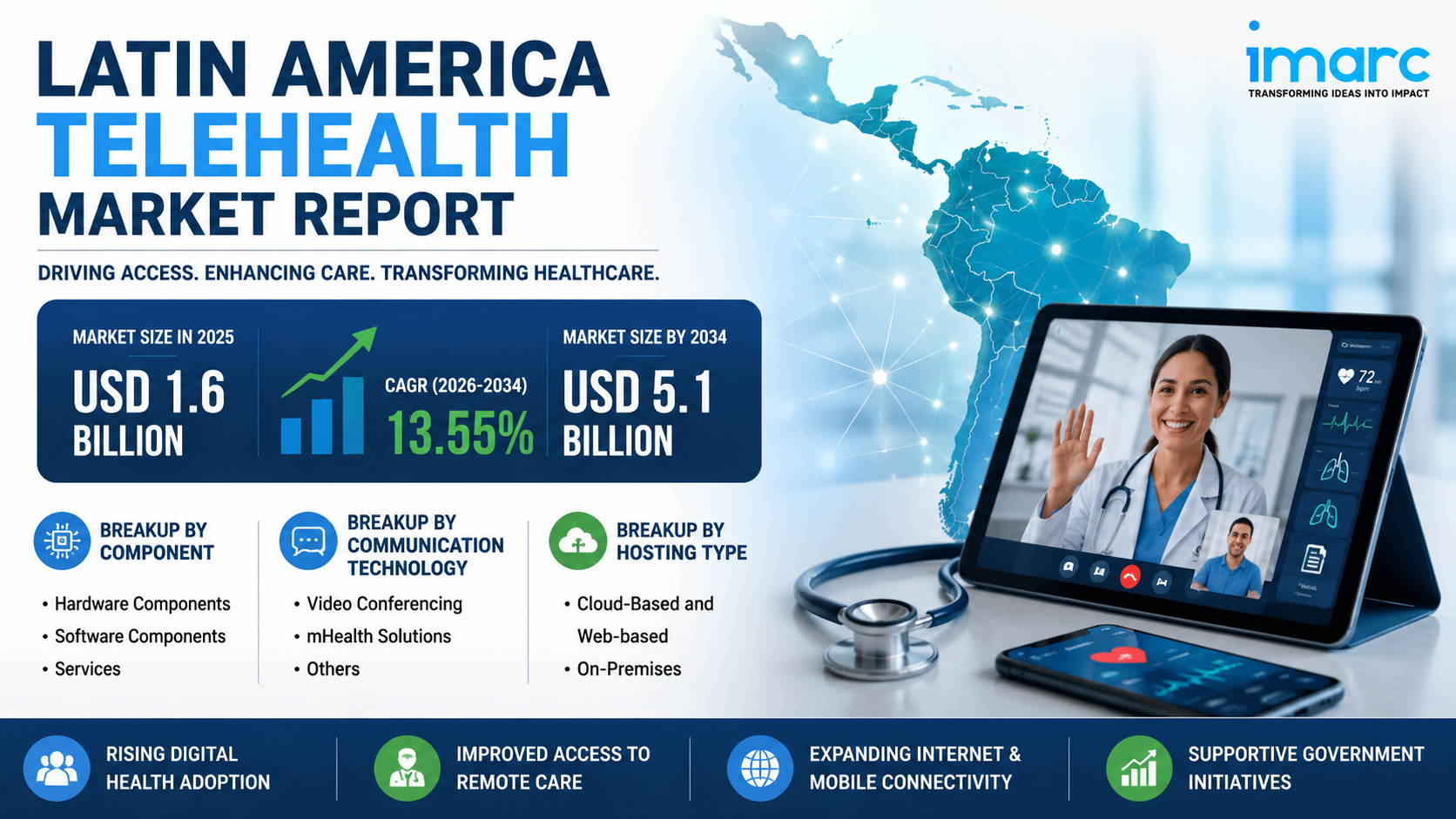
The Latin America telehealth market refers to the sector of the healthcare industry dedicated to the remote delivery of medical services, clinical information, and health education using modern telecommunications and digital technologies. By leveraging video conferencing, mobile health (mHealth) applications, and remote patient monitoring (RPM), telehealth enables healthcare professionals to provide consultations, track real-time patient statistics, and manage chronic conditions without the need for physical proximity. As of 2025, the market reached a valuation of USD 1.6 Billion and is projected to experience explosive growth, reaching USD 5.1 Billion by 2034. With a remarkable CAGR of 13.55%, this industry is fundamentally reshaping patient care across the region.
What Is Driving the Rapid Expansion of the Latin America Telehealth Market for Healthcare Providers?
For healthcare professionals and hospital administrators, the Latin America telehealth market is growing primarily due to the need for efficient resource management and the rising prevalence of chronic diseases.
- Chronic Disease Management: The high prevalence of ailments such as cardiovascular diseases, cancer, and arthritis requires continual medical supervision. Telehealth allows providers to monitor these patients remotely, reducing the burden on physical facilities.
- Technological Integration: The integration of innovative technologies like AI, predictive analytics, and Picture Archiving and Communication Systems (PACS) is enhancing diagnostic accuracy and streamlining workflows for clinicians.
- Post-Pandemic Shift: The COVID-19 pandemic acted as a catalyst, normalizing remote consultations and proving that telehealth can effectively mitigate infection risks while maintaining high standards of care.
- Medical Education: Providers are increasingly using telehealth platforms for tele-mentoring and medical training, ensuring that specialized knowledge can be shared across borders effortlessly.
How Are Regulatory Support and Government Initiatives Influencing Market Growth for Policy Makers?
For government bodies and regulatory authorities, the Latin America telehealth market is a strategic tool for achieving equitable healthcare access and modernizing national health systems.
- Brazil’s Legislative Framework: Brazil leads the region with strong regulatory support, specifically through Law No. 14,510/2022, which provides a clear legal structure for the expansion of remote medical services.
- Addressing Rural Disparities: Governments in countries like Mexico are focusing on telehealth to solve rural healthcare challenges, ensuring that underserved populations can connect with specialists in urban hubs.
- Public Health Promotion: Various health initiatives are being introduced across the region to promote the adoption of digital solutions, aiming to reduce the overall cost of public healthcare while improving patient outcomes.
- Innovation Hubs: Countries like Brazil, Argentina, Chile, and Colombia are implementing AI-driven strategies focused on oncology and pathology, positioning the region as a leader in digital health research.
Why Are mHealth Solutions Becoming Essential for Tech-Savvy Patients and Rural Communities?
For the end-user – the patient – the rise of mHealth (mobile health) within the Latin America telehealth market offers unprecedented convenience and personalized care.
- Personalized Monitoring: Through mobile apps and smart wearable devices, patients can track vital signs and physical activity in real-time, receiving immediate feedback from their doctors.
- Accessibility in Remote Areas: For those living in rural locations with limited access to specialists, mHealth acts as a lifeline, bridging the gap between home and hospital.
- User Engagement: Mobile platforms increase patient participation in their own care, leading to better adherence to treatment plans and more timely medical interventions.
- Digital Prescriptions: The rise of telemedication services allows patients to receive digital prescriptions after a virtual consultation, enhancing the overall efficiency of the recovery process.
What Role Does Hosting Type and Communication Technology Play for IT Decision Makers?
For IT specialists and healthcare payers, the technical infrastructure of the Latin America telehealth market determines the scalability and security of digital health services.
- Cloud-Based vs. On-Premises: The market is segmented into cloud-based and web-based hosting, which offer greater flexibility and lower upfront costs, versus on-premises solutions that provide high-level data control for large institutions.
- Communication Modes: Video conferencing remains a cornerstone for teleconsultations, while mHealth solutions are gaining ground for long-term monitoring and data collection.
- AI and Digital Healthcare Ventures: Strategic partnerships, such as the joint venture between SK Biopharmaceuticals and Eurofarma, are focusing on AI-driven platforms to predict seizures and manage complex conditions like epilepsy via real-time detection.
- Logistics Innovation: In 2025, pilot programs involving drone delivery systems in Guyana demonstrated the potential to deliver critical medical supplies to remote communities, perfectly complementing telehealth consultations.
Sample Request For Your Business
Which Countries Are Dominating the Telehealth Landscape Across Latin America?
The Latin America telehealth market is geographically diverse, with several key nations driving the regional CAGR of 13.55%.
- Brazil: Currently the largest market share holder, Brazil’s success is built on a combination of massive population needs and proactive AI research strategies.
- Mexico: Focusing heavily on bridging the rural-urban divide, Mexico is a major adopter of teleradiology and telecardiology services.
- Argentina and Chile: These nations are at the forefront of implementing AI initiatives in oncology and pathology to improve diagnostic speed and accuracy.
- Colombia and Peru: Both countries are rapidly expanding their virtual healthcare services to reduce the burden on traditional hospital infrastructures and improve system-wide efficiency.
How Are Specialized Applications Like Teleradiology and Tele-Psychiatry Reshaping the Industry?
The Latin America telehealth market is not a monolith; it is comprised of various specialized applications that cater to specific medical needs.
- Teleradiology and Telecardiology: These allow for the remote interpretation of medical images and heart data, ensuring that patients receive expert opinions regardless of their physical location.
- Tele-Psychiatry and Tele-Dermatology: These sectors have seen significant growth as they are highly suited for virtual formats, providing privacy and convenience for mental health and skin consultations.
- Tele-ICU: By allowing intensive care specialists to monitor multiple critically ill patients from a central command center, Tele-ICU services are helping hospitals manage resource shortages and improve survival rates.
Conclusion:
The Latin America telehealth market is on an unstoppable path toward becoming the primary model for healthcare delivery in the region. With a projected value of USD 5.1 Billion by 2034, the market is fueled by technological breakthroughs in AI, strong regulatory support in Brazil, and an increasing demand for accessible care in rural Mexico. As mHealth solutions and virtual services continue to bridge health disparities, Latin America is setting a global example for how digital innovation can create a more equitable and efficient healthcare ecosystem.