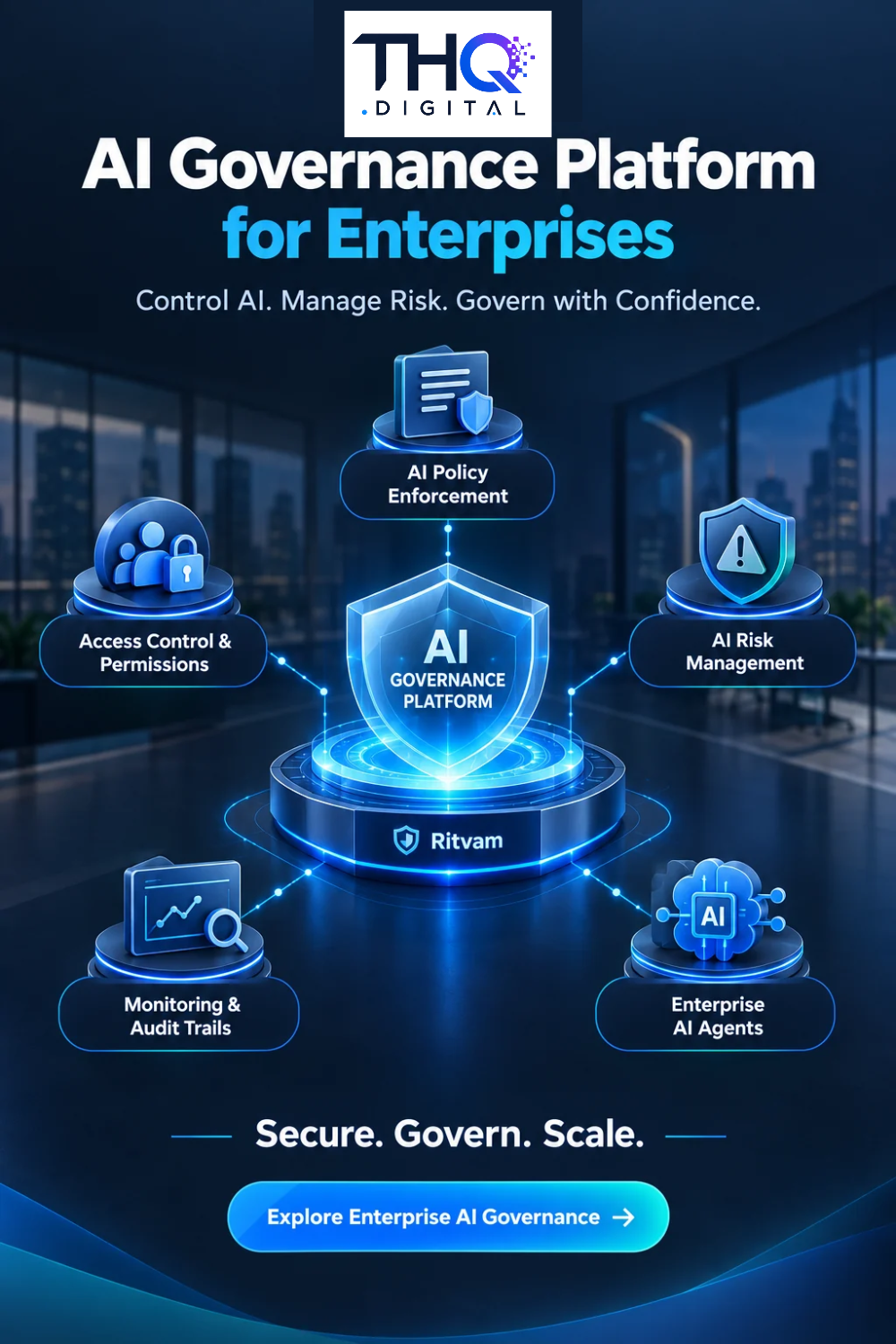
As organisations expand their use of generative AI, private large language models (LLMs), and autonomous AI agents, enterprise AI governance is becoming essential for maintaining security, accountability, and operational control. A strong governance framework helps businesses define how AI systems access data, make decisions, interact with applications, and operate within organisational policies.
In 2027, effective governance will require more than establishing internal AI guidelines. Enterprises will need secure AI infrastructure, continuous monitoring, runtime policy enforcement, and clearly defined human oversight. These capabilities are particularly important in regulated and data-sensitive sectors such as banking, non-banking financial companies (NBFCs), and aviation, where uncontrolled AI activity can introduce operational, security, and compliance risks.
1. Establish Clear AI Governance Policies
The foundation of enterprise AI governance is a documented set of policies that defines how AI technologies can be developed, deployed, and used. Organisations should establish clear responsibilities for AI developers, system administrators, business teams, security professionals, and senior management.
Policies should cover acceptable AI usage, data handling, model deployment, risk classification, and accountability. For example, a bank using AI to assist with customer support should define which customer information the system can access and which decisions require human approval.
A governance policy should also identify who is responsible for reviewing AI-related incidents and approving changes to production systems.
2. Strengthen Data Security and Privacy
AI systems often process sensitive information, including financial records, customer details, internal documents, and business communications. Protecting this information is therefore a central part of enterprise AI governance.
Organisations should implement data encryption, secure storage, access restrictions, and appropriate data-retention policies. They should also understand where information is processed, whether it is shared with external model providers, and how it is used during AI interactions.
Private LLMs can provide greater control over deployment environments and data handling, but private deployment alone does not guarantee security. Enterprises must still establish safeguards against unauthorised access, data leakage, prompt injection, and inappropriate information retrieval.
3. Build Secure and Scalable AI Infrastructure
Reliable AI infrastructure provides the technical foundation for governed enterprise AI adoption. It includes computing resources, model hosting, data pipelines, networking, storage, deployment environments, and monitoring capabilities.
Organisations should design infrastructure around their security requirements, workloads, and operational needs. This may involve private cloud environments, on-premises deployments, or hybrid architectures.
For example, an NBFC deploying an internal AI assistant may need controlled access to loan documentation, customer records, and internal policies. Its infrastructure should separate sensitive data, authenticate users, and ensure that AI applications access only approved information.
A well-managed infrastructure also supports scalability without losing visibility into models, agents, and connected systems.
4. Implement Strong Identity and Access Controls
AI models and agents should not receive unrestricted access to enterprise systems. Each user, application, model, and agent should have permissions appropriate to its assigned responsibilities.
Role-based access control (RBAC), identity management, multi-factor authentication, and least-privilege principles can help organisations reduce unnecessary access.
For example, an AI agent designed to retrieve flight information should not automatically receive permission to modify passenger bookings or access unrelated financial systems.
Enterprises should also review permissions regularly, revoke unused credentials, and maintain clear records of which identities can access specific resources.
5. Enforce AI Policies at Runtime
Governance should continue after an AI system is deployed. Runtime policy enforcement ensures that models and agents follow organisational rules while processing requests and performing actions.
For example, an AI agent in a financial organisation might be allowed to retrieve customer information but should require authorisation before updating account records or initiating transactions. Controls should validate requests, restrict tool usage, and block actions that exceed an agent’s permissions.
Organisations should also prepare for threats such as prompt injection, sensitive information disclosure, and excessive agent autonomy. The OWASP GenAI Security Project’s 2026 guidance identifies these as important risks in LLM applications.
6. Improve AI Observability and Monitoring
AI observability gives organisations visibility into how systems behave in real operating environments. Traditional infrastructure monitoring may show whether a service is available, but enterprise AI governance also requires insight into model interactions, agent actions, data retrieval, and decision workflows.
Organisations should monitor response quality, latency, usage patterns, tool calls, unusual access attempts, and policy violations. Logs should capture enough context to investigate incidents without unnecessarily storing sensitive information.
In aviation, for instance, an AI assistant supporting operational teams should be monitored to identify inaccurate outputs, unexpected system interactions, or attempts to access restricted operational data. Monitoring should include clear alert thresholds and escalation procedures.
7. Maintain Audit Trails and Accountability
Every significant AI activity should be traceable. Audit records can help organisations understand which user initiated a request, which model or agent processed it, what tools or data sources were accessed, and whether a human approved the resulting action.
Enterprises should maintain version histories for models, prompts, policies, and system configurations. These records are useful when investigating incidents, reviewing decisions, or demonstrating how internal governance controls operate.
Accountability must also be clearly assigned. AI systems may support decisions, but organisations should identify the people or teams responsible for approving, supervising, and reviewing their use.
8. Introduce Meaningful Human Oversight
Not every AI-generated recommendation needs human approval. However, decisions involving financial transactions, customer eligibility, safety, or critical business operations may require additional review.
Enterprises should classify AI actions by risk and define when human intervention is necessary. Low-risk tasks may be automated within approved limits, while high-impact actions should include approval workflows, escalation paths, and the ability to stop or reverse an operation.
Human oversight should be practical rather than symbolic. Reviewers need sufficient context, authority, and time to challenge an AI recommendation instead of simply approving it.
9. Test AI Systems Before and After Deployment
AI governance requires continuous testing because model behaviour, connected data, prompts, and application integrations can change over time.
Before deployment, organisations should conduct security assessments, access-control tests, model evaluations, and adversarial testing. Testing should examine risks such as prompt injection, data exposure, unreliable outputs, and unauthorised tool use.
After deployment, teams should repeat relevant tests when models, datasets, prompts, or integrations change. The OWASP GenAI Security Project’s 2026 Top 10 can help security teams identify key LLM application risks to include in their testing plans.
10. Review and Improve the Governance Framework
Enterprise AI governance should be treated as an ongoing management process, not a one-time compliance exercise. Organisations should regularly review their AI inventory, risk assessments, access permissions, security controls, incidents, and performance indicators.
Recognised frameworks can provide useful structure. The NIST AI Risk Management Framework offers guidance for managing AI-related risks, while ISO/IEC 42001 specifies requirements for establishing, maintaining, and continually improving an AI management system. These frameworks can help organisations organise governance activities around their business needs.
Review cycles should also account for new AI capabilities, changing business requirements, supplier risks, and applicable regulatory obligations.
Conclusion
Effective enterprise AI governance in 2027 will depend on aligning organisational policies with technical controls and continuous oversight. Secure AI infrastructure, strong identity management, runtime policy enforcement, AI observability, and meaningful human supervision help enterprises manage risks as AI systems become more integrated into business operations.
The objective is not to restrict innovation but to make AI adoption controlled, accountable, and sustainable. Organisations that build governance into the full AI lifecycle will be better positioned to use generative AI, private LLMs, and autonomous agents while maintaining security, visibility, and trust.
Frequently Asked Questions
Q1. What is enterprise AI governance?
Enterprise AI governance is the framework of policies, processes, responsibilities, and technical controls that helps organisations manage AI systems securely, ethically, and accountably throughout their lifecycle.
Q2. Why is AI infrastructure important for enterprise AI governance?
AI infrastructure provides the computing, data, networking, deployment, and monitoring foundations needed to operate AI systems securely. Well-managed infrastructure helps enforce access controls, protect sensitive information, and maintain operational visibility.
Q3. Which frameworks can organisations use for AI governance?
Organisations can refer to the NIST AI Risk Management Framework and ISO/IEC 42001 to structure AI risk management, establish governance responsibilities, and support continual improvement. The right approach depends on the organisation’s AI use cases, risks, and applicable obligations.