
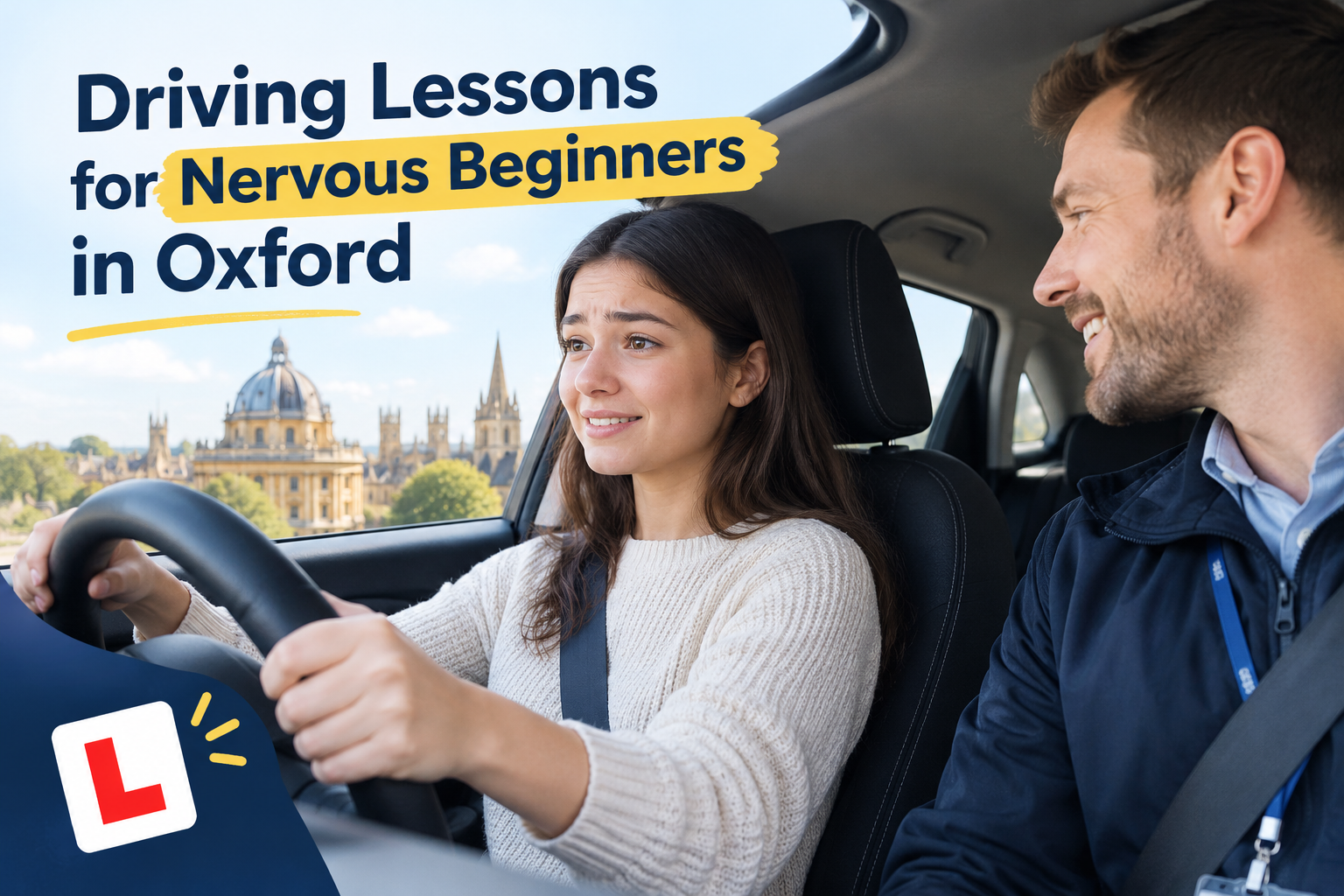
Learning to drive is exciting, but for some beginners, the first lesson can feel more stressful than exciting. Sitting behind the wheel for the first time, dealing with traffic and trying to remember everything an instructor says can quickly become overwhelming.
If you are nervous about learning to drive in Oxford, you are not alone. Driving requires you to manage several things at once, and confidence usually develops gradually through practice rather than appearing after one or two lessons.
The good news is that you do not need to be a naturally confident driver to learn successfully. With the right instructor, a calm learning environment and regular practice, nervous beginners can build their skills step by step.
If you are looking for a Driving School in Oxford, it is worth choosing an instructor who understands that different learners progress at different speeds and can adapt lessons around your confidence level.
Why Are Some Beginners Nervous About Driving?
Driving anxiety can come from several different sources.
Some learners worry about making mistakes in front of an instructor. Others are uncomfortable with busy roads, roundabouts, junctions or driving near cyclists and pedestrians.
Common worries include:
- Stalling the car
- Making a mistake at a junction
- Driving in busy traffic
- Getting confused at roundabouts
- Being watched or judged by other drivers
- Forgetting what the instructor has explained
- Losing control of the car
- Failing the driving test
These concerns are understandable, particularly when everything is unfamiliar.
The important thing is not to expect yourself to feel completely confident before you start. Confidence generally comes from becoming familiar with the skills and situations that initially make you nervous.
What Should Nervous Beginners Look for in a Driving School in Oxford?
Choosing an instructor is particularly important if you already feel anxious about driving.
The Driver and Vehicle Standards Agency (DVSA) recommends looking for an instructor who is reliable, adapts their teaching to the learner and focuses on developing safe driving skills rather than simply getting someone through the test.
For a nervous beginner, consider asking a potential instructor:
Do they adapt lessons to your pace?
You may need more time with basic controls before moving into busier traffic. A good lesson should challenge you without putting you unnecessarily outside your comfort zone.
Are they patient and clear?
When you are nervous, it can be difficult to process lots of instructions at once. Clear explanations and calm feedback can make a significant difference.
Do they track your progress?
Knowing what you have already learned can make driving feel less overwhelming. Instead of thinking about everything you still need to learn, you can focus on the next skill.
Are they focused on safe driving?
Passing the test is important, but becoming a safe and independent driver is the bigger goal. DVSA’s current learning guidance covers 27 driving skills, including vehicle control, observation, junctions, roundabouts, manoeuvres, different road types and independent driving.
How Your First Driving Lessons May Work
Your first lesson does not need to involve busy Oxford roads immediately.
A good instructor can begin with the basics and gradually introduce more demanding situations as your confidence develops.
Early lessons may cover:
- Adjusting your seat and mirrors
- Understanding the car’s controls
- Moving away and stopping safely
- Steering and road positioning
- Using mirrors
- Signalling
- Observation
- Simple junctions
- Basic speed control
Once these skills become more familiar, you can progress towards busier roads, roundabouts, parking and more complex traffic situations.
This gradual approach can make a big difference to a nervous learner because you are not expected to master everything at once.
Building Confidence on Oxford Roads
Oxford provides a mixture of driving environments, which means learners can gradually experience different situations as their skills improve.
Depending on where you live and where your lessons take place, you may eventually practise:
- Residential streets
- Busier urban roads
- Multi-lane roads
- Junctions and traffic lights
- Roundabouts
- One-way systems
- Dual carriageways
- Rural roads outside the city
- Independent driving
The aim should not be to memorise a particular test route. DVSA does not publish official driving test routes, and instructors instead use roads that provide similar types of situations for practice.
This is useful for nervous beginners because it encourages you to learn how to deal with situations rather than simply remembering where to turn.
What If You Make Mistakes During a Lesson?
Making mistakes is part of learning.
You might stall, choose the wrong lane, forget a mirror check or hesitate at a junction. That does not mean you are bad at driving.
Your instructor can use mistakes as opportunities to identify what needs more practice.
For example, if roundabouts make you nervous, several lessons might include repeated practice until you become more comfortable with:
- Reading road signs and markings
- Choosing the correct lane
- Checking mirrors
- Approaching at an appropriate speed
- Giving way
- Moving into the correct exit
- Checking mirrors and signalling when necessary
Breaking a difficult situation into smaller steps can make it much easier to understand.
How to Manage Driving Test Nerves
Nerves do not necessarily disappear just because your driving improves.
The DVSA’s Ready to Pass guidance specifically recognises driving test nerves as a normal reaction. Its advice includes planning ahead, getting enough sleep, avoiding excessive caffeine and discussing ways to manage nerves with your instructor.
It also recommends taking the test when you are properly prepared rather than rushing simply because you have booked a date.
A useful way to prepare is to practise under conditions that are similar to the real test.
Take mock driving tests
Mock tests can help you become familiar with the structure and pressure of the real assessment.
A proper mock test can include general driving, reversing, independent driving, vehicle safety questions and different types of roads.
The more familiar the process becomes, the less mysterious test day may feel.
You Do Not Need to Be Perfect to Pass
One common fear among nervous learners is that making one mistake automatically means failing.
That is not how the practical test works.
The current car driving test includes an eyesight check, two vehicle safety questions, general driving ability including independent driving, and a reversing exercise. The driving section lasts around 35 minutes.
If you make a mistake, you should continue concentrating on the road rather than assuming the test is over. DVSA guidance explains that a mistake does not necessarily affect the result if it is not serious.
This is an important mindset for nervous learners: one mistake does not mean you should give up on the rest of the drive.
Independent Driving Can Feel Difficult at First
Independent driving is another part of the test that can worry beginners.
During the car driving test, you may need to follow a sat nav, traffic signs or a combination of both for around 20 to 35 minutes.
At first, managing the route while also watching traffic may feel difficult.
That is why it should be introduced during lessons rather than left until the final few sessions.
Your instructor can gradually help you become comfortable with:
- Following sat nav instructions
- Reading road signs
- Planning ahead
- Choosing lanes
- Staying aware of other road users
- Recovering calmly if you miss a direction
Importantly, taking a wrong turn does not automatically mean you have failed. The examiner can help you get back on route.
Private Practice Can Help Build Confidence
If you have access to a suitable supervising driver and an appropriate insured vehicle, private practice can complement professional lessons.
However, it should support what your instructor is teaching rather than introduce conflicting habits.
DVSA recommends starting with professional driving lessons and then adding private practice when your instructor believes you are ready.
For a nervous learner, short and manageable practice sessions can be more useful than trying to drive for a long period while feeling overwhelmed.
You might start with familiar roads and gradually introduce more challenging situations.
How Long Will It Take to Feel Confident?
There is no fixed number of lessons that guarantees confidence or test readiness.
Different learners progress at different speeds.
One learner might become comfortable with junctions quickly but need more time with roundabouts. Another might be confident in traffic but struggle with manoeuvres.
Rather than counting lessons alone, look at what you can actually do independently.
The DVSA’s current progress guidance uses different levels of development for driving skills, moving from being introduced to a skill, through receiving help and prompts, towards performing it independently.
That is a much more useful way to judge progress than asking, “How many lessons should I have had by now?”
When Are You Ready for the Driving Test?
Nervous learners sometimes book a test because they feel they need a deadline.
However, booking too early can create unnecessary pressure.
According to the DVSA’s Ready to Pass guidance, you will usually be ready when:
- You no longer need prompts from your instructor
- You are not making serious or dangerous mistakes
- You can complete mock driving tests successfully
- You have practised managing your nerves
- Your instructor agrees that you are ready
If you are not ready, taking additional lessons is not a failure. It simply means you need more time to develop the skills and confidence required for independent driving.
What Makes a Good Driving Lesson for a Nervous Beginner?
The best lesson is not necessarily the one where you learn the most new things.
For a nervous beginner, a productive lesson may involve repeating a skill until it becomes more comfortable.
A good lesson might look like:
Warm-up → Previous skill → New skill → Guided practice → Independent practice → Feedback
For example, an instructor might begin with familiar roads, then introduce a new type of junction and gradually reduce the amount of help they provide.
This gives you an opportunity to experience success while still learning something new.
Choosing the Right Driving School in Oxford
If you are searching for a Driving School in Oxford, do not choose solely on price or availability.
Consider the teaching approach as well.
Look for an instructor who:
- Has the appropriate DVSA registration
- Has experience teaching nervous learners
- Explains things clearly
- Gives constructive feedback
- Adjusts the pace of lessons
- Helps you understand why something is done
- Tracks your progress
- Prepares you for independent driving, not just the test
You can also ask whether the instructor teaches manual or automatic lessons, what areas of Oxford they cover and how they structure lessons for complete beginners.
The DVSA advises learners to check whether an instructor is fully qualified or a trainee. A green badge indicates a fully qualified Approved Driving Instructor, while a pink badge indicates a trainee instructor.
Frequently Asked Questions
Are driving lessons in Oxford suitable for very nervous beginners?
Yes. Nervousness is common among new learners, and lessons can be structured progressively so that you develop skills before moving into more challenging traffic situations.
What if I am too nervous to drive on busy roads?
Tell your instructor. They can work with you on quieter roads first and gradually introduce busier environments as your control and observation improve.
Can I change instructors if I do not feel comfortable?
Yes. Your relationship with your instructor matters. If the teaching style is increasing your anxiety rather than helping you learn, it may be worth discussing your concerns or finding an instructor whose approach suits you better.
How can I prepare for my driving test if I get very nervous?
Practise under test-like conditions, complete mock tests and discuss your nerves with your instructor. Getting enough sleep and avoiding excessive caffeine before the test can also help.
Should I book my test as soon as possible?
Not necessarily. Current DVSA guidance recommends booking when you are ready and your instructor agrees that you are ready to drive independently.
Does making a mistake during the driving test mean I have failed?
No. A mistake does not automatically mean failure. Continue driving safely and follow the examiner’s instructions.
Final Thoughts
Being nervous about driving does not mean you will become a poor driver. For many beginners, confidence develops as unfamiliar situations become familiar.
The key is to learn progressively, practise consistently and work with an instructor who understands your individual pace.
If you are looking for a Driving School in Oxford, focus on finding an instructor who can help you become a safe, independent and confident driver—not simply someone who can get you through the test.
With the right support, even a very nervous beginner can move from feeling uncomfortable behind the wheel to driving independently with confidence.
Sources
This article is based on current guidance and information from the Driver and Vehicle Standards Agency (DVSA), including its Ready to Pass campaign, driving test guidance and learner-driver resources.