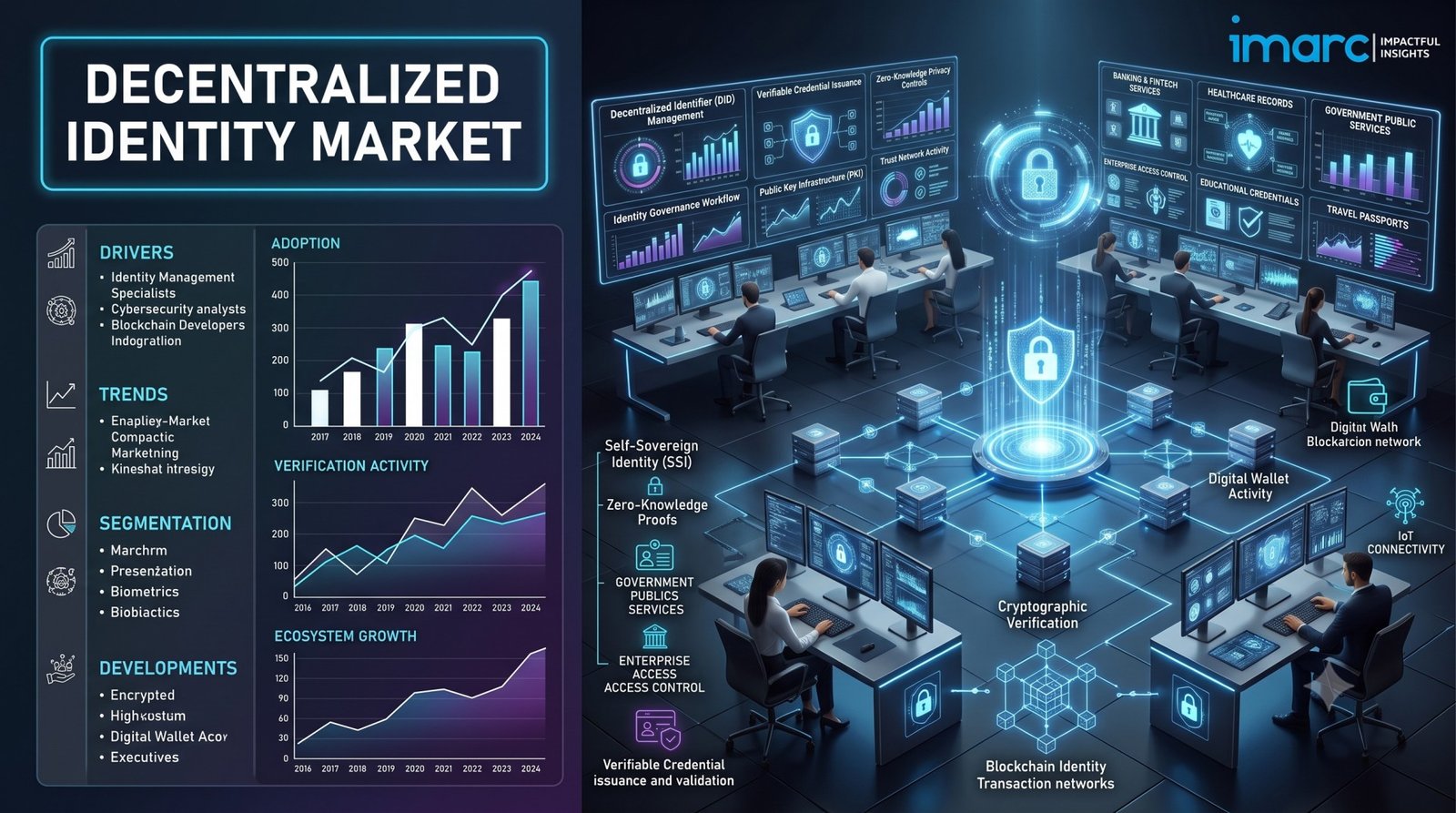
IMARC Group, a leading global market research and management consulting firm, has published its latest market intelligence report on the decentralized identity market. The global decentralized identity market size was valued at USD 1,870.2 Million in 2025. Looking forward, IMARC Group estimates the market to reach USD 1,26,449.8 Million by 2034, exhibiting a CAGR of 59.71% from 2026-2034, driven by rising concerns over personal data ownership, growing adoption of blockchain based identity across industrial applications, rapid digitalization of government services, and mounting regulatory pressure from data protection laws worldwide.
The market is on an explosive growth trajectory as centralized identity databases, long a preferred target for breaches, give way to self-sovereign models that put individuals in control of their own credentials. Biometric verification methods now anchor most decentralized identity deployments, prized for the difficulty of replication and the seamless user experience they offer across finance, healthcare and government services. Large enterprises remain the primary adopters, drawn by the promise of faster onboarding, reduced fraud and easier compliance with regulations such as GDPR, while BFSI institutions lead sector adoption given their acute exposure to identity theft and know your customer obligations.
Decentralized Identity Market at a Glance
- Market Size 2025: USD 1,870.2 Million
- Forecast Size 2034: USD 1,26,449.8 Million
- Growth Rate 2026-2034: CAGR of 59.71%
- Leading Type: Biometric, around 64.0% share in 2025
- Leading Enterprise Size: Large Enterprises, around 65.2% share in 2025
- Leading Vertical: BFSI, around 19.3% share in 2025
- Dominant Region: North America, with 35.0% market share in 2025
How AI Is Reshaping the Future of the Decentralized Identity Market
- AI Agents Now Get Their Own Verifiable Identity: Microsoft Entra Agent ID reached general availability in April 2026, giving individual AI agents dedicated, policy controlled identities distinct from human and application accounts, an approach Microsoft says is needed after its own Identiverse 2026 roundtable found unmanaged agent sprawl present in 9 out of 10 organizations.
- Biometric and Verifiable Credentials Combined to Beat Deepfakes: In March 2026, IDEMIA Public Security and Indicio announced a strategic partnership combining biometric identity proofing with decentralized verifiable credentials, purpose built to defend financial institutions against AI generated deepfake and synthetic identity fraud.
- Verifiable Credentials as the Answer to AI Generated Forgery: As generative AI makes it possible to fabricate convincing fake diplomas, certificates and identity documents in minutes, organizations are shifting toward cryptographically signed, tamper evident credentials that remain mathematically verifiable regardless of how convincing an AI forged document appears.
Grab a sample PDF of this report: https://www.imarcgroup.com/decentralized-identity-market/requestsample
Decentralized Identity Market Trends and Drivers
Rising concern over data privacy and personal ownership of information is the foundational driver of decentralized identity adoption. More than 60% of large businesses are expected to be using at least one Privacy Enhancing Technology solution by the end of 2025, and the total global cost of financial crime compliance has reached USD 275.13 Billion annually, underscoring the pressure organizations face to replace breach prone centralized identity stores with user controlled alternatives.
A structural driver reshaping the market at the government level is the sheer scale of digital identity mandates now moving from policy to deployment. The European Parliament has projected that 80% of EU citizens will use a digital ID by 2030 as part of the bloc’s Path to the Digital Decade strategy, a target that is pulling banks, healthcare systems and public agencies across Europe toward interoperable, verifiable credential infrastructure well ahead of that deadline.
A third driver, and one that sets up the regulatory and policy landscape detailed further below, is the parallel wave of national digital identity programs now underway outside Europe. From India’s next generation Aadhaar roadmap to the United States’ mobile driver’s license rollout to the Gulf’s blockchain backed national identity platforms, governments worldwide are racing to modernize identity infrastructure, creating sustained demand for decentralized identity technology across both public and private sectors.
Ask an analyst for customized report: https://www.imarcgroup.com/request?type=report&id=7111&flag=E
Global Regulatory and Standards Landscape Shaping Demand
- EU Digital Identity Wallet Mandate Approaching Its Hard Deadline: Under eIDAS 2.0, all 27 EU member states must provide at least one certified European Digital Identity Wallet to citizens and businesses by December 2026, with regulated private sector organizations required to accept it for authentication by 2027.
- Data Protection Laws Pushing User Centric Identity Models: GDPR and comparable data protection regimes worldwide continue to make self-sovereign, user consent driven identity architectures a compliance advantage rather than a technical curiosity, particularly for cross-border service providers.
- W3C Verifiable Credentials Becoming the De Facto Technical Standard: Enterprise identity platforms are converging around W3C Verifiable Credentials and Decentralized Identifiers, with interoperability frameworks including EBSI, Sovrin and Hyperledger Indy/Aries now referenced as baseline requirements in enterprise procurement.
- REAL ID Enforcement Reinforcing Standards Based Mobile Credentials: REAL ID enforcement began in the United States on 7 May 2025, raising the bar for secure, standards-based digital credentials and accelerating state adoption of the ISO/IEC 18013-5 mobile driver’s license standard.
- AI Agent Identity Emerging as a Parallel Governance Frontier: As enterprises deploy autonomous AI agents at scale, identity platforms are extending verifiable, policy-controlled credentialing from humans to non-human agents, a governance question regulators and standards bodies are only beginning to address.
Key Government Schemes and Policy Programs Supporting the Industry
- European Union, eIDAS 2.0 and the European Digital Identity Wallet: Entered into force in May 2024, the regulation requires all 27 member states to issue at least one certified EUDI Wallet by December 2026, with mandatory private sector acceptance following in 2027, directly seeding demand for interoperable verifiable credential infrastructure across the bloc.
- India, Aadhaar Vision 2032: Announced by the Unique Identification Authority of India in November 2025, the initiative commits to rebuilding the world’s largest biometric identity platform, which already covers roughly 144 crore enrollments as of March 2026, using artificial intelligence, blockchain and quantum resistant security, alongside a DigiLocker credential ecosystem that had reached 53.92 crore users by June 2025.
- United States, REAL ID and Mobile Driver’s License Rollout: Following REAL ID enforcement from May 2025, 21 states and Puerto Rico now issue ISO/IEC 18013-5 compliant mobile driver’s licenses covering an estimated 41% of Americans, with the Transportation Security Administration accepting these credentials at more than 250 priority airports.
- United Arab Emirates, Emirates Blockchain Strategy 2021: Targeting 50% of government transactions on blockchain by 2031, the strategy underpins UAE PASS, the country’s national digital identity platform; in September 2026 the UAE’s Telecommunications and Digital Government Regulatory Authority announced a partnership to upgrade UAE PASS’s Digital Vault to Avalanche blockchain infrastructure, serving more than 12.5 Million users.
Decentralized Identity Industry Segmentation
Analysis by Type:
- Non-Biometric
- Biometric
Biometric stood as the largest type in 2025, holding around 64.0% of the market, as facial recognition, fingerprints and iris scans provide unique, hard to replicate identifiers that reduce fraud and support a seamless user experience within decentralized identity systems.
Analysis by Enterprise Size:
- Large Enterprises
- Small and Medium-sized Enterprises
Large enterprises led the market with around 65.2% of market share in 2025, driven by the need for secure, scalable identity management that streamlines onboarding, reduces fraud and improves compliance with data privacy regulations.
Analysis by Vertical:
- BFSI
- Government
- Healthcare and Life Sciences
- Telecom and IT
- Retail and E-Commerce
- Transport and Logistics
- Real Estate
- Media and Entertainment
- Travel and Hospitality
- Others
BFSI led the market with around 19.3% share in 2025, as financial institutions turn to decentralized identity to mitigate identity theft and fraud, support GDPR-aligned regulatory compliance, and simplify KYC processes while maintaining customer control over sensitive information.
Regional Analysis:
- North America: United States, Canada
- Asia Pacific: China, Japan, India, South Korea, Australia, Indonesia, Others
- Europe: Germany, France, United Kingdom, Italy, Spain, Russia, Others
- Latin America: Brazil, Mexico, Others
- Middle East and Africa
North America accounted for the largest market share of 35.0% in 2025, supported by a mature blockchain innovation ecosystem, heavy venture capital investment in identity related projects, and clear regulatory frameworks in the United States and Canada, with the United States alone accounting for 83.8% of the North American market that year.
Competitive Landscape
The decentralized identity market is seeing strong activity across product launches, partnerships, funding rounds, government initiatives and research, with collaborations between identity specialists and biometric or cloud platform providers among the most common strategies for scaling adoption. The report provides a comprehensive analysis of the competitive landscape in the decentralized identity market with detailed profiles of all major companies, including:
- 1Kosmos Inc
- Avast Software s.r.o.
- Dragonchain
- Finema Co. Ltd
- Microsoft Corporation
- Nuggets
- Serto
- Validated ID SL
- Wipro Limited
The competitive set spans cybersecurity majors, blockchain native startups and global IT services firms rather than a single dominant vendor, and the surrounding digital identity ecosystem is already generating meaningful economic activity, with 266 dedicated digital identity firms in the United Kingdom alone reporting close to USD 2.72 Billion in combined annual revenue in 2023-2024.
Market Concentration Analysis
- Fragmented Market With No Single Dominant Player: The competitive landscape spans cybersecurity giants, blockchain-native startups and global IT services majors, including 1Kosmos, Avast, Dragonchain, Finema, Microsoft, Nuggets, Serto, Validated ID and Wipro, with no vendor commanding an outsized global share.
- Big Tech Entering Through Adjacent Identity Infrastructure: Microsoft’s build out of Entra Agent ID and Entra Verified ID directly into its existing enterprise identity stack shows large platform vendors extending decentralized identity capability from within established enterprise relationships rather than launching standalone identity products.
- Regional Champions Anchored to Government Mandates: EU-focused vendors such as Validated ID are positioned around eIDAS 2.0 compliance, while state-run platforms including India’s Aadhaar and DigiLocker and the UAE’s UAE PASS represent government-anchored identity infrastructure that private vendors increasingly integrate with rather than compete against directly.
What Does The Full Report Cover?
- Complete market sizing with revenue forecasts covering the full 2020-2034 projection period
- Segment-wise historical and future assessment across type, enterprise size and vertical
- Country-level data for the United States, Canada, Germany, France, United Kingdom, Italy, Spain, Russia, China, Japan, India, South Korea, Australia, Indonesia, Brazil and Mexico
- Competitive landscape and detailed profiling of major decentralized identity providers
- Porter’s Five Forces analysis and value chain assessment
- Quantified growth driver, restraint and opportunity mapping across the value chain
- Investment and market entry opportunity mapping across verifiable credentials, self-sovereign identity and AI agent identity infrastructure
Recent News and Developments in Decentralized Identity Market
- June 2025: Moca Foundation launched Moca Chain, an EVM-compatible layer-1 blockchain focused on decentralized, privacy-preserving identity verification, integrated with AIR Kit to extend reach to over 700 Million users through partners including OK Cashbag and One Football.
- March 2026: IDEMIA Public Security and Indicio announced a strategic partnership combining biometric identity proofing with decentralized verifiable credentials to deliver portable, privacy-preserving identity verification for financial services, with built-in defenses against deepfake and synthetic identity fraud.
- April 2026: Microsoft Entra Agent ID reached general availability, becoming Microsoft’s identity and access platform purpose built for AI agents, extending policy-controlled, auditable identity from human users to autonomous non-human agents.
- July 2026: Pan-European digital identity specialist Signicat finalized a strategic partnership with TrustTech to deploy reusable identity verification frameworks, allowing users to complete a single biometric identity check and reuse the resulting credential across a global network of participating platforms.
- August 2026: Microsoft Entra Agent ID for Dataverse entered public preview, giving each AI agent interacting with business data its own dedicated, individually identifiable and policy-controlled identity rather than a shared application account.
- September 2026: The UAE’s Telecommunications and Digital Government Regulatory Authority partnered with Deca4 and Ava Labs to integrate Avalanche blockchain technology into UAE PASS’s Digital Vault, a system serving more than 12.5 Million users for secure storage and sharing of verified government documents.
Note: If you require specific details, data, or insights that are not currently included in the scope of this report, we are happy to accommodate your request. As part of our customization service, we will gather and provide the additional information you need, tailored to your specific requirements. Please let us know your exact needs, and we will ensure the report is updated accordingly to meet your expectations.
Key Questions This Report Answers
- How big is the global decentralized identity market and what is its projected value by 2034?
- What is the projected CAGR of the decentralized identity market during 2026-2034?
- Which type and enterprise size segments hold the largest share of the global decentralized identity market?
- Which vertical leads decentralized identity adoption and why?
- Which region dominates the global decentralized identity market and what factors explain its lead?
- How are government digital identity mandates and data protection regulations worldwide reshaping decentralized identity demand?
- Who are the leading companies in the decentralized identity market and how are they differentiating through AI and blockchain capability?
About Us
IMARC Group is a global management consulting firm that helps the world’s most ambitious changemakers to create a lasting impact. The company provides a comprehensive suite of market entry and expansion services. IMARC offerings include thorough market assessment, feasibility studies, company incorporation assistance, factory setup support, regulatory approvals and licensing navigation, branding, marketing and sales strategies, competitive landscape and benchmarking analyses, pricing and cost research, and procurement research.
Media and Sales Contact
IMARC Group
Email: sales@imarcgroup.com
United States: +1-201-971-6302
India: +91-120-433-0800
United Kingdom: +44-753-714-6104