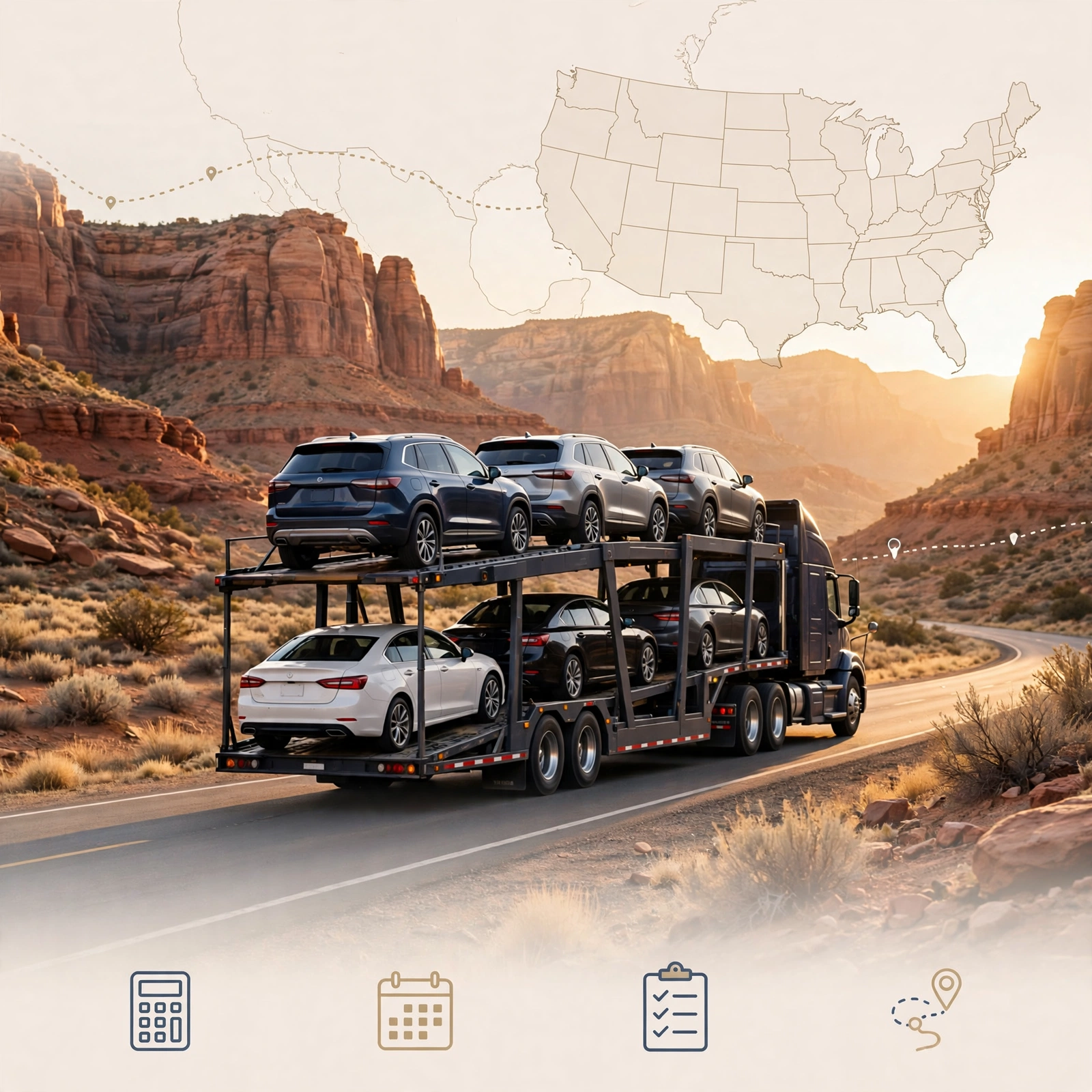
Moving from the East Coast to the West Coast involves more than packing boxes and arranging a new address. Your vehicle also needs to reach its destination. Driving it yourself may mean several days on the road, additional mileage, fuel expenses, overnight stops and time away from other moving responsibilities. Professional auto transport offers another way to handle the journey.
Naturally, the first question is about the cost to ship car across country. How much should you budget? Does a longer route always mean a proportionally higher rate? Is enclosed transport worth paying extra for? And what happens if your vehicle is an SUV, pickup or non-running car?
For a standard, operable sedan traveling approximately 2,000 miles or more on an open carrier, 2026 consumer pricing research commonly places cross-country transport around $1,200 to $1,900. Some routes may fall below or exceed that range. Enclosed shipping and larger vehicles usually require a higher budget.
These figures are planning estimates, not fixed rates. Your actual quote depends on the route, vehicle, pickup window and available carrier capacity.
Rapid Auto Shipping helps customers arrange vehicle transportation across the United States. Here’s how to understand long-distance shipping costs and prepare for a more predictable booking experience.
Start With the Distance: What Counts as Cross-Country Shipping?
Cross-country auto transport usually refers to moving a vehicle across a substantial portion of the continental United States, often covering approximately 2,000 miles or more.
Common examples include:
- California to Florida
- Washington to New York
- Oregon to Pennsylvania
- Texas to New Jersey
- Arizona to Massachusetts
- Colorado to North Carolina
The mileage is important, but the route itself matters too. A carrier traveling between major metropolitan areas may have more opportunities to find vehicles along the same corridor. A pickup or delivery location far from a major transport route may require additional planning.
For example, shipping a car from Los Angeles to Miami involves a different route and carrier market from transporting one between two smaller inland communities. Even if the estimated mileage is similar, the availability of trucks and the accessibility of the addresses may affect the quote.
Alaska and Hawaii require different transport arrangements, often involving port and ocean shipping. Their costs should not be compared directly with standard mainland cross-country shipments.
A Practical 2026 Budget for Long-Distance Car Shipping
A useful budget should account for the type of carrier and vehicle being transported. The following ranges provide a broad planning reference for standard vehicles on common mainland routes.
| Shipment type | Broad planning estimate |
| Standard sedan, open carrier | 1,200–1,900 |
| SUV or pickup, open carrier | Often higher than a sedan |
| Standard sedan, enclosed carrier | Often 1,700–2,900 |
| Non-running vehicle | Additional handling charges may apply |
These are indicative market ranges, not guaranteed offers from Rapid Auto Shipping. Actual rates vary with route demand, vehicle dimensions, pickup dates and carrier availability.
A useful detail often overlooked by first-time customers is the difference between total price and price per mile. A 500-mile shipment may have a higher per-mile rate than a 2,500-mile shipment because loading, unloading, dispatch coordination and other operating expenses are spread across fewer miles on shorter routes.
This is why a simple mileage multiplication is not enough to calculate a dependable cross-country quote.
What Actually Pushes a Cross-Country Shipping Quote Up or Down?
Rather than treating every shipment as identical, transport providers assess several practical details.
1. Vehicle dimensions and weight
A compact sedan takes up less trailer space than a full-size SUV or heavy pickup. Larger vehicles may reduce the number of other vehicles a carrier can load, affecting the transporter’s operating economics.
Modified vehicles need particular attention. Lift kits, oversized tires, roof accessories and lowered suspensions may affect loading clearance or available trailer space.
Provide the exact year, make and model when requesting a quote. Mention modifications rather than assuming the vehicle will be treated as a standard model.
2. Open versus enclosed carrier
The trailer you choose has a direct effect on the service and the price.
Open transport is the common option for everyday vehicles. Cars are secured on an exposed multi-vehicle trailer. It is widely available and usually the more economical choice for standard transportation.
Enclosed transport places the vehicle inside a covered trailer. It offers additional protection from weather and road debris, making it a popular option for classic cars, exotic models, luxury vehicles and valuable collectibles.
Enclosed transport generally costs more because it is a specialized service with different equipment and loading capacity.
The decision should reflect the vehicle’s value, condition and protection requirements—not simply the difference between two quotes.
3. Vehicle operating condition
A vehicle that starts, steers and brakes normally is easier to load than one that cannot move under its own power.
Non-running vehicles may require a winch, special loading equipment or a carrier capable of handling inoperable vehicles. Cars with locked wheels, damaged suspension or accident-related issues may need additional arrangements.
Before booking, explain whether the vehicle:
- Starts and drives
- Rolls but does not start
- Has working brakes and steering
- Has damaged or missing wheels
- Has been involved in a collision
Accurate details help prevent loading problems and unexpected adjustments.
4. Pickup and delivery accessibility
Large transport trailers need sufficient room to maneuver. A narrow residential street, low tree branches, steep driveway or restricted apartment entrance may prevent a driver from reaching the exact address.
Door-to-door service means pickup and delivery as close to the requested addresses as safely and legally possible. If the street is unsuitable, the driver may arrange a nearby meeting location.
Discuss access before the carrier is dispatched. A suitable meeting point can make the process smoother.
5. Seasonal demand and pickup flexibility
Vehicle shipping demand changes throughout the year. Spring and summer moving activity, college relocations and snowbird travel can create additional demand on certain routes.
If many customers want to move vehicles in the same direction during a limited period, carrier space may become more competitive.
Flexible pickup dates can help. If you don’t need the vehicle collected on one exact day, tell the transport provider. A wider pickup window may give dispatch more opportunities to locate an appropriate carrier.
Open Transport or Enclosed Transport: Make the Right Long-Distance Choice
Choosing the trailer is not just a pricing decision. It is also about how much protection your vehicle needs.
| Feature | Open transport | Enclosed transport |
| Trailer | Exposed carrier | Covered carrier |
| Cost | Usually lower | Usually higher |
| Weather exposure | Exposed to outdoor conditions | Greater protection |
| Common vehicles | Sedans, SUVs and pickups | Classic, luxury and exotic cars |
| Availability | Generally broader | More specialized |
For a regular commuter vehicle, open transport is often a sensible choice. For a restored classic or a high-value sports car, enclosed shipping may justify the additional expense.
Ask whether the quote includes the exact trailer type you requested. A low open-carrier estimate is not a fair comparison with an enclosed transport offer.
How to Avoid Unexpected Charges During a Cross-Country Move
A quote is useful only when you understand what it covers.
Before confirming a shipment, ask the provider to explain the following:
Is the quoted amount an estimate or a confirmed transport price? Understand whether the amount is subject to carrier availability or changes in shipment details.
When is payment due? Some arrangements involve an initial payment followed by a balance paid to the carrier. Others use a different payment structure. Request the complete schedule in writing.
Does the quote reflect my vehicle’s actual condition? A non-running vehicle or modified truck should never be quoted as an ordinary sedan.
Are there additional charges for expedited pickup? A shorter collection window may require a different carrier offer.
What happens if the pickup location changes? A new address can change route planning and accessibility.
What insurance applies? Ask for the assigned carrier’s cargo insurance details, coverage limits, exclusions and claim process. Do not assume every type of damage is automatically covered.
These questions make it easier to compare offers based on the actual service rather than a headline number.
Should You Drive the Car or Hire an Auto Transport Company?
The cheapest option on paper is not always the least expensive once the entire journey is considered.
Driving across the country may involve:
- Fuel for thousands of miles
- Hotel stays and meals
- Tolls and parking
- Additional vehicle mileage
- Tire and maintenance wear
- Time away from work or other responsibilities
Professional transport has a separate service cost, but it avoids making the entire journey yourself. It can be particularly useful when relocating with family, coordinating a household move, purchasing a vehicle from another state or managing two vehicles at once.
The better comparison is the total cost and time commitment of each option—not fuel expenses alone.
A Better Way to Prepare for Long-Distance Vehicle Shipping
A few practical steps can make pickup and delivery easier.
- Clean the vehicle: A clean exterior makes it easier to identify existing scratches, dents and paint damage.
- Take photographs: Capture all sides of the car, the wheels, the roof and any existing damage.
- Remove personal belongings: Keep the cabin and trunk clear unless the provider has explicitly approved an exception.
- Check the fuel level: Leave only the amount needed for loading and unloading, following the transport provider’s instructions.
- Secure loose accessories: Remove or secure detachable items that could become loose during transit.
- Prepare the keys: Make sure the carrier can access the vehicle when needed.
- Review the Bill of Lading: Check the vehicle inspection report at pickup and delivery, and document any new damage before signing.
Do not rely only on photographs taken before pickup. Review the inspection report with the driver and keep a copy of the completed paperwork.
How Rapid Auto Shipping Helps With Cross-Country Moves
A long-distance shipment requires coordination between the customer, dispatch team and assigned carrier. Clear vehicle details and realistic pickup expectations help everyone plan the move.
Rapid Auto Shipping arranges vehicle transportation throughout the United States, offering:
- Open and enclosed transport options
- Door-to-door service where safely accessible
- Free instant quote assistance
- Shipment updates
- Transportation options for different vehicle types
Customers planning a cross-country move should provide their pickup ZIP code, delivery ZIP code, vehicle year and model, operating condition and preferred pickup window.
These details help the team assess the shipment and discuss suitable transport arrangements.
Before booking, review the quote, payment schedule, carrier information and insurance details. A well-understood agreement is an important part of a smooth vehicle shipment.
Frequently Asked Questions
1. What is the cost to ship a car across the country in 2026?
For a standard, running sedan on an open carrier, a broad planning range is approximately 1,200–1,900 for many cross-country mainland routes. Actual quotes may be lower or higher depending on mileage, vehicle size, route demand and pickup timing.
2. How much does it cost to ship a car 2,500 miles?
A 2,500-mile shipment may fall within the broad cross-country pricing range, but there is no universal rate. The vehicle, origin and destination, carrier type and available pickup dates all influence the final quote.
3. Is open transport the cheapest way to ship a car across the country?
Open transport is usually the most economical standard option. It is widely used for everyday vehicles and is generally more readily available than enclosed transport.
4. Why does enclosed cross-country shipping cost more?
Enclosed carriers provide a covered transport environment and specialized service. They typically carry fewer vehicles and are often selected for classic, exotic, luxury and collectible cars.
5. Does shipping an SUV cost more than shipping a sedan?
Often, yes. SUVs and larger vehicles occupy more trailer space and may weigh more. Lifted trucks and oversized vehicles may require additional arrangements.
6. Can I ship a car across the country if it doesn’t run?
Yes, many inoperable vehicles can be transported. The provider needs to know whether the vehicle rolls, steers and brakes. Winch loading or specialized equipment may increase the cost.
7. How long does cross-country car shipping take?
Transit time depends on the route, distance, carrier schedule, weather and road conditions. Pickup scheduling and delivery transit are separate parts of the process, so ask for estimates for both rather than assuming a guaranteed arrival date.
8. Does door-to-door auto transport mean the truck comes to my driveway?
Not always. The carrier will get as close as safely and legally possible. If your street has limited access, you may need to meet the driver at a nearby accessible location.
9. When should I book a cross-country car shipment?
Booking a few weeks ahead is a sensible planning approach, particularly during busy moving seasons. Earlier planning gives you more flexibility, although carrier availability still affects the actual pickup schedule.
10. How can I get an accurate cross-country car shipping quote?
Provide both ZIP codes, vehicle details, running condition, preferred trailer type and pickup availability. The more accurate the information, the more useful the quote will be.
Final Thoughts
The cost to ship a car across the country is shaped by more than the number of miles between two addresses. Vehicle dimensions, trailer selection, operating condition, route demand and pickup flexibility all contribute to the final amount.
Start with a realistic budget, compare equivalent transport options and review the payment and insurance terms before booking. A clear quote and accurate shipment details can help you avoid surprises and choose a service that fits your move.
Planning a long-distance vehicle move? Request a free quote from Rapid Auto Shipping and explore transport options for your route.