
Introduction
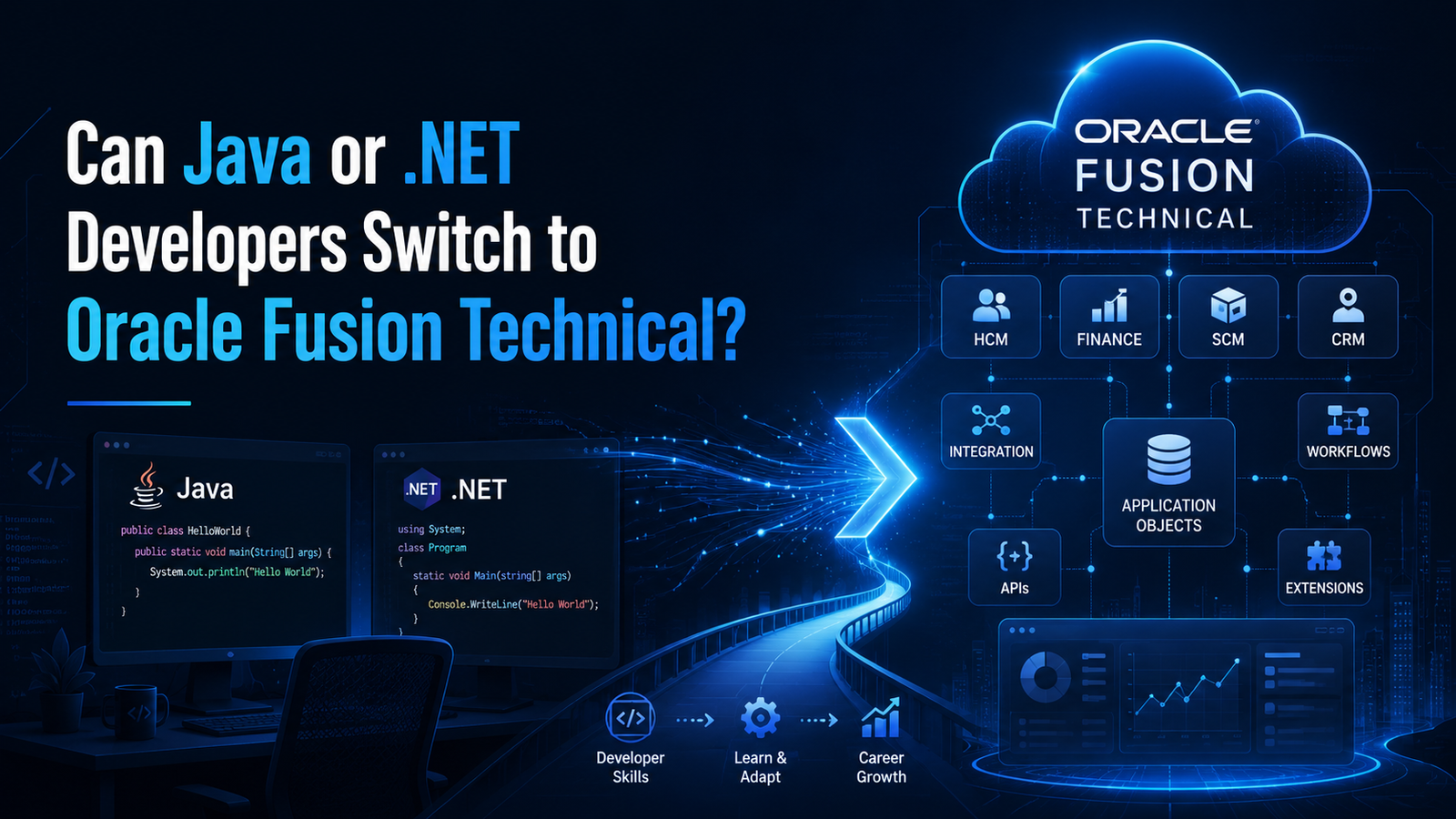
If you’re a Java or .NET developer weighing this move, you’ve probably noticed the same thing many others have: Oracle Fusion openings are everywhere, but skilled technical talent is scarce. Soft Online Training has guided plenty of developers through this exact shift, and it’s less intimidating than it sounds. As companies retire their old EBS and custom Java/.NET setups in favor of Oracle Fusion Cloud, someone needs to build, integrate, and maintain these systems. That’s where Oracle Fusion Technical Training in Pune comes in, helping developers turn existing coding skills into a genuine career advantage.
Why Java and .NET Developers Are Looking at Oracle Fusion Technical
Let’s be honest about what’s happening in the market. Pure Java and .NET development roles aren’t disappearing overnight, but they’re getting crowded. Every year there are more developers chasing the same set of openings. Meanwhile, ERP platforms Oracle Fusion in particular are growing across finance, HR, procurement, and supply chain teams in almost every mid-to-large company you can think of. Someone has to build the reports, wire up the integrations, and customize these systems once they go live, and that someone is increasingly hard to find.
Here’s the part that surprises most developers: this isn’t starting over. You already think in terms of logic, debugging, APIs, and databases the exact muscles you’ll use on the Fusion side too. What’s actually new is the platform itself and Oracle’s own way of naming things. Once you get past the unfamiliar terminology, the underlying thinking is stuff you’ve been doing for years.
What Does an Oracle Fusion Technical Consultant Actually Do?
It helps to know what you’re signing up for before you commit any time to this. On a typical week, a Fusion Technical consultant might be doing a mix of the following:
- Building or tweaking reports in BI Publisher (BIP) and OTBI
- Setting up integrations through Oracle Integration Cloud (OIC)
- Consuming or exposing REST and SOAP services to connect Fusion with outside systems
- Writing Fast Formulas for payroll and HCM calculations
- Loading data through FBDI and HDL files
- Customizing screens using Application Composer, Page Composer, and VBCS
- Digging into PL/SQL when something needs backend validation
Read that list again and you’ll notice that a lot of it is just “backend logic, APIs, and UI work” wearing different names. That’s really the honest answer to how hard this switch is. You’re not learning to code from zero. You’re learning where Oracle keeps things and how it likes them done.
Transferable Skills That Give You an Edge
Your SQL background carries real weight here. Most Java and .NET developers already live in relational databases day to day, and Fusion leans heavily on PL/SQL and SQL for reporting and validation work. You won’t be starting from a blank page.
API experience translates almost one-to-one. If you’ve built anything with Spring Boot or .NET Web API, you already get request/response cycles, tokens, and JSON payloads which is basically the language OIC speaks.
Groovy will feel familiar fast. Application Composer uses Groovy scripting, and if you’ve spent real time with Java, the syntax won’t feel foreign for long. A few weeks in, most developers stop noticing the difference.
And maybe the most underrated skill is patience with broken things. Years of chasing down bugs teaches a certain calm that comes in handy when an integration silently fails at 6 PM on a Friday. Fusion has its own quirks, but the instinct to isolate and fix a problem doesn’t change.
The Learning Curve: What You’ll Actually Need to Pick Up
I won’t pretend there’s nothing new to learn there is, and skipping past that wouldn’t be fair to you. Expect to spend real time on:
- Fusion’s cloud architecture and data model, which looks nothing like a typical Java/.NET app
- Report building in BI Publisher, including RTF and Excel templates
- OTBI subject areas and how analyses get built
- OIC adapters and connection patterns
- Fast Formula syntax (this one trips up almost everyone at first)
- FBDI and HDL file structures for bulk data loads
- Fusion’s security and role-based access setup
None of this is impossible to self-teach, but it’s slow going if you’re piecing it together from scattered blog posts and forum threads at 11 PM after a full day of work. That’s usually where people either give up halfway or end up in a structured program that just walks them through it properly.
Why Pune Makes Sense for This Move
Pune’s IT scene has quietly become one of the stronger ERP hubs in the country. There are Oracle implementation partners, product companies, and consulting firms scattered across Hinjewadi, Kharadi, and Baner, and most of them are hunting for the same kind of talent. If you’re based here, or willing to be, that local demand actually matters. It’s the difference between learning a skill nobody nearby is hiring for and learning one where the job openings are practically down the road. Oracle Fusion Technical Training in Pune plugs you straight into that ecosystem instead of leaving you to figure out where the opportunities even are.
A lot of Java and .NET developers in the city end up searching for Oracle Fusion Technical Training in Pune specifically because the local training providers have adjusted their syllabus to match what recruiters are asking for right now, not what was relevant three years ago. That alone saves you from learning outdated material and having to unlearn it later.
What a Decent Oracle Fusion Technical Training in Pune Program Should Actually Cover
Not every training program is built the same, so it’s worth knowing what to look for before you enroll anywhere:
- Real hands-on labs on BI Publisher, OTBI, and Application Composer not just someone reading slides at you
- Project-style scenarios that mimic actual client work, like building an integration end-to-end or writing a payroll Fast Formula from scratch
- Proper OIC coverage, including REST/SOAP work, FBDI loads, and what to do when something breaks
- Mock interviews built around actual Fusion Technical questions, not generic ones
- Trainers who’ve genuinely implemented Fusion projects, not just people reciting certification material
- Some kind of placement support, or at least guidance on how to frame your Java/.NET background to recruiters
If a program calls itself Oracle Fusion Technical Training in Pune but skips half of this, it’s worth asking why before you sign up. The good ones are built specifically for people switching in from other technologies; they don’t assume you’re starting with zero technical ability, because you’re clearly not.
The Questions Developers Usually Ask Before Making the Jump
Will I lose my coding edge if I move into this?
Not really. You’ll still write Groovy, still touch PL/SQL, still work with Java-based custom adapters inside OIC. You’re changing where you apply the skill, not giving it up.
Does it pay as well as Java/.NET roles?
In most cases, yes sometimes better, honestly. There just aren’t enough skilled Fusion technical people around right now, while the Java/.NET talent pool is fairly saturated. Basic supply and demand.
What if I don’t know anything about ERP functionally?
That’s fine, and pretty normal actually. Nobody’s expecting you to understand every business process behind Fusion on day one. Your value as a technical consultant is in building and fixing things, not in configuring functional modules.
Final Thoughts
None of this is about throwing away what you already know and starting fresh, it’s about pointing those same skills to a platform where the demand is only going up. Your grip on logic, APIs, and databases already puts you ahead of someone learning Fusion cold. Soft Online Training has seen this exact transition play out for enough developers to know it’s not a leap of faith, it’s a fairly predictable path if you follow it with some discipline. If you’re genuinely considering this, looking into Oracle Fusion Technical Training in Pune is probably the most practical first step; it gets you structured guidance and puts you close to where the actual jobs are. Give it a few focused months, and for a lot of developers, this ends up being one of the better career decisions they’ve made.