
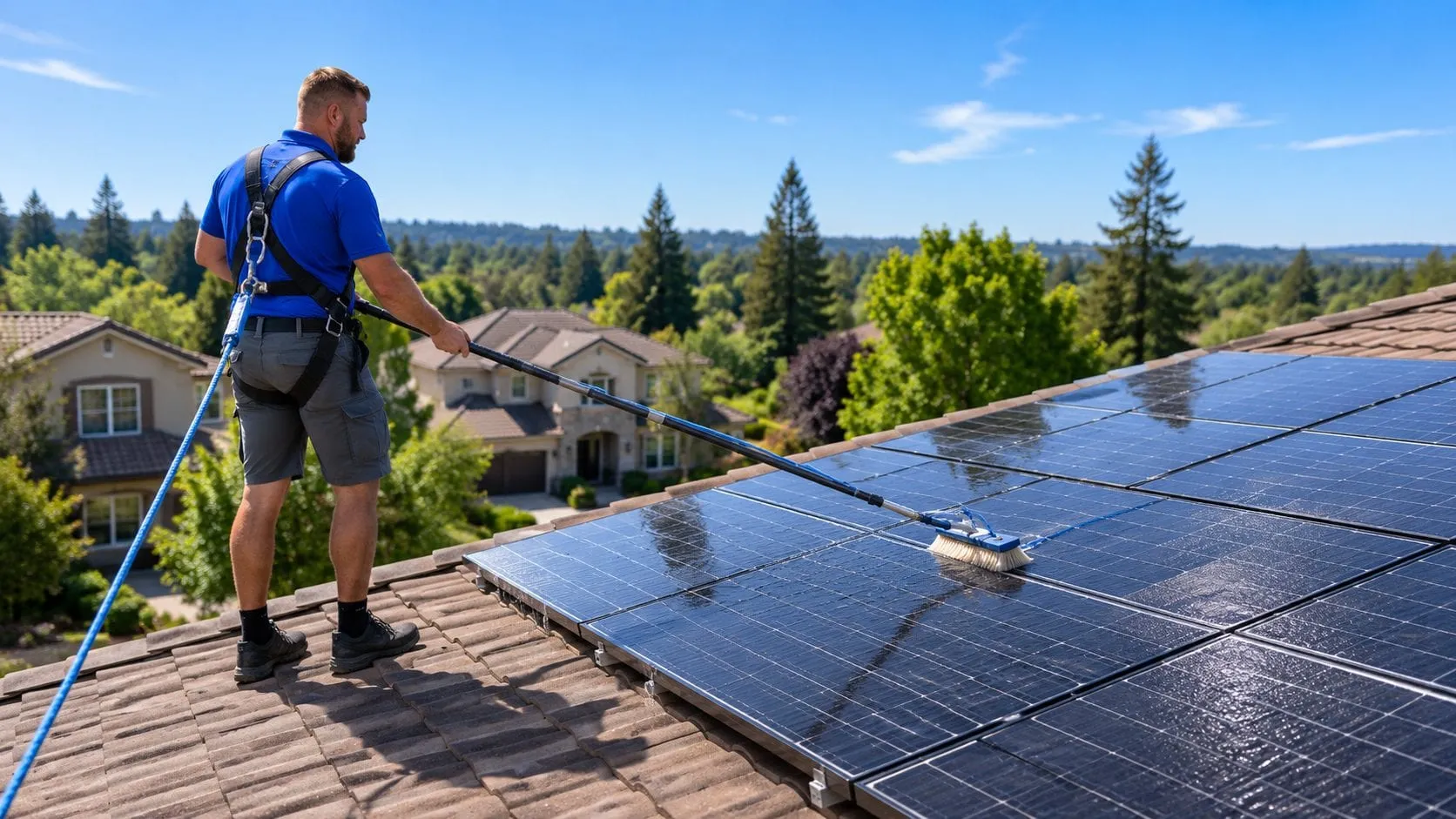
Washing dusty photovoltaic modules with a standard garden hose seems like a quick, harmless chore. However, using untreated tap water—whether during a DIY wash or an unequipped solar panel cleaning service—can leave behind stubborn mineral crusts that block sunlight and permanently etch glass. Understanding how dissolved solids interact with heated solar glass will help you protect panel efficiency, avoid voided manufacturer warranties, and choose safe rinsing methods.
What Makes Water “Hard” and Why It Matters for Glass
Hard water contains elevated concentrations of dissolved minerals, primarily calcium and magnesium, along with trace amounts of iron, silica, and bicarbonates. Municipal water suppliers and private wells across the United States naturally pick up these minerals as water filters through limestone, chalk, and gypsum deposits underground. According to the U.S. Geological Survey (USGS), water hardness is measured in milligrams per liter (mg/L) or grains per gallon (gpg) of calcium carbonate, with levels above 120 mg/L (7 gpg) classified as hard and anything over 180 mg/L (10.5 gpg) classified as very hard.
While these dissolved minerals are safe to drink, they behave differently once sprayed onto an exposed outdoor surface. When water droplets sit on solar glass, the pure H2O molecules evaporate into the air, leaving every bit of dissolved calcium, magnesium, and silica behind on the surface.
Unlike standard residential windows, solar panels sit tilted directly toward the sun and absorb massive amounts of thermal energy. Even on a mild spring morning, the surface temperature of a photovoltaic module can climb well above the ambient air temperature. That heat accelerates evaporation, baking mineral deposits onto the glass within seconds before you have a chance to squeegee or towel the surface dry.
How Hard Water Damages Solar Panels Over Time
A single rinse with tap water will not shatter a solar panel, yet repeated exposure triggers several compounding forms of physical and electrical degradation. For cleaning professionals and property owners alike, recognizing these mechanisms explains why water quality is non-negotiable in solar maintenance.
Mineral Scaling and Light-Blocking Film
When hard water evaporates on a panel, calcium and magnesium carbonate crystallize into white, chalky rings known as mineral scale. Over multiple wash cycles, these rings overlap to form an opaque, crusty film across the glass surface.
Because photovoltaic cells rely on unobstructed photons passing through the tempered glass to generate electricity, any opaque barrier acts like permanent shade. A thin layer of mineral scale scatters incoming sunlight and reduces light transmittance, steadily dragging down the system’s kilowatt-hour output. Worse still, that rough mineral crust traps airborne dust, pollen, and bird droppings far more aggressively than smooth glass, accelerating future soiling.
Hot Spots and Micro-Cracking Risks
Solar cells inside a panel are wired together in series, meaning the lowest-performing cell in a string limits the current flowing through the entire circuit. When thick mineral deposits accumulate unevenly—such as along the bottom edge of a tilted panel where rinse water pools—the shaded cells beneath that crust cannot produce electricity at the same rate as their neighbors.
Instead of generating power, those shaded cells act as electrical resistors and convert incoming energy into localized heat. This phenomenon, known as a “hot spot,” raises temperatures in a small area of the module. Over months and years, repeated thermal stress from hot spots can discolor the protective encapsulant, degrade solder joints, or cause micro-cracks in the fragile silicon wafers beneath the glass.
Degradation of Anti-Reflective Coatings
Modern solar modules rarely feature bare tempered glass. Manufacturers apply a microscopic, porous anti-reflective (AR) coating—often made from nanoporous silica—to minimize glare and capture more sunlight during early morning and late afternoon hours.
Hard water minerals bond tightly to these microscopic pores. When someone attempts to scrub off dried hard water spots using abrasive pads, stiff brushes, or harsh acidic descalers, they strip away the delicate anti-reflective layer. Once an AR coating is scratched or chemically etched off, the glass becomes permanently hazy and loses its light-trapping efficiency.
Frame Corrosion and Sealant Deterioration
Damage from mineral-heavy water is not limited to the glass surface. Anodized aluminum frames, mounting rails, and rubber edge gaskets also suffer when exposed to concentrated mineral runoff and alkaline tap water.
As water pools along the lower aluminum lip of the frame, trapped minerals and moisture create localized galvanic or crevice corrosion, leaving white pitting on the metal. Simultaneously, repeated wet-dry cycles with high-mineral water can dry out and crack the silicone perimeter seals that keep moisture out of the internal electrical junction box and cell layers.
Can Using Hard Water Void a Solar Panel Warranty?
Most major solar manufacturers—including Qcells, REC, Canadian Solar, and SunPower—outline strict cleaning guidelines inside their installation and maintenance manuals. While phrasing varies by brand, warranty documents routinely exclude damage caused by improper maintenance, abrasive tools, unapproved chemicals, and hard water deposits.
Manufacturers frequently specify a maximum acceptable water hardness level or Total Dissolved Solids (TDS) limit for rinsing panels. If a panel suffers premature power loss due to severe mineral scaling, glass etching, or hot spots caused by uncleaned mineral buildup, the manufacturer can deny a warranty claim during inspection. For commercial cleaning operators, ignoring water quality specifications exposes the business to liability claims if a client’s warranty is invalidated after a wash.
Water Quality Comparison for Solar Panel Cleaning
Choosing the right water source is the single most effective way to prevent mineral spotting during solar panel cleaning. The table below compares common water types used in exterior maintenance based on dissolved mineral content, spot risk, and operational suitability.
Comparison of Water Types Used in Solar Panel Maintenance
| Water Type | Typical TDS Range (ppm) | Mineral Content | Risk of Panel Damage | Best Use Case |
| Untreated Well Water | 250 – 800+ ppm | Very high calcium, magnesium, iron, and sulfur | Severe – Causes rapid scaling, rust staining, and etching | Never suitable for rinsing solar modules |
| Municipal Tap Water | 100 – 400 ppm | Moderate to high dissolved minerals and chlorine | Moderate to High – Leaves white water spots upon evaporation | Only acceptable if thoroughly dried immediately with a soft squeegee |
| Softened Tap Water | 100 – 400 ppm | Replaces calcium and magnesium with sodium ions | Moderate – Leaves salty white sodium residue that attracts dirt | Not recommended; still leaves conductive salt deposits |
| Reverse Osmosis (RO) Water | 10 – 30 ppm | Removes 90–98% of dissolved minerals and salts | Low – Minimal spotting in moderate temperatures | Large commercial arrays as a primary filtration stage |
| Deionized (DI) Water | 0 – 10 ppm | Virtually zero dissolved ions or minerals | None – Evaporates completely spot-free without drying | Residential and commercial solar panel cleaning |
As the comparison shows, standard household water softeners do not solve the problem. Ion-exchange softeners simply swap hardness minerals for sodium ions, meaning the TDS count remains unchanged and dried droplets still leave behind a hazy salt residue. True spot-free rinsing requires removing dissolved solids altogether through reverse osmosis, deionization, or a combination of both.
Safest Methods for Cleaning Solar Panels Without Hard Water Damage
Whether you are maintaining a rooftop array or adding solar maintenance to an exterior cleaning business, following a disciplined purification and washing workflow eliminates mineral risk.
Use Deionized or Reverse Osmosis Water
Purified water is the gold standard for professional solar panel cleaning. A deionization (DI) tank uses positively and negatively charged resin beads to strip dissolved mineral ions from tap water, bringing the TDS reading down to 000 parts per million (ppm). Because pure water contains no dissolved solids, you can rinse the panels and allow them to air-dry naturally in the sun without leaving a single spot or streak.
For regions with very hard tap water (above 200 ppm), pairing a reverse osmosis (RO) membrane with a final DI polishing resin extends resin life dramatically. The RO membrane filters out roughly 95 percent of the minerals first, leaving the DI resin to capture the remaining trace ions at a fraction of the operating cost.
Test Water Quality With a Digital TDS Meter
Never guess the mineral content of an unfamiliar water spigot. A pocket-sized digital TDS meter costs under twenty dollars and provides an instant readout of Total Dissolved Solids in parts per million.
Before connecting hoses to a property’s exterior spigot, run the water for thirty seconds and test a sample in a clean cup. Check the output at the end of your water-fed pole brush as well. As a practical rule of thumb, keep rinse water below 10 ppm for guaranteed spot-free air drying, and replace or regenerate your DI resin as soon as readings climb above 15 to 20 ppm.
Clean During Cooler Hours of the Day
Timing plays a major role in preventing thermal shock and rapid evaporation. Wash panels early in the morning, late in the evening, or on overcast days when the glass is cool to the touch.
Spraying cold water onto scorching afternoon glass causes thermal stress that can crack tempered glass or stress internal cell connections. Cooler glass also gives you plenty of working time to agitate stubborn debris and rinse thoroughly before water droplets flash-dry on the surface.
Pair Pure Water With Non-Abrasive Tools
Purified water acts as a natural magnet for dirt because mineral-free H2O molecules aggressively bond with loose dust and grime. In most routine cleanings, pure water combined with a soft-bristled, solar-rated nylon brush or microfiber pad lifts away dirt without any soaps or detergents.
Avoid household dish soaps, glass cleaners containing ammonia, bleach, and abrasive scrubbing pads. Soaps leave behind sticky surfactant films that attract dust faster and often contain chemicals that void panel warranties. Never aim a high-pressure washer at solar modules, as concentrated water pressure can force moisture past edge seals and fracture cells beneath the glass.
How to Safely Remove Existing Hard Water Spots From Solar Panels
If panels already have crusty white mineral deposits from past tap water rinses or sprinkler overspray, standard pure water alone will not dissolve hardened calcium scale. Removing existing buildup requires gentle, targeted treatment to avoid scratching the anti-reflective coating.
Start by inspecting the sprinklers around the property. Lawn irrigation systems aimed toward low-mounted roofs or ground-mount arrays are one of the most common culprits behind chronic hard water staining on solar panels. Adjusting sprinkler heads away from the array prevents the problem from returning immediately after cleanup.
For light mineral haze, apply a mild, solar-safe acidic solution—such as a 1:1 mixture of distilled white vinegar and distilled water, or a manufacturer-approved biodegradable mineral remover—using a soft microfiber cloth on cool glass. Let the solution dwell for two to three minutes to soften the calcium carbonate, gently agitate with a non-abrasive pad, and immediately flush the entire panel and aluminum frame with deionized water so no acidic residue remains.
Avoid harsh commercial lime removers, hydrofluoric acid, muriatic acid, or razor blades. Strong acids rapidly eat through anti-reflective coatings and corrode aluminum frames, while metal scrapers permanently gouge tempered glass. If heavy scaling does not lift after two gentle treatments, consult the panel manufacturer before attempting stronger chemical restoration.
Hard water can quietly undermine solar panel performance by baking opaque mineral scale onto glass, triggering localized hot spots, eroding anti-reflective coatings, and risking voided manufacturer warranties. Standard tap water and salt-based softened water both leave behind stubborn residues when they evaporate on sun-heated modules. By testing every water source with a digital TDS meter, rinsing exclusively with deionized or reverse osmosis water below 10 ppm, and working during cooler hours with soft brushes, cleaners and system owners can protect both glass integrity and peak power generation. Before your next wash, check your water’s TDS reading and make purified water the standard for every panel you clean.
Frequently Asked Questions
Is rainwater safe for solar panels compared to tap water?
Yes, rainwater is naturally soft and contains almost no dissolved minerals, making it safe for solar panels. However, because rainwater picks up airborne dust and pollen as it falls, it often leaves light dirt streaks rather than hard mineral scale, so panels still need periodic purified-water cleaning.
What TDS level is safe for cleaning solar panels?
A Total Dissolved Solids (TDS) reading between 0 and 10 parts per million (ppm) is ideal for spot-free air drying. Readings up to 30 ppm may work if you immediately dry the glass with a clean rubber squeegee, while water above 50 ppm carries a high risk of leaving mineral spots.
Can I use softened household water to wash solar panels?
No, standard water softeners are not recommended for solar panel cleaning. While they remove calcium and magnesium, they replace those minerals with sodium ions, which evaporate into a white salty film that attracts dust and can corrode aluminum frames over time.
Does hard water permanently ruin solar panels?
Light hard water spotting is usually reversible if addressed early with a gentle, solar-safe mineral remover and pure water rinse. However, years of neglected mineral scaling or aggressive scrubbing to remove baked-on deposits can permanently etch anti-reflective coatings and cause irreversible hot-spot cell damage.
Why shouldn’t I use dish soap or window cleaner on solar panels?
Dish soaps and commercial window cleaners often contain harsh surfactants, ammonia, or solvents that degrade anti-reflective glass coatings and rubber seals. They also leave behind a microscopic residue that traps airborne dust more quickly and can void the panel manufacturer’s warranty.