Introduction
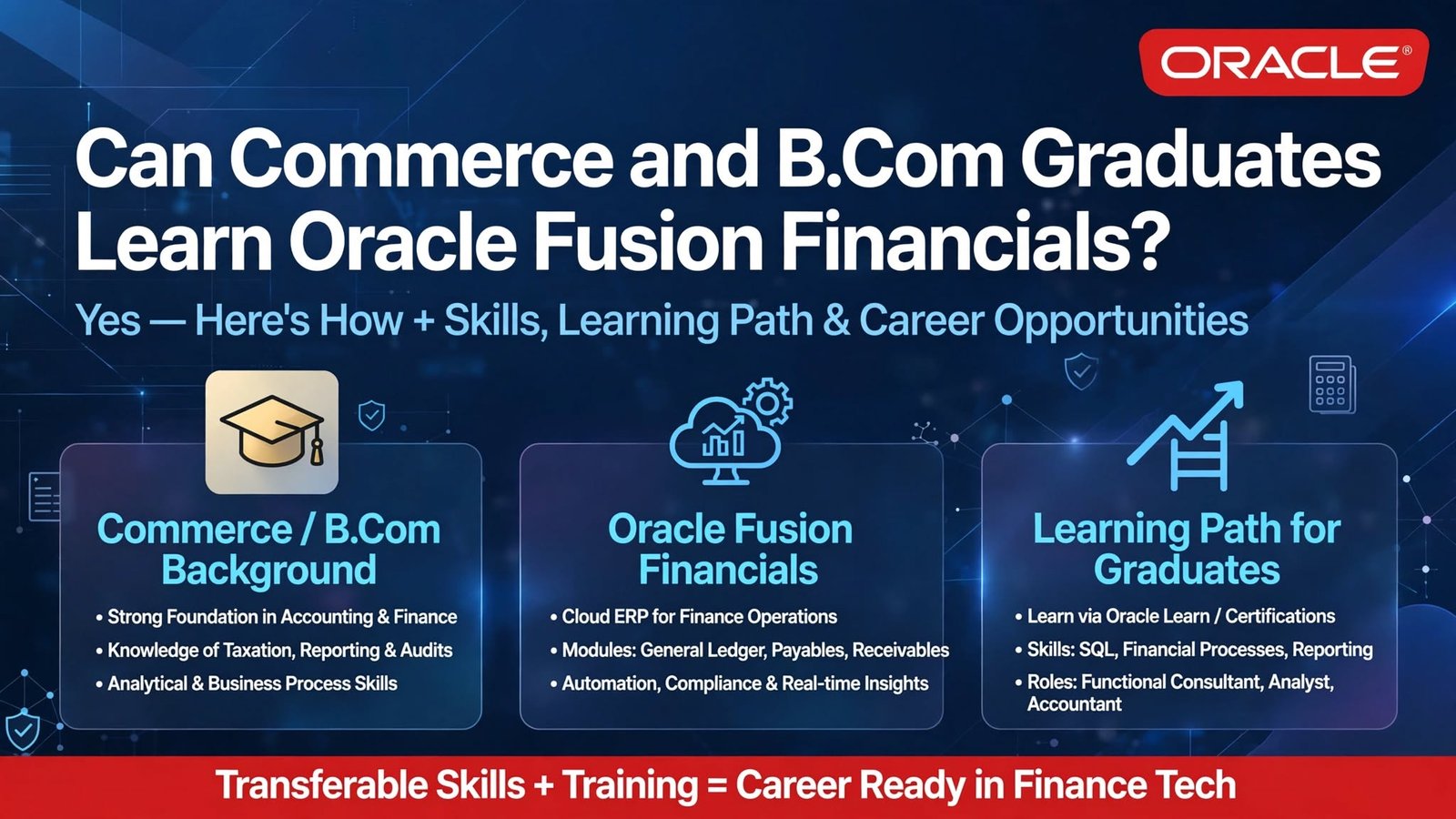
Plenty of commerce graduates finish college with strong accounting skills and a quiet worry about software. At Tech Leads IT, we hear the same question every week: can a B.Com graduate learn Oracle Fusion Financials without an IT background? Yes, and often faster than engineers do, because this is an accounting system first and software second.
Your degree already gives you the language it was built around. This blog covers why that is an advantage, what you will study, and how Oracle Cloud Financials Online Training fits around real life. The right Oracle Cloud Financials Training Online program makes the switch smoother.
Why Commerce Graduates Already Have a Head Start
Think about what a B.Com syllabus covers: financial accounting, cost accounting, taxation, auditing, banking, business law. Now think about what a finance team does in a company that runs Oracle Fusion. It books supplier invoices, collects customer payments, tracks fixed assets, reconciles bank statements, closes the books each month and reports the numbers.
That overlap is huge. When a trainer talks about a debit hitting an expense account or an accrual being reversed next period, you do not need the idea explained. You only need to learn where the button is. A software engineer, on the other hand, often has to learn what a journal entry even means before the system makes sense.
This is the part many commerce graduates underestimate. Domain knowledge is the harder half of an ERP career. Clicking through screens can be taught in a few weeks, whereas understanding why a ledger behaves the way it does takes years of accounting exposure. You have already done that groundwork.
What Oracle Fusion Financials Actually Covers
Before deciding whether it is too hard, it helps to see what is inside. Oracle Fusion Financials is a suite of modules that map neatly onto accounting functions you have already studied:
General Ledger is where all the accounting ends up. You will work with charts of accounts, journals, ledgers, period close and financial reports.
Accounts Payable handles supplier invoices, approvals, payments and tax. If you have studied creditors and purchase accounting, this will feel familiar.
Accounts Receivable deals with customer invoices, receipts, credit memos and collections, which is the debtors side of what you learned in college.
Fixed Assets covers asset additions, depreciation, transfers and retirements. Depreciation methods from your textbooks show up almost unchanged.
Cash Management is about bank accounts, statements and reconciliation.
Subledger Accounting and Tax connect transactions to the ledger and apply the right tax treatment.
Notice that nothing on that list is a programming topic. Each module is a business process, and a commerce graduate is often better placed to understand the why behind it than someone who has only seen the screens.
Do You Need Technical Skills to Begin?
This is the fear that stops most people, so let us be direct about it. You do not need to code to become an Oracle Fusion Financials functional consultant. You will not be writing Java or building applications. Your job is to understand a business requirement, configure the system to meet it, test it and support the users.
What you will need is a comfortable relationship with a computer. That means being decent with Excel, being able to learn new software screens without panic, and being willing to read a process flow. If you have used Tally or any accounting package during your studies, you are already ahead of where you think you are.
Some light technical awareness does help later. Knowing a little SQL lets you check data directly. Understanding spreadsheet-based data loading helps during implementations. But these are add-ons you can pick up gradually after you are comfortable with the core modules. Nobody expects them on day one.
How Oracle Cloud Financials Online Training Fits a Commerce Graduate’s Schedule
Many commerce graduates are either preparing for CA or CMA exams, working in a first job, or sitting at home waiting for placements. Classroom batches in a city across town rarely suit any of those situations. That is one reason Oracle Cloud Financials Online Training has become the preferred route for people coming from a non-IT background.
The practical benefits are easy to see. You can attend sessions from home, which saves commuting time and cost. Recorded classes let you revisit a topic that did not click the first time, and that matters a lot when you are learning something new. You can also keep your current job or study routine going while you learn in the evenings or on weekends.
There is a catch, though. Online learning only works if you actually get hands-on practice. Watching someone else configure a payables setup is not the same as doing it yourself. Look for a program that gives you access to a real Oracle Fusion environment, so you can create invoices, run payments and close periods with your own hands. Without that, you will understand the theory and freeze at the first interview question about a live scenario.
What a Good Oracle Cloud Financials Training Online Program Should Teach
Not every course is built the same way, and as a beginner it is hard to tell the difference at first glance. When you compare options for Oracle Cloud Financials Training Online, check for these things:
Business process first, screens second. A good trainer explains the procure-to-pay or order-to-cash cycle before opening the application. If a course jumps straight into clicking, you will memorise steps without knowing why.
Real scenarios. Ask whether the course includes situations like an invoice stuck on hold, a receipt that will not apply, or a period that will not close. Real projects are full of these, and employers ask about them.
Configuration along with transactions. Many beginners only learn to enter data. A well-rounded course also shows how the setup works: ledgers, business units, payment terms, approval rules and accounting rules.
Reporting. Knowing how to pull and read financial reports is part of the job from the first week.
Interview and certification support. Mock interviews, resume guidance and help preparing for Oracle’s certification exam all make a visible difference to how quickly you land a role.
If a course promises a job in thirty days with no effort, treat that as a warning sign. Good training is steady and practical, and the results come from the hours you put in.
A Realistic Learning Path for the First Six Months
Here is a sensible way to structure the learning if you are starting from a commerce background.
Month one: Get comfortable with the Fusion interface and the basics of how Oracle structures a company, including ledgers, legal entities and business units. Revise your accounting fundamentals alongside it, because you will use them constantly.
Months two and three: Focus on General Ledger and Accounts Payable. These two modules give you the strongest foundation, and most entry-level roles touch them.
Month four: Move to Accounts Receivable and Cash Management. By now the pattern of how modules post to the ledger should feel familiar.
Month five: Study Fixed Assets, Subledger Accounting and the period close process. This is where things start to feel like a real finance department.
Month six: Revisit everything through scenario practice. Do mock cases, prepare for interviews and, if you want to, sit for a certification exam.
Keep a small notebook of every issue you solve in the practice environment. It sounds minor, but those notes become the stories you tell in interviews.
Jobs You Can Aim For
Once you have solid skills, there are several doors open to a commerce graduate. Entry-level positions include Oracle Fusion Financials Functional Analyst, Finance Systems Associate, ERP Support Analyst and Accounts Payable or Receivable Specialist working on Oracle. With experience you can move to Functional Consultant, Implementation Consultant or Finance Systems Lead.
Companies also value people who can sit between the finance team and the technical team and explain each to the other. That translator role is where commerce graduates tend to shine, because they can talk accounting with finance leaders and process with the IT team.
Salaries in this field generally rise faster than in traditional accounting roles at the same experience level, mostly because trained Fusion consultants are in short supply compared to demand. That is an honest advantage worth considering, though outcomes vary with the company, city and your own preparation.
Final Thoughts
So, can commerce and B.Com graduates learn Oracle Fusion Financials? Absolutely. Your degree has already taught you the hardest part: how business money moves and gets recorded. What remains is learning how Oracle models those same ideas, and steady practice with good guidance will get you there.
If you are serious, choose Oracle Cloud Financials Online Training that gives you real system access, teaches processes before screens and supports you through interviews. At Tech Leads IT, we help commerce graduates make this move with confidence. With the right Oracle Cloud Financials Training Online, a few consistent months can make the software feel like the accounting you already know.