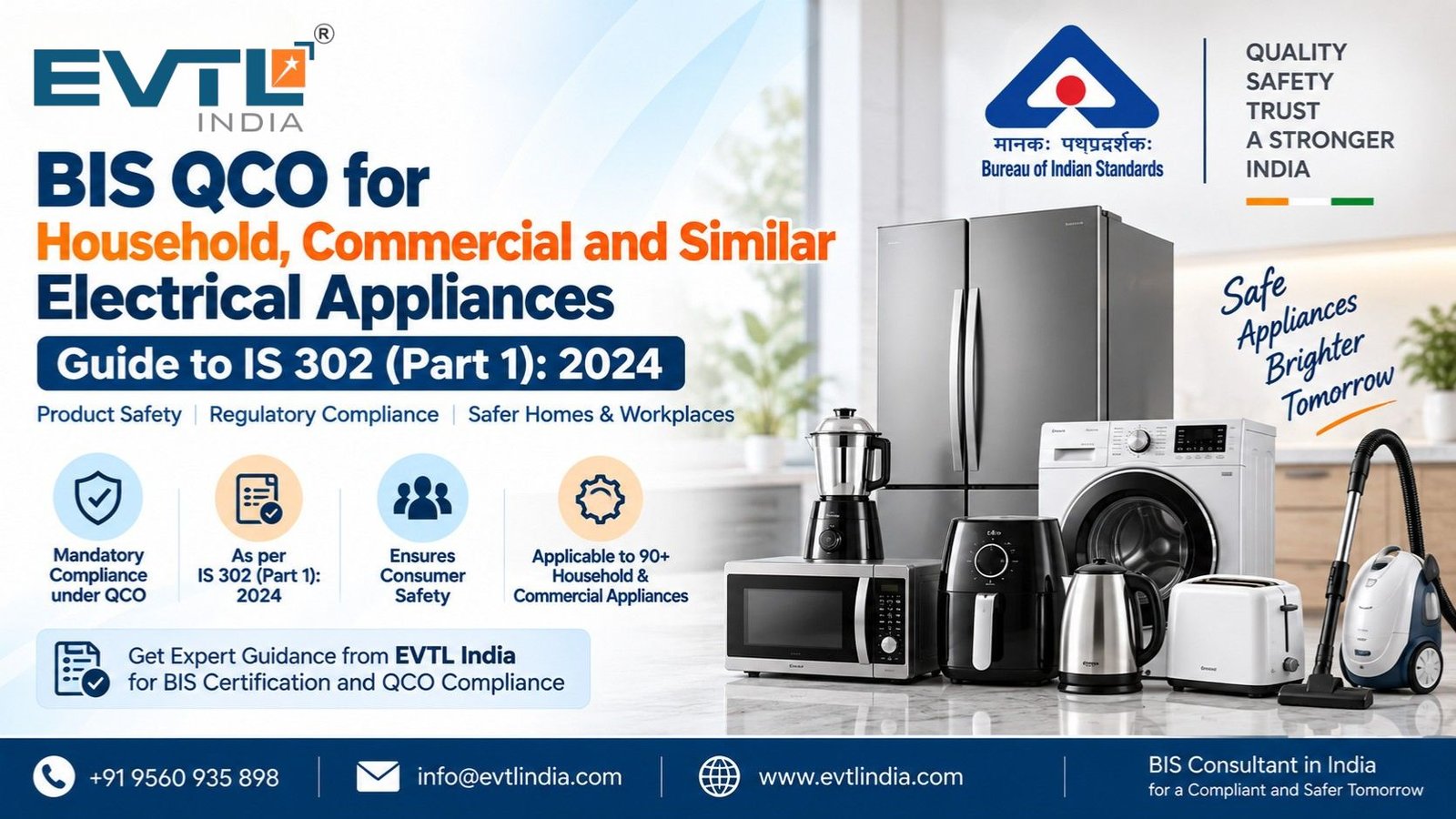
Electrical appliances have become a regular part of homes, offices, hotels, restaurants, and other commercial spaces. From cooking equipment and vacuum cleaners to food processors and water-heating appliances, these products are used frequently in daily life. Since many of them operate directly on electricity, meeting the required safety standards is important for manufacturers, importers, and businesses.
In India, several electrical appliances are regulated under mandatory safety and quality requirements. The BIS QCO for home appliances applies to products that fall within its specified scope and requires compliance with the relevant Indian Standards. For applicable products, IS 302 (Part 1): 2024 provides the general safety requirements, while additional product-specific standards may apply depending on the type of appliance.
For manufacturers and businesses planning to manufacture, import, or sell these products in India, understanding the applicable Quality Control Order and BIS requirements is an important step toward regulatory compliance.
What Is a Quality Control Order?
A Quality Control Order, commonly known as a QCO, is a government notification that makes compliance with specified Indian Standards mandatory for products covered by the order.
When a product falls within the scope of a mandatory QCO, the manufacturer may need to obtain the required BIS licence and comply with the applicable conformity assessment requirements before placing the product on the Indian market.
The Quality Control Order for home appliances applies to specified electrical appliances used for household, commercial, and similar purposes. However, businesses should not assume that every product sold as a home appliance is automatically covered. The exact product description, scope, exclusions, applicable standard, and implementation requirements need to be checked carefully.
Understanding IS 302 (Part 1): 2024
IS 302 (Part 1): 2024 specifies general safety requirements for household and similar electrical appliances. The standard is based on IEC 60335-1:2020 and provides a general framework for assessing the safety of covered appliances.
The requirements address different safety aspects associated with the construction and operation of electrical appliances. Depending on the type of product, a relevant Part 2 standard may also apply. Part 2 standards generally contain additional requirements for particular categories of appliances.
Therefore, manufacturers should identify both the general requirements and any product-specific requirements before beginning the testing and certification process.
For businesses searching for information about the BIS QCO for IS 302 Part 1, it is important to understand that compliance may involve more than simply checking the general standard. The product category and applicable Part 2 requirements also need to be considered.
Which Electrical Appliances May Be Covered?
The order applies to specified Household, Commercial, and Similar Electrical Appliances. Depending on the applicable product entries, covered products can include different types of kitchen, cleaning, heating, and food-processing appliances.
Examples may include vacuum cleaners, cooking appliances, food processors, electric water boilers, coffee makers, frying appliances, steam cookers, dishwashers, and certain commercial cooking equipment.
The actual scope depends on the wording of the applicable notification. Some products may have separate standards or may already be covered under another mandatory regulatory requirement.
This is why manufacturers should check their exact product specifications rather than relying only on a broad category such as “home appliance” or “electrical equipment.”
What Does the QCO Mean for Manufacturers?
The Quality Control Order for IS 302 Part 1 establishes mandatory compliance requirements for products falling within its notified scope. Manufacturers need to ensure that their products meet the applicable Indian Standards and follow the relevant BIS conformity assessment procedure.
The process generally starts with identifying the applicable standard and reviewing the product against its requirements. The manufacturer may then need to arrange product testing, prepare technical documents, provide manufacturing information, and submit the required application and supporting documents to BIS.
Depending on the applicable certification route, BIS may also evaluate the manufacturing facility and quality-control arrangements.
Manufacturers should also ensure that the product submitted for certification remains consistent with the product manufactured and supplied in the market.
Why Is BIS Certification Important?
BIS Certification provides a formal mechanism for demonstrating conformity with applicable Indian Standards under the relevant BIS certification scheme.
For products covered by a mandatory order, obtaining the required certification is part of regulatory compliance. It also requires manufacturers to maintain appropriate product quality and manufacturing controls as applicable to their certification.
Before applying, businesses should therefore check the latest regulatory notification, applicable Indian Standard, testing requirements, documentation, and implementation timeline.
Proper preparation can help reduce avoidable issues during testing and the certification process.
Understanding the Applicable Compliance Requirements
The QCO for Household, Commercial and Similar Electrical Appliances should be considered along with the relevant Indian Standards and product-specific requirements.
For example, a manufacturer may need to consider the general requirements under IS 302 (Part 1): 2024 as well as additional requirements applicable to the specific appliance. The product’s intended use, design, electrical characteristics, and construction can all be relevant when determining the applicable requirements.
Businesses should also keep track of regulatory updates because implementation dates, product coverage, and transitional provisions can change through subsequent government notifications.
How Manufacturers Can Prepare
Manufacturers can begin by identifying every electrical appliance they manufacture or import and checking whether each product falls within the applicable regulatory scope.
The next step is to identify the relevant Indian Standard and determine whether a product-specific Part 2 standard applies. Technical specifications and product construction should then be reviewed before testing.
Documentation should also be prepared carefully. Depending on the certification requirements, this may include product specifications, component information, technical documents, test reports, manufacturing details, quality-control information, and other supporting records.
Starting the compliance process early gives manufacturers more time to address testing or documentation issues before the applicable implementation deadline.
How EVTL India Can Help
For manufacturers and businesses, understanding BIS requirements can sometimes be difficult, particularly when they handle multiple electrical appliance categories.
EVTL India assists businesses with understanding applicable BIS requirements and navigating the certification process. The support can include identifying the relevant Indian Standard, understanding testing requirements, documentation guidance, application support, and coordination during the certification process.
For businesses affected by the Quality Control Order for Household, Commercial and Similar Electrical Appliances, professional guidance can help them understand which requirements apply to their specific products and how to prepare for compliance.
Conclusion
EVTL India is one of the leading BIS Consultant in India, helping manufacturers obtain their BIS licences hassle-free. The BIS QCO for home appliances is an important regulatory consideration for manufacturers and businesses dealing with covered electrical products in India. IS 302 (Part 1): 2024 provides the general safety requirements, while additional product-specific standards may apply depending on the appliance.
The Quality Control Order for Household, Commercial and Similar Electrical Appliances should always be reviewed based on the latest applicable notification and the exact product being manufactured or imported.
By identifying the applicable standards, arranging the required testing, preparing documentation, and completing the appropriate BIS process in advance, businesses can plan their regulatory compliance more effectively and prepare their electrical appliances for the Indian market.