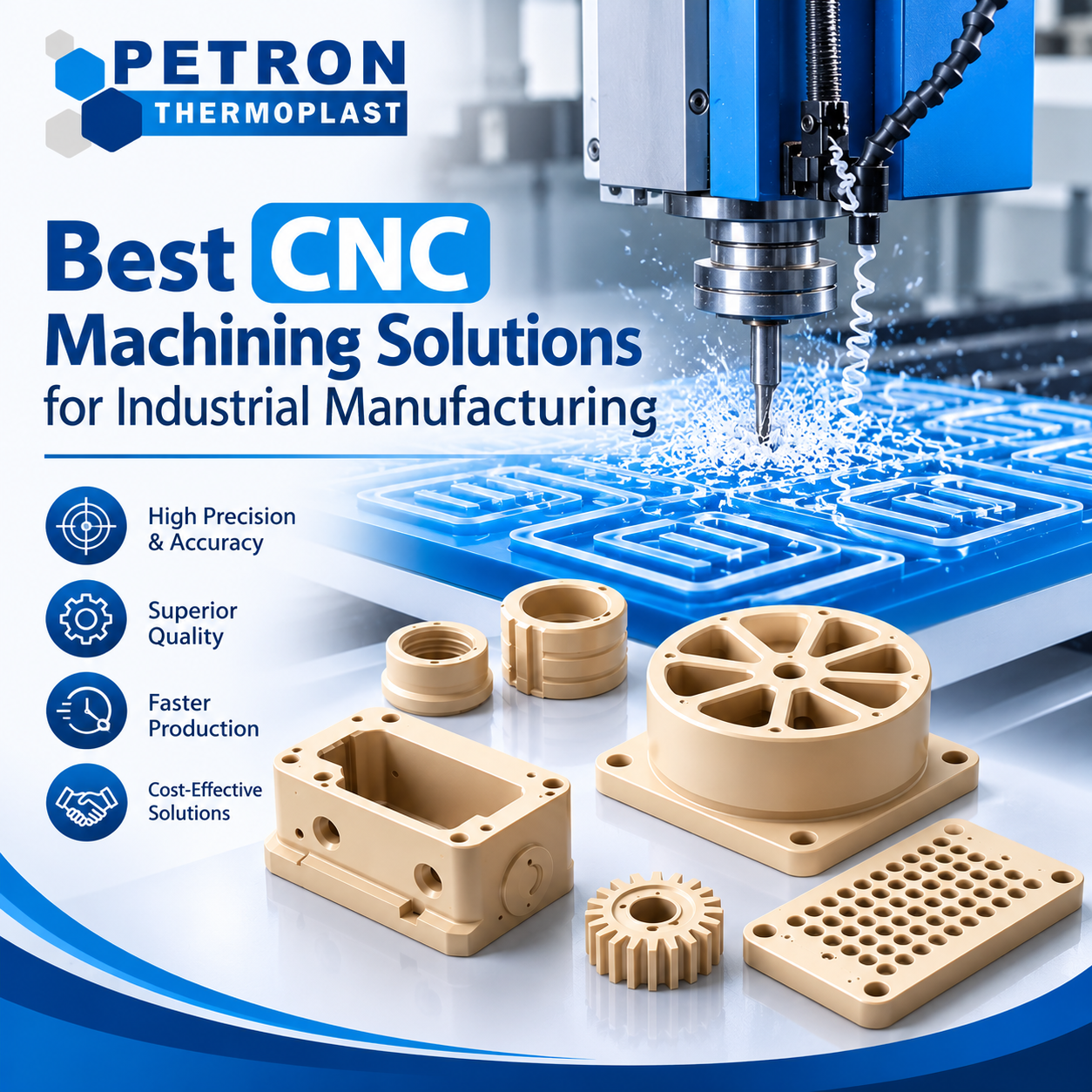
Modern industrial manufacturing requires precision, consistency, and customized components to support different production processes. CNC machining has become an important manufacturing technology for producing components with accurate dimensions, detailed designs, and repeatable quality. From engineering plastic parts to customized industrial components, CNC machining solutions help manufacturers meet specific application requirements.
The Best CNC Machining Solutions for Industrial Manufacturing focus on producing components according to technical drawings, CAD designs, material specifications, and project requirements. Petron Thermoplast offers CNC machining solutions for customized industrial components, supporting businesses looking for precision-machined plastic parts for different industrial applications.
What Is CNC Machining?
CNC (Computer Numerical Control) machining is a manufacturing process in which computer-controlled equipment performs cutting, drilling, routing, milling, and other machining operations. The machine follows programmed instructions to produce components according to a predefined design.
Unlike conventional manual machining, CNC technology allows manufacturers to control machining movements through digital programs. This helps achieve consistent dimensions and repeatable production results when the machine, tooling, material, and operating parameters are properly configured.
CNC machining is widely used for manufacturing customized components where specific shapes, dimensions, holes, slots, and surface finishes are required.
Importance of CNC Machining in Industrial Manufacturing
Industrial manufacturing involves different types of components that must meet specific dimensional and functional requirements. Standard products may not always suit every machine, equipment configuration, or production system.
CNC machining provides flexibility for manufacturing components based on individual project requirements.
Some important advantages include:
- Dimensional Accuracy: Computer-controlled machining helps produce components according to defined measurements and tolerances.
- Customized Manufacturing: Components can be manufactured using customer drawings and CAD designs.
- Repeatability: Programmed machining operations support consistent production across multiple components.
- Design Flexibility: Complex shapes, profiles, slots, and holes can be produced according to tooling and machine capabilities.
- Material Utilization: Proper machining strategies help manage raw material consumption.
- Production Efficiency: Automated operations can reduce repetitive manual work and improve manufacturing consistency.
These benefits make CNC machining a valuable solution for industrial equipment manufacturers and engineering companies.
CNC Machining Solutions for Custom Plastic Components
Engineering plastics are used in many industrial environments because of their application-specific properties, including chemical resistance, low weight, electrical insulation, and wear resistance.
CNC machining allows manufacturers to convert plastic sheets, rods, blocks, and other suitable stock materials into customized components.
Common examples of CNC-machined plastic components include:
- Plastic machine parts
- Customized industrial brackets
- Mounting plates and support components
- Plastic housings and enclosures
- Drilled and machined plates
- Spacers and bushings
- Customized equipment components
- Plastic fixtures and functional parts
Materials Used in CNC Machining
Material selection plays an important role in determining the performance and suitability of a CNC-machined component. Different engineering plastics offer different mechanical, thermal, and chemical properties.
- HDPE
High-Density Polyethylene (HDPE) is a thermoplastic material known for its impact resistance, low moisture absorption, and chemical resistance in suitable applications. CNC machining can be used to manufacture customized HDPE components, plates, and industrial parts.
- Polypropylene (PP)
Polypropylene is used in industrial applications requiring lightweight construction and resistance to various chemicals. CNC-machined PP components can be considered for selected chemical handling and industrial equipment applications.
- PVC
PVC is used in industrial applications where suitable chemical resistance, rigidity, and dimensional requirements are important. CNC machining can produce customized PVC components according to specific drawings.
- Nylon
Nylon is an engineering plastic used in applications requiring wear resistance, strength, and suitable mechanical performance. It is commonly considered for bushings, spacers, and selected machine components.
- PEEK
PEEK is a high-performance engineering thermoplastic used in demanding applications involving higher temperatures and mechanical requirements. Its suitability depends on the specific grade and operating conditions.
The final material selection should always consider chemical exposure, temperature, load, friction, dimensional stability, and service conditions.
CNC Machining Processes for Industrial Components
Different machining operations are used depending on the design and geometry of the required component.
- CNC Milling
CNC milling uses rotating cutting tools to remove material from a workpiece. It is suitable for producing flat surfaces, pockets, slots, profiles, and customized component shapes.
- CNC Routing
CNC routing is used for cutting and shaping suitable plastic sheets, plates, and other materials. It is useful for producing customized profiles, cutouts, and component patterns.
- CNC Drilling
Drilling operations create holes at specified positions and dimensions. These holes may be required for mounting, fastening, connections, and equipment assembly.
- CNC Cutting
CNC cutting helps produce components from larger material sheets or blocks according to programmed dimensions and designs.
The appropriate process depends on material properties, machine configuration, tooling, component geometry, and production requirements.
Customized CNC Machining Based on CAD Drawings
Industrial customers often require components that are not available in standard dimensions. Customized CNC machining provides an option to manufacture parts according to individual engineering specifications.
Customers can share their requirements through technical drawings, CAD files, dimensions, or component samples.
Important design details include:
- Overall component dimensions
- Hole diameter and positioning
- Slot and groove measurements
- Required material grade
- Surface finish requirements
- Dimensional tolerances
- Quantity requirements
- Application-specific design considerations
Industrial Applications of CNC Machining
CNC-machined components are used in various industrial sectors where customized parts and precise dimensions are required.
- Chemical Processing Industries
Plastic components are used in selected chemical processing equipment, support arrangements, and fluid-handling systems. Material compatibility is essential when components are exposed to chemicals.
- Water Treatment Plants
CNC-machined plastic parts can be used in selected equipment assemblies, mounting arrangements, and industrial treatment systems.
- Manufacturing Industries
Manufacturing facilities use customized machined components in machinery, production equipment, fixtures, and supporting structures.
- Electrical and Electronics Industries
Suitable engineering plastics are used for selected insulating components, housings, and equipment support parts.
- Industrial Machinery
CNC machining helps manufacture customized brackets, spacers, plates, bushings, and other components required for machinery assemblies.
- Engineering and Fabrication Projects
Engineering companies may require specially designed plastic components that match their equipment layouts and project drawings.
How to Choose the Right CNC Machining Service?
Selecting the right CNC machining partner is important for achieving the required component quality and manufacturing consistency.
Before placing an order, consider the following factors:
- Manufacturing Capabilities: Check whether the machining equipment can produce the required component dimensions and geometry.
- Material Knowledge: Confirm that the manufacturer understands the properties and machining requirements of the selected plastic.
- Drawing Compatibility: Ensure that customer drawings and CAD files can be reviewed before production.
- Dimensional Inspection: Discuss measurement and inspection requirements for critical dimensions.
- Customization: Choose a machining partner that can work with project-specific designs.
- Production Requirements: Confirm production quantity, delivery schedules, and repeat-order requirements.
- Technical Communication: Clear communication helps avoid errors during design review and manufacturing.
Why Choose Petron Thermoplast for CNC Machining?
Petron Thermoplast focuses on industrial plastic products, customized manufacturing, and CNC-machined component requirements. Our CNC machining activities support the production of plastic components according to customer specifications and industrial project needs.
Our manufacturing approach focuses on:
- Customized plastic component machining
- Manufacturing based on customer drawings and CAD files
- Different component shapes and dimensions
- Project-specific machining requirements
- Industrial plastic material applications
- Support for bulk manufacturing enquiries
- Customer-oriented manufacturing solutions
Conclusion
CNC machining has become an important part of modern industrial manufacturing because it supports customized designs, repeatable production, and accurate component fabrication. From plastic plates and machine parts to specially designed engineering components, CNC machining provides flexibility for different industrial requirements.
Choosing the right material, machining process, equipment, and manufacturing partner is essential for achieving the desired results.
Petron Thermoplast supports customized CNC machining requirements for industrial plastic components, helping customers develop parts according to their drawings, dimensions, and project specifications. Looking for customized CNC machining solutions for your industrial manufacturing project? Contact Petron Thermoplast to discuss your component requirements and request a quotation.
Frequently Asked Questions (FAQs)
- What is CNC machining used for in industrial manufacturing?
CNC machining is used to manufacture customized components through computer-controlled cutting, milling, routing, drilling, and other machining operations.
- Can CNC machines manufacture plastic components?
Yes. Suitable CNC machines can process materials such as HDPE, PP, PVC, Nylon, and PEEK, depending on machine capabilities and material specifications.
- What industries use CNC-machined plastic parts?
Chemical processing, water treatment, manufacturing, electrical equipment, industrial machinery, and engineering industries use CNC-machined plastic components.
- Can CNC machining produce customized components?
Yes. Components can be manufactured according to customer drawings, CAD files, dimensions, and specific project requirements.
- Which factors affect CNC machining accuracy?
Machine condition, tooling, material properties, machining parameters, workpiece holding, and inspection methods all influence dimensional accuracy.
- How can I request a CNC machining quotation from Petron Thermoplast?
You can contact Petron Thermoplast with your CAD drawings, technical specifications, material requirements, and expected quantity to discuss your machining project.