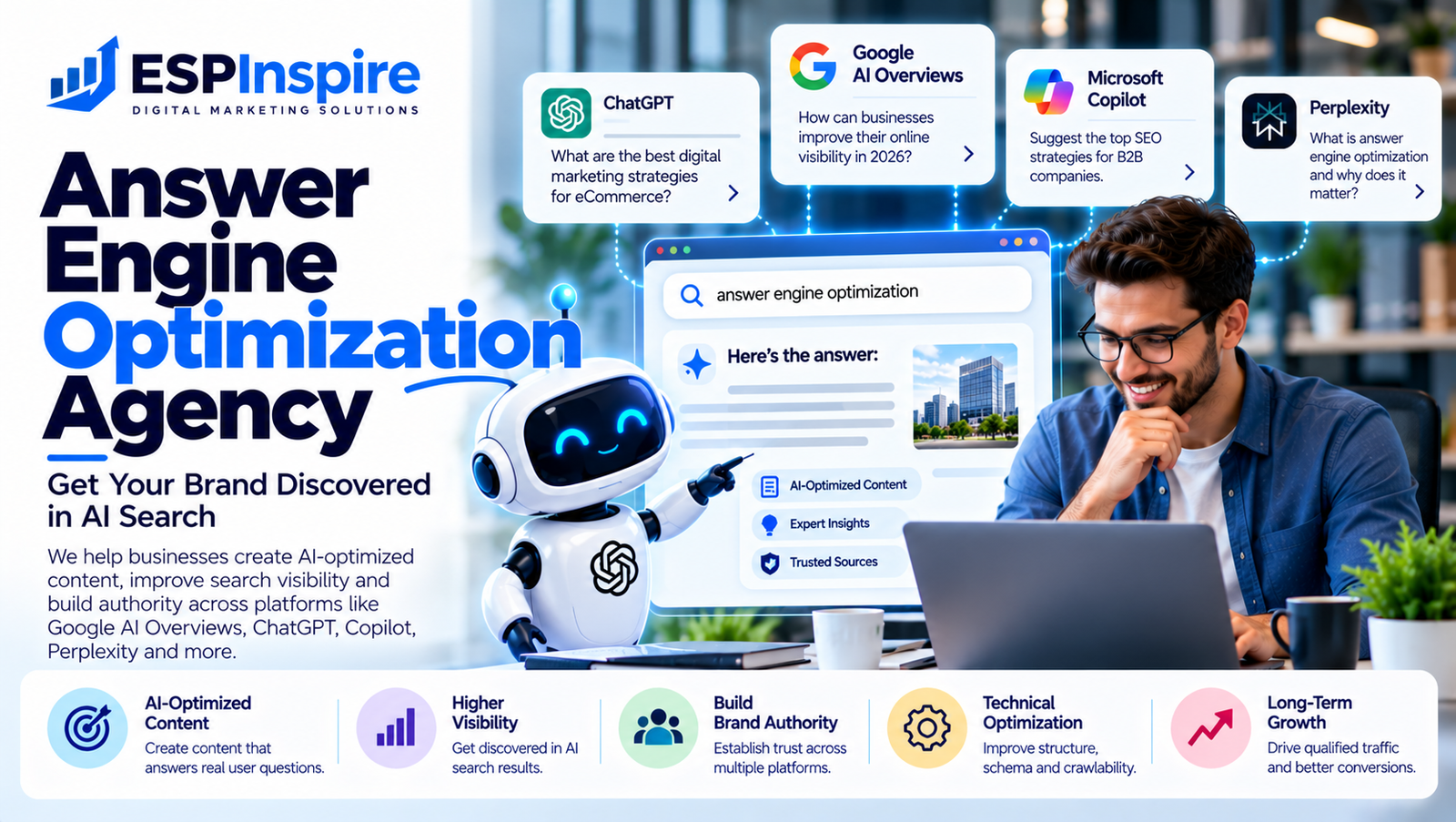
The digital search landscape is entering a new phase. People are no longer relying exclusively on traditional search engines to discover brands, compare services, or research products. Increasingly, they are using AI-powered assistants to ask detailed questions and receive personalized, conversational responses.
This change is creating new challenges for businesses that depend on online visibility.
A company may have a well-designed website, publish regular blog posts, and maintain competitive search rankings, yet still struggle to establish a presence in AI-assisted discovery experiences.
As consumers explore platforms such as ChatGPT, Google AI Overviews, Perplexity, and Microsoft Copilot, businesses need to reconsider how their information is presented, organized, and discovered.
Answer Engine Optimization, commonly known as AEO, provides a framework for adapting content to these changing search behaviors.
Rather than focusing exclusively on attracting clicks from search results, AEO emphasizes making business information useful, understandable, and accessible to systems that generate answers.
The Evolution From Search Results to AI-Generated Answers
Traditional online search typically involves entering a query, reviewing a list of websites, and selecting a result.
AI-assisted search introduces a different experience.
Users can ask complete questions, request comparisons, and continue a conversation without repeatedly starting new searches.
For example, someone researching marketing services might ask:
“Which digital marketing strategy is most effective for a small software company trying to attract international clients?”
Instead of receiving only a list of websites, an AI-powered system may provide an explanation of several strategies, their potential advantages, and relevant considerations.
This creates an opportunity for businesses that publish detailed and credible information.
However, it also means brands cannot rely solely on conventional keyword placement.
They need content that addresses real customer questions and provides useful context.
Why Traditional SEO Alone May Not Address Every Search Opportunity
Search Engine Optimization remains an essential part of digital marketing.
Technical website performance, relevant content, backlinks, and search intent continue to influence conventional organic visibility.
However, AI-assisted discovery can introduce additional considerations.
A website might rank for a short keyword phrase while offering limited information about the specific questions users ask conversational assistants.
For example, a company may target “business automation software” without explaining how different automation solutions compare, which businesses need them, or what implementation challenges to expect.
AEO encourages organizations to develop content around these broader information needs.
It does not replace SEO.
Instead, it extends an existing search strategy to account for more conversational forms of information discovery.
Understanding Customer Intent in Conversational Search
One of the most important aspects of AEO is understanding why people ask particular questions.
Traditional keyword research often begins with search volume and competition.
Conversational search research also considers the context behind a user’s question.
Customer intent can be divided into several categories.
Informational Intent
Users want to understand a topic, process, or concept.
Examples include questions about how AI search works or why businesses need digital marketing.
Comparative Intent
Users want to evaluate different solutions before making a decision.
They may ask how two services compare or which approach is better for a particular business requirement.
Commercial Investigation
Users are researching providers, pricing models, service features, or expected outcomes.
Transactional Intent
Users are ready to contact a provider, request a consultation, or make a purchase.
A comprehensive AEO strategy considers these stages and develops content that helps users move through their research journey.
Why Brand Credibility Matters in AI-Powered Discovery
AI-generated responses can be influenced by information retrieved from external sources, depending on the platform and search experience.
For businesses, accurate and consistent online information is important.
A brand with unclear service descriptions, outdated website content, or conflicting business details may create confusion for potential customers.
Organizations can strengthen their digital presence by maintaining clear information about their services, expertise, and business identity.
Useful credibility signals may include:
- Detailed company and service pages
- Accurate business contact information
- Clearly identified authors or contributors
- Relevant professional experience
- Original research and practical examples
- Transparent explanations of services
- Consistent information across reputable platforms
- Regularly reviewed and updated content
These practices support user trust and may improve the quality of information available to search and answer systems.
They do not guarantee that a particular AI platform will recommend or cite a brand.
How an Answer Engine Optimization Agency Helps Brands Become More Discoverable
As AI-assisted search becomes part of customer research, businesses may need specialized guidance to evaluate their digital presence.
An experienced answer engine optimization agency can help organizations understand how their content addresses conversational queries and where important information gaps exist.
The process may begin with reviewing the website’s existing service pages, educational resources, technical accessibility, and brand information.
Next, the agency can research the questions potential customers ask during different stages of their decision-making process.
For example, a digital marketing company may need content explaining the differences between SEO, AEO, and Generative Engine Optimization.
A software business may benefit from detailed guides addressing implementation costs, integration challenges, and solution comparisons.
By organizing information around real customer needs, businesses can create more useful resources for traditional search visitors and AI-assisted research.
Building a Question-Driven Content Strategy
AEO content development starts with understanding the questions customers want answered.
Instead of producing separate articles for every minor keyword variation, businesses can organize content around meaningful topics.
A comprehensive content strategy may include several formats.
Educational Guides
Detailed guides explain important industry concepts and help readers understand complex subjects.
Service Comparison Articles
Comparison content helps potential customers evaluate different approaches, features, and requirements.
Frequently Asked Questions
FAQ sections provide concise answers to recurring customer concerns.
Industry-Specific Resources
Industry-focused content demonstrates how services or technologies apply to particular business situations.
Case Studies
Accurate case studies can explain project challenges, implementation approaches, and measurable outcomes.
Practical Checklists
Checklists help readers evaluate options and prepare for important decisions.
These formats can improve content usefulness while supporting broader topical coverage.
The Importance of Clear and Structured Website Content
Content organization plays an important role in helping readers understand information.
Long paragraphs without clear headings can make important details difficult to locate.
A well-structured page should guide readers logically from the main question to supporting explanations.
Useful practices include descriptive headings, concise introductions, relevant examples, and clear definitions.
For question-based topics, providing a direct answer near the beginning of a section can improve readability.
Supporting paragraphs can then explain exceptions, limitations, and additional details.
Businesses should avoid creating repetitive sections solely to include more keywords.
The objective is to make information easier to understand, not to artificially increase content length.
How Technical SEO Supports Answer Engine Optimization
Strong content is only one component of digital discoverability.
Technical website problems can prevent search systems from accessing or understanding important pages.
Technical SEO reviews may include:
- Website crawlability
- Indexing configurations
- Internal linking structure
- Canonical URL implementation
- Mobile usability
- Page performance
- Content accessibility
- Structured data accuracy
- XML sitemap maintenance
Structured data can provide search engines with additional machine-readable context about certain types of content.
However, adding schema markup does not automatically cause a page to appear in AI-generated responses.
Technical improvements should follow applicable platform guidelines and accurately represent the website’s content.
Creating Content That Demonstrates Real Expertise
Generic information is widely available online.
Businesses can distinguish their content by contributing knowledge that reflects practical experience.
For example, a marketing agency could publish a detailed explanation of how it evaluates search performance across different customer acquisition channels.
A technology consultancy might explain common workflow automation problems and the considerations involved in solving them.
Original insights can make content more useful to readers.
Businesses should prioritize factual accuracy and avoid inventing statistics, client achievements, or case studies.
When claims involve industry research, reliable supporting sources can improve transparency.
Expertise is best demonstrated through useful information rather than repeated promotional statements.
The Relationship Between AEO and Generative Engine Optimization
Answer Engine Optimization and Generative Engine Optimization are closely related concepts.
AEO generally emphasizes creating content that can address user questions clearly and accurately.
Generative Engine Optimization, or GEO, focuses on improving how information is represented and potentially surfaced within generative AI experiences.
In practice, the strategies overlap considerably.
Both may involve improving content quality, technical accessibility, entity clarity, and topical relevance.
Businesses should avoid treating the two terms as completely separate technologies with guaranteed outcomes.
A coordinated strategy can address traditional organic search alongside emerging AI-assisted discovery channels.
How ESPInspire Can Position Itself in the AI Search Market
For a digital marketing brand such as ESPInspire, AI search creates an opportunity to develop educational resources around changing discovery behavior.
A useful content strategy could explain how conversational search differs from traditional SEO, why accurate brand information matters, and how businesses can prepare their websites for AI-assisted research.
ESPInspire can also use topic-focused content to communicate its perspective on modern search marketing.
Businesses evaluating an AEO provider should verify the company’s actual service offerings, technical capabilities, and relevant experience before making a decision.
Publishing practical, credible resources can help establish a clearer brand identity without relying on unsupported claims about guaranteed AI visibility.
Measuring Brand Visibility Beyond Traditional Rankings
Conventional SEO reports often emphasize keyword rankings, organic sessions, and search impressions.
These remain valuable indicators.
However, AI-assisted discovery may require additional forms of observation.
AI Brand Mentions
Businesses can periodically review whether their brand appears in relevant AI-generated responses.
Source References
Some AI search experiences display links or citations that can be monitored.
Referral Traffic
Website analytics may reveal visits from certain AI-related platforms when referral information is available.
Search Demand
Changes in branded search interest may provide useful context, although they cannot always be attributed to AEO.
Lead Quality
Businesses can evaluate whether incoming inquiries are relevant and aligned with their services.
Content Engagement
Page engagement and conversions can help assess whether educational resources meet audience needs.
AI responses can vary by platform, user context, and time.
For this reason, AEO measurement should use consistent methods and avoid interpreting isolated results as guaranteed performance trends.
Common Mistakes That Limit AI Search Readiness
Businesses sometimes make avoidable mistakes when adapting their content strategies.
One mistake is publishing hundreds of nearly identical articles targeting minor keyword variations.
Another is assuming that AI platforms will automatically recommend a brand because its website contains specific phrases.
Other common problems include:
- Outdated service information
- Unclear business descriptions
- Thin or repetitive content
- Unsupported marketing claims
- Poor website organization
- Inaccessible important pages
- Neglected technical SEO
- Excessive dependence on automated content production
A more sustainable approach focuses on meaningful content improvements and long-term credibility.
Choosing the Right AEO Strategy for Business Growth
Not every organization requires the same optimization approach.
A local service business may prioritize accurate business details, location-specific information, and customer questions.
A software company may need technical documentation, comparison resources, and product explanations.
An e-commerce brand may benefit from detailed product specifications, buying guides, and consistent catalog information.
Professional service providers may focus on educational resources that explain their expertise and help customers evaluate services.
The right strategy depends on the audience, business model, existing content, and available resources.
AEO should support broader marketing objectives rather than operate as an isolated activity.
The Future of Brand Discovery in an AI-Driven World
Digital discovery is becoming more diverse.
People may move between traditional search engines, conversational assistants, social platforms, and specialized research tools before choosing a business.
This creates a need for consistent and useful information across multiple channels.
Organizations that maintain strong technical foundations, publish original insights, and address customer questions can develop a more adaptable digital presence.
As AI search platforms evolve, optimization methods and measurement capabilities will continue to change.
Businesses should remain flexible and evaluate new practices based on reliable evidence rather than exaggerated promises.
Conclusion
The rise of AI-assisted search is changing how customers discover information and evaluate businesses.
Answer Engine Optimization provides a practical approach to improving content clarity, search accessibility, and relevance to conversational questions.
A qualified answer engine optimization agency can help businesses identify information gaps, improve website structure, and develop resources that support modern customer research.
For brands such as ESPInspire, investing in useful educational content and a credible online presence can support long-term digital marketing objectives.
Ultimately, successful AI search readiness depends on providing accurate information, demonstrating real expertise, and creating content that genuinely helps people make informed decisions. Read more blog