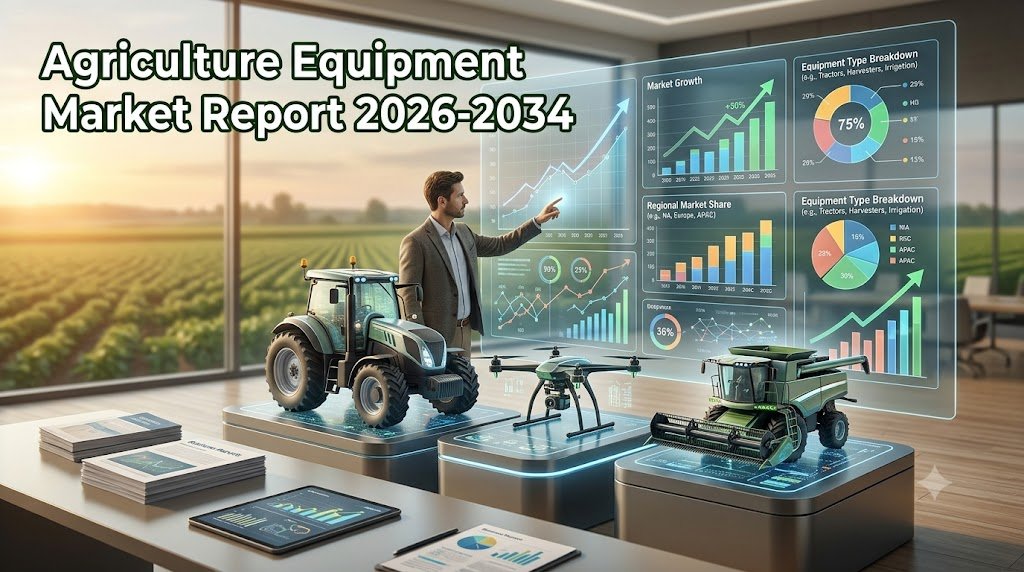
Market Overview:
According to IMARC Group’s latest research publication, “Agriculture Equipment Market: Global Industry Trends, Share, Size, Growth, Opportunity and Forecast 2026-2034”, The agriculture equipment market size increased from USD 188.8 Billion in 2025 to USD 196.0 Billion in 2026 and is projected to reach USD 264.6 Billion by 2034, exhibiting a CAGR of 3.82% during 2026-2034.
This detailed analysis primarily encompasses industry size, business trends, market share, key growth factors, and regional forecasts. The report offers a comprehensive overview and integrates research findings, market assessments, and data from different sources. It also includes pivotal market dynamics like drivers and challenges, while also highlighting growth opportunities, financial insights, technological improvements, emerging trends, and innovations. Besides this, the report provides regional market evaluation, along with a competitive landscape analysis.
How AI and Automation Are Reshaping the Future of the Agriculture Equipment Market
- GPS-guided auto-steering and variable-rate application systems are now standard configurations in mid-tier tractor models, with falling GNSS component costs accelerating adoption among smallholder operators across Asia-Pacific and Latin America.
- Deere holds approximately 60% of the tractor market share in North America and is advancing toward fully autonomous tractor platforms using deep neural networks that classify each image pixel in approximately 100 milliseconds to decide whether to continue or stop the machine.
- Asia-Pacific leads the global market with a 36.8% share in 2025, driven by large farming populations in India, China, and Southeast Asia, along with national government mechanization programs.
- Agriculture supports the livelihoods of almost 55% of India’s population as of February 2026, making the country a critical demand center for affordable and government-subsidized farm equipment.
- Latin America is the fastest-growing region, with Brazil and Argentina driving soybean, corn, and sugarcane cultivation expansion that sustains demand for high-capacity mechanized equipment.
Download a sample PDF of this report: https://www.imarcgroup.com/agriculture-equipment-market/requestsample
Key Trends in the Agriculture Equipment Market
- GPS-Guided Precision Machinery Going Mainstream: Multi-constellation GNSS receivers enabling sub-inch auto-steering accuracy are now available across a wide range of tractor models. Real-time kinematic (RTK) correction networks, operated by national authorities or OEM subscription services, are extending precision coverage into previously underserved rural areas. Falling GNSS component costs and simplified user interfaces are bringing precision navigation within reach of smallholder operators across Asia-Pacific and Latin America, fundamentally reshaping equipment value propositions and average selling prices.
- Autonomous and Semi-Autonomous Equipment Gaining Ground: Major OEMs are commercializing autonomous tractor platforms capable of performing tillage, planting, and transport operations without a human operator. Semi-autonomous systems with remote monitoring capabilities are already deployed on large farms in North America and Europe. Kubota reported an 18% increase in revenues for the Farm and Industrial Machinery segment for the six-month period ended June 30, 2026, demonstrating that precision agriculture and autonomy investments are translating into measurable revenue growth.
- Electric and Hybrid Machinery Entering Commercial Development: Several leading manufacturers have launched electric tractor prototypes and light-duty electric utility vehicles for farming operations. Battery-powered equipment offers lower operating costs and zero tailpipe emissions, aligning with sustainability mandates across the European Union and North America. While current adoption remains limited to smaller-horsepower segments, electrification is expected to scale meaningfully through the forecast period as battery economics improve.
- AI and Machine Learning Integration Across Equipment Platforms: AI-powered platforms are enabling predictive maintenance scheduling, automated yield forecasting, and real-time disease detection when integrated with connected equipment. Equipment manufacturers and agri-tech firms are partnering to embed ML models into in-cab displays and fleet management software, adding software-as-a-service revenue layers to traditional equipment sales models, thereby shifting the monetization structure of the entire industry.
- Labor Shortages Structurally Driving Mechanization Demand: John Deere Chairman and CEO John May noted that while the global large agriculture industry continues to face challenges, there is encouraging ongoing recovery in demand within both construction and small agriculture segments. According to the Economic Survey 2023-24, over 40% of India’s population is anticipated to reside in urban regions by 2030, reducing farm labor availability and creating structural demand for mechanized harvesting, planting, and processing equipment.
We explore the factors driving the growth of the market, including technological advancements, consumer behaviors, and regulatory changes, along with emerging agriculture equipment market trends.
Growth Factors in the Agriculture Equipment Market
- Rising Global Food Demand and Farm Mechanization Need: Expanding global population and shifting dietary preferences toward protein-intensive diets are increasing pressure on agricultural output. Farm mechanization offers a critical solution by raising yield per acre and reducing post-harvest losses. The overall wheat output from eight key wheat-producing states in India as of March 31, 2025, was projected to reach 122.724 Million Tons, underscoring the scale of agricultural activity that mechanized equipment must support.
- Government Subsidies and Modernization Programs: Public sector support through direct subsidies, tax exemptions, and low-interest rural credit programs is significantly lowering the effective cost of farm equipment. National mechanization missions across India, China, Brazil, and African nations are channeling billions annually toward equipment adoption. India’s Sub-Mission on Agricultural Mechanization (SMAM) scheme provides direct subsidies of up to 50% to farmers for purchase of agricultural equipment, with higher rates applicable for small and marginal farmers and farmers belonging to Scheduled Castes and Scheduled Tribes.
- Land Development Commanding Largest Application Share: Land development leads the application segment at 26.7% in 2025, supported by demand for tractors equipped with front-end loaders, disk plows, and sub-soilers used in land clearing, soil inversion, and seedbed preparation. These activities are directly tied to agricultural expansion and intensification programs across Asia-Pacific, Sub-Saharan Africa, and Latin America.
- OEM Channel Dominance Reinforcing Manufacturer Revenues: Original equipment manufacturers dominate the sales channel at 68.3% in 2025. OEM purchases offer warranty coverage, operator training, financing packages, and service contracts that provide holistic ownership support. The USDA forecasts a 0.7% year-over-year dip in net farm income to USD 153.4 Billion in 2026, yet OEM demand remains resilient as fleet operators, agri-cooperatives, and large commercial farms continue to prefer new equipment purchases through authorized channels.
- Agricultural Tractor Segment Leading Equipment Type at 35.9%: Agricultural tractors dominate the equipment type segment with a 35.9% share in 2025, serving as the foundational power unit across virtually every farm operation, from soil preparation and planting to material handling and post-harvest processing. Deep rural credit penetration, subsidized tractor ownership programs, and expanding two-wheel tractor adoption in Southeast Asia are all adding incremental volume to this segment.
Leading Companies Operating in the Global Agriculture Equipment Industry:
- Deere and Company
- CNH Industrial N.V.
- AGCO Corporation
- Kubota Corporation
Agriculture Equipment Market Report Segmentation:
Breakup By Equipment Type:
- Agriculture Tractor
- Harvesting Equipment
- Irrigation and Crop Processing Equipment
- Agriculture Spraying and Handling Equipment
- Soil Preparation and Cultivation Equipment
- Others
Agricultural tractors account for the largest share at 35.9% in 2025, owing to their indispensable role as the primary power unit across all farming operations, from soil preparation and planting to transport and post-harvest processing.
Breakup By Application:
- Land Development
- Threshing and Harvesting
- Plant Protection
- After Agro Processing
Land development leads with a 26.7% share in 2025, supported by soil preparation, irrigation infrastructure, and land clearing activities tied to agricultural expansion programs across Asia-Pacific, Sub-Saharan Africa, and Latin America.
Breakup By Sales Channel:
- Original Equipment Manufacturers (OEM)
- Aftermarket
OEM dominates with 68.3% share in 2025, reflecting strong manufacturer-dealer networks, bundled financing, warranty services, and comprehensive after-sales support that consistently drive new equipment purchases through authorized channels.
Breakup By Region:
- North America (United States, Canada)
- Asia Pacific (China, Japan, India, South Korea, Australia, Indonesia, Others)
- Europe (Germany, France, United Kingdom, Italy, Spain, Russia, Others)
- Latin America (Brazil, Mexico, Others)
- Middle East and Africa
Asia-Pacific holds the leading position with a 36.8% share in 2025, driven by large farming populations in India and China, government mechanization programs, expanding arable land, and growing adoption of precision agriculture tools across the region.
Recent News and Developments in the Agriculture Equipment Market
- February 2026: John Deere announced the launch of six new 8R and 8RX tractor models featuring additional higher horsepower options, a ground-up redesign, and improved performance, maneuverability, and versatility, with models offering up to 540 horsepower. The new lineup features an Electric Variable Transmission (EVT), push button start with PIN-based operator control, and front hitch and front PTO options, positioning the 8-Series as a precision-ready business platform for large-scale farming operations.
- April 2026: Deere settled a U.S. case involving repair access commitments, resulting in a significant expansion of farmers’ right-to-repair capabilities, with the settlement tied to a million-dollar fund and new repair access commitments. The settlement followed a January 2026 FTC and states lawsuit against Deere over repair access, reflecting growing regulatory and legislative pressure on equipment manufacturers to open up diagnostic software and repair access for farmers.
- August 2026: Kubota reported an 18% increase in revenues for the Farm and Industrial Machinery segment for the six-month period ended June 30, 2026, with management expecting segment revenues to grow further in 2026, supported by robust North American construction equipment demand, recovery in Europe and Thailand, and continued strength in India. The Zacks Consensus Estimate for Kubota’s fiscal 2026 earnings moved up 15% over the prior 60 days, reflecting improved confidence in the company’s precision agriculture and mechanization growth trajectory.
Note: If you require specific details, data, or insights that are not currently included in the scope of this report, we are happy to accommodate your request. As part of our customization service, we will gather and provide the additional information you need, tailored to your specific requirements. Please let us know your exact needs, and we will ensure the report is updated accordingly to meet your expectations.
About Us:
IMARC Group is a global management consulting firm that helps the world’s most ambitious changemakers to create a lasting impact. The company provides a comprehensive suite of market entry and expansion services. IMARC offerings include thorough market assessment, feasibility studies, company incorporation assistance, factory setup support, regulatory approvals and licensing navigation, branding, marketing and sales strategies, competitive landscape and benchmarking analyses, pricing and cost research, and procurement research.
Contact Us:
IMARC Group
134 N 4th St. Brooklyn, NY 11249, USA
Email: sales@imarcgroup.com
Tel No: (D) +91 120 433 0800
United States: +1-201-971-6302