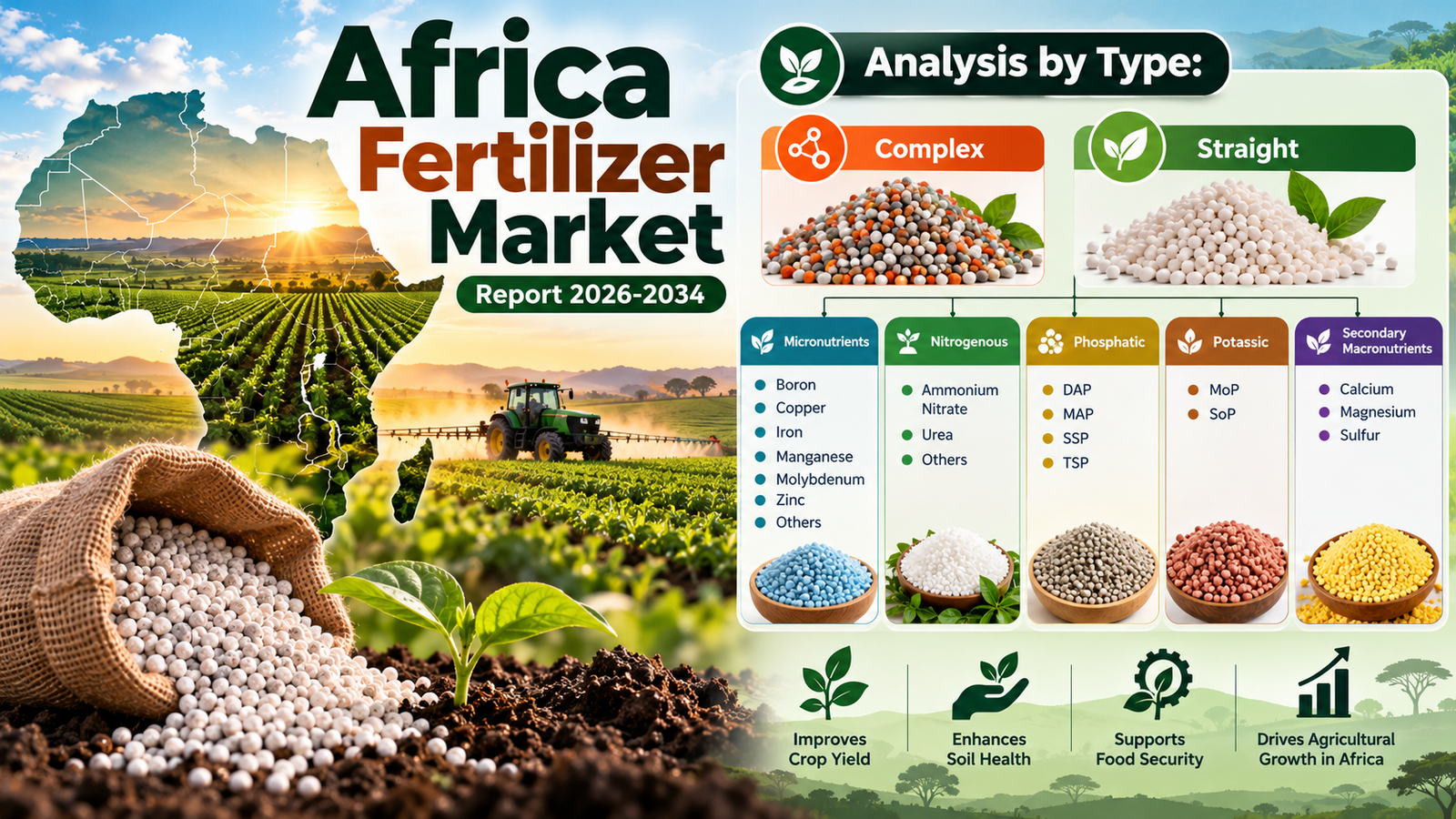
IMARC Group, a leading global market research and management consulting firm, has published its latest market intelligence report on the Africa fertilizer market size reached USD 188.13 Billion in 2025. The market is projected to reach USD 247.02 Billion by 2034, growing at a CAGR of 3.07% during 2026-2034, driven by expanding government-led fertilizer subsidy programs aimed at food security, accelerating investments in domestic production capacity to reduce import dependency, and growing adoption of precision agriculture technologies that improve nutrient efficiency across the continent.
The market is experiencing steady momentum as African governments, development finance institutions, and industrial groups align behind a common goal: raising fertilizer use and local supply to lift crop yields. Smallholder farmers, who dominate African agriculture, are gaining better access to nutrients through subsidy schemes, blended products matched to local soils, and mobile advisory tools. At the same time, large urea and phosphate complexes are being built close to natural gas and phosphate reserves, shifting the continent from import reliance toward regional self-sufficiency.
How AI is Reshaping the Future of the Africa Fertilizer Market?
- AI-Powered Precision Nutrient Management for Smallholder Farmers: Machine learning platforms analyze satellite imagery, soil health data, weather patterns, and crop conditions to generate field-specific fertilizer recommendations. These tools can help farmers cut fertilizer waste by up to 30% while protecting yields, making agronomic expertise available through basic mobile phones in areas with limited extension services.
- Mobile AI Advisory and Digital Farming Programs: Fertilizer producers are launching AI-driven apps that suggest the right product, quantity, and timing based on real-time weather and soil data. Yara International introduced such a mobile application in Kenya in July 2024, showing how input suppliers are moving from selling bags to selling data-backed crop solutions.
- Smarter Supply Chain, Demand Forecasting, and Plant Operations: AI-based demand forecasting helps manufacturers and distributors plan production, port logistics, and inland stocking ahead of planting seasons. Predictive maintenance and process optimization in ammonia, urea, and phosphate plants raise uptime and lower energy use, which is critical as new large-scale capacity comes online.
Grab a sample PDF of this report: https://www.imarcgroup.com/africa-fertilizer-market/requestsample
Africa Fertilizer Market Trends and Drivers
The Africa fertilizer market is witnessing steady expansion, fueled by the convergence of food security priorities, subsidy-backed access, large-scale industrial investment, and the shift toward data-driven farming.
Government subsidy programs are widening access. Active fertilizer subsidy schemes operate in more than 30 African countries, benefiting millions of farming households that could not otherwise afford commercial inputs. Kenya doubled its subsidized fertilizer distribution from 6 million bags to 12 million bags, supporting maize output of more than 80 million bags. Ethiopia’s Agricultural Transformation Agency has promoted blended fertilizers tailored to regional soils, Nigeria operates the National Fertilizer Quality Control Scheme to improve quality and distribution, and Ghana’s Planting for Food and Jobs program supports smallholder input use.
The Nairobi Declaration is setting a continental direction. Adopted in May 2024 at the Africa Fertilizer and Soil Health Summit, the declaration commits African Union member states to triple domestic production and distribution of certified fertilizers within ten years. It also targets agronomic services for at least 70% of smallholder farmers, and it establishes the Soil Initiative for Africa and a ten-year action plan. The declaration calls for full operation of the Africa Fertilizer Financing Mechanism. Its backdrop is a usage rate well below the Abuja target of 50 kg of nutrients per hectare, which highlights the scale of the opportunity.
Domestic production capacity is expanding rapidly. Dangote Group’s USD 2.5 Billion urea complex in Lagos produces 3 million metric tons of urea annually, roughly twice Nigeria’s domestic demand, which has made the country a net exporter. The group is adding four new granulation units to lift capacity beyond 8 million tons and is building a USD 2.5 Billion plant in Ethiopia’s Gode region. Morocco’s OCP Group launched the Mzinda-Meskala Strategic Program in September 2024, targeting a 9 million ton rise in fertilizer capacity through new hubs in Youssoufia and Essaouira that use renewable energy and desalinated water. Indorama Eleme operates a urea plant in Rivers State with annual capacity of 1.4 million tons, with a further line planned.
Digital agriculture is improving nutrient efficiency. Satellite monitoring, drone mapping, soil testing, and AI advisory apps are enabling site-specific, crop-specific application instead of blanket recommendations. Precision approaches have been shown to reduce fertilizer use by up to 30% and save up to 50% of irrigation water, and the African Union’s Digital Transformation Strategy explicitly supports their adoption.
Key challenges remain. Africa imports over 80% of its fertilizer needs, and fertilizer costs doubled in countries such as Kenya, Uganda, and Tanzania during the Ukraine crisis. Sub-Saharan Africa uses less than 20 kg of fertilizer per hectare against a global average of 146 kg, and local prices are typically four times higher than in Europe. Fewer than 25% of smallholders have access to formal credit, and weak roads, ports, and storage raise delivered costs for inland farmers. Addressing these gaps is central to the next phase of market development.
Africa Fertilizer Industry Segmentation
The report has segmented the market into the following categories:
Breakup By Type:
- Complex
- Straight
- Micronutrients (Boron, Copper, Iron, Manganese, Molybdenum, Zinc, Others)
- Nitrogenous (Ammonium Nitrate, Urea, Others)
- Phosphatic (DAP, MAP, SSP, TSP)
- Potassic (MoP, SoP)
- Secondary Macronutrients (Calcium, Magnesium, Sulfur)
Nitrogenous products such as urea and phosphatic products such as DAP and TSP anchor demand, supported by large new urea capacity in West and East Africa and by North Africa’s phosphate base. Potash remains a notable supply gap, with the bulk of imports consisting of nitrogen and potash products.
Breakup By Form:
- Conventional
- Speciality
- CRF
- Liquid Fertilizer
- SRF
- Water Soluble
Conventional granular products serve the bulk of field crop demand, while speciality fertilizers are gaining relevance in high-value horticulture and irrigated farming where efficiency and precision matter most.
Breakup By Application Mode:
- Fertigation
- Foliar
- Soil
Soil application remains the most widely used method among smallholders, while fertigation and foliar feeding are expanding with drip irrigation and commercial horticulture.
Breakup By Crop Type:
- Field Crops
- Horticultural Crops
- Turf and Ornamentals
Field crops such as maize, rice, wheat, and cassava account for the bulk of nutrient demand, supported by subsidy programs, while horticultural crops are a growing, higher-margin opportunity.
Breakup By Country:
- South Africa
- Morocco
- Nigeria
- Tunisia
- Kenya
- Others
Morocco leads as a producer through OCP Group, while Nigeria is emerging as a major urea exporter. South Africa and Kenya combine commercial farming demand with large blending and distribution networks.
Competitive Landscape
The competitive structure of the Africa fertilizer industry is moderately fragmented, with established global firms and fast-growing regional players pursuing capacity expansion, government partnerships for subsidy delivery, vertical integration, and investment in rural distribution. The report provides a comprehensive analysis of the competitive landscape with detailed profiles of leading companies, including:
- OCP Group
- Dangote Fertilizer Limited
- Indorama Eleme Fertilizer & Chemicals Limited
- Yara International ASA
- Notore Chemical Industries
Recent News and Developments in Africa Fertilizer Market
- June 2026: Africa Finance Corporation announced backing for a US$7 billion Dangote Group fertilizer expansion programme designed to triple production capacity in Nigeria and build a major new manufacturing platform in Ethiopia. The support includes US$600 million in financing for Dangote Fertilizer’s expansion.
- May 2026: Officials announced that investment in the Dangote Fertilizer project in Ethiopia would rise to over US$4 billion, reinforcing its role as East Africa’s largest planned urea complex.
- April 2026: Indorama Corp. signed a contract to invest US$525 million in a fertilizer project in Egypt, adding to its African nitrogen portfolio.
- November 2025: Dangote Fertilizer Limited signed a licensing agreement with thyssenkrupp Uhde to add four urea granulation units at its Lagos facility, each producing 4,235 metric tons per day. The expansion will lift total annual output from 2.65 million tons to over 8 million tons.
- October 2025: Dangote Group and the Ethiopian government launched construction of a USD 2.5 Billion fertilizer plant in Gode, Ethiopia. It is designed to produce three million metric tons of urea annually using natural gas from the Ogaden Basin.
- August 2025: OCP Group announced that its TSP production capacity would reach 7 million tons through two new lines at the Jorf Lasfar platform, each adding 500,000 tons annually to output of more than 5 million tons.
Note: If you require specific details, data, or insights that are not currently included in the scope of this report, we are happy to accommodate your request. As part of our customization service, we will gather and provide the additional information you need, tailored to your specific requirements. Please let us know your exact needs, and we will ensure the report is updated accordingly to meet your expectations.
About Us
IMARC Group is a global management consulting firm that helps the world’s most ambitious changemakers to create a lasting impact. The company provides a comprehensive suite of market entry and expansion services. IMARC offerings include thorough market assessment, feasibility studies, company incorporation assistance, factory setup support, regulatory approvals and licensing navigation, branding, marketing and sales strategies, competitive landscape and benchmarking analyses, pricing and cost research, and procurement research.
Contact Us
IMARC Group
134 N 4th St. Brooklyn, NY 11249, USA
Email: sales@imarcgroup.com
Tel No: (D) +91 120 433 0800
United States: +1-201-971-6302