
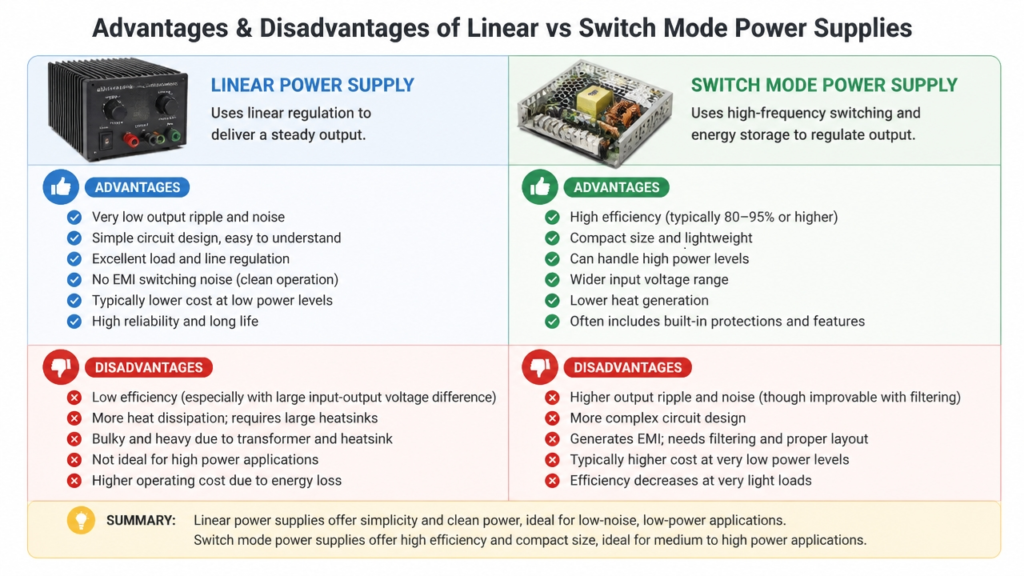
When selecting a power supply for electronic equipment, the two main options are linear power supplies and switch mode power supplies. Both convert AC mains electricity into DC voltage, but they do so using very different methods, which affects their efficiency, size, cost and electrical noise output.
Understanding the differences between these two types is essential for choosing the right unit for a specific application. This article explains how each type works, outlines their strengths and weaknesses and provides guidance on when to use each one, with particular attention to sensitive electronics.
How Linear Power Supplies Work
Linear power supplies operate by passing AC voltage through a transformer, which steps the voltage down to a lower level. The reduced AC voltage is then rectified into DC and passed through a regulator circuit that smooths the output to a constant voltage.
The key characteristic of a linear supply is that the regulating transistor operates in its linear region, meaning it acts like a variable resistor to drop excess voltage. Any difference between the input voltage and the required output voltage is dissipated as heat.
Advantages of Linear Power Supplies
- Very low output ripple and noise. Linear supplies produce clean DC output with minimal voltage fluctuation, making them ideal for audio equipment, precision measurement devices and laboratory instruments.
- Simple design. They use fewer active components, which makes them easier to troubleshoot and repair.
- Excellent transient response. They respond quickly to sudden changes in load current.
- No high-frequency switching noise. Because they do not switch at high frequencies, they generate no electromagnetic interference in the radio frequency range.
Disadvantages of Linear Power Supplies
- Poor efficiency. Typically 30% to 50% efficient, with the remainder lost as heat. Large heatsinks are required to dissipate that heat.
- Large and heavy. The mains-frequency transformer is bulky and heavy, especially for higher output currents.
- Limited power range. Above roughly 100 Watts, linear supplies become impractical due to size and heat.
- Cost at higher power. The transformer and heatsink materials make high-power linear supplies expensive.
How Switch Mode Power Supplies Work
Switch mode power supplies (SMPS) use a different approach. They rectify the AC mains to DC, then rapidly switch that DC voltage on and off at high frequencies, typically between 50kHz and 1MHz. This high-frequency AC is passed through a much smaller transformer, which steps the voltage up or down as required. The output is then rectified and filtered to produce DC.
The switching transistor operates in either a fully on or fully off state, which minimises energy loss. The output voltage is regulated by adjusting the duty cycle of the switching waveform. The article What Exactly Is a Power Supply? AC vs DC Explained has detailed information about SMPs.
Advantages of Switch Mode Power Supplies
- High efficiency. Typically 80% to 95%, meaning less wasted energy and less heat generation.
- Compact and lightweight. The high-frequency transformer is much smaller than a mains-frequency transformer, allowing for compact designs.
- Wide input voltage range. Many switch mode supplies accept a broad range of input voltages (100–240V AC), making them suitable for international use.
- Cost-effective at higher power. For outputs above about 25 Watts, switch mode designs are generally cheaper to manufacture.
- Built-in protection. Most switch mode units include short-circuit, overvoltage and overcurrent protection as standard.
Disadvantages of Switch Mode Power Supplies
- Output noise and ripple. Switch mode supplies exhibit switching ripple at the converter frequency, typically in the range of 10 to 100 millivolts. This can interfere with sensitive analogue circuits.
- Electromagnetic interference (EMI). The high-frequency switching generates EMI, which can affect nearby equipment. Proper filtering and shielding are required.
- More complex design. The higher component count and control circuitry make them harder to repair.
- Slower transient response. Compared to linear supplies, switch mode units may respond more slowly to rapid load changes.
Comparison Table
| Feature | Linear Power Supply | Switch Mode Power Supply |
|---|---|---|
| Efficiency | 30–50% | 80–95% |
| Output ripple and noise | Very low | Low to moderate |
| Size and weight | Large and heavy | Compact and lightweight |
| Heat generation | High | Low |
| Cost at low power (<25W) | Low | Higher |
| Cost at high power (>25W) | High | Lower |
| Electromagnetic interference | Minimal | Requires filtering/shielding |
| Transient response | Fast | Slower |
| Complexity | Simple | Complex |
| Typical power range | Up to ~100W | From <1W to several kW |
| Typical lifespan | Long (fewer stressed parts) | Depends on capacitor quality |
Typical Use Cases
Linear Power Supplies Are Best For:
- Audio amplifiers and studio equipment. Ripple and noise corrupt audio signals and linear supplies provide the cleanest DC possible.
- Laboratory bench supplies. Precision measurements require stable, low-noise output.
- RF circuits and radio transceivers. Switching noise can interfere with radio frequency performance.
- Medical instrumentation (in controlled settings). Low noise is critical for sensitive biological measurements.
Switch Mode Power Supplies Are Best For:
- Computers and digital equipment these devices tolerate small ripple and benefit from high efficiency and compact size.
- LED lighting drivers efficiency and small form factor are important.
- Battery chargers the wide input range and low cost make SMPS the standard choice.
- Industrial equipment high power output, protection features and efficiency suit factory environments.
- Everyday consumer electronics phone chargers, laptop adapters and set-top boxes all use switch mode technology.
Which Type Is Best for Sensitive Electronics vs Everyday Devices?
Sensitive Electronics
For sensitive analogue circuits, precision instruments and high-end audio equipment, a linear power supply is generally the better choice. The low output ripple and absence of high-frequency switching noise prevent interference that could degrade signal quality or measurement accuracy. Where absolute cleanliness of DC is required, linear supplies remain the industry standard.
Everyday Devices
For everyday electronics, computers, monitors, routers, chargers and most consumer equipment, switch mode power supplies are the superior option. They are efficient, inexpensive, compact and reliable. The small amount of ripple they produce is easily handled by the voltage regulators built into digital circuitry.
Australian Electrical Standards A General Note
In Australia, all power supplies sold for consumer use must comply with relevant standards managed by Standards Australia, including AS/NZS 62368.1 for audio/video and ICT equipment safety. Mains-connected power supplies must also meet electromagnetic compatibility requirements under the Australian Communications and Media Authority (ACMA) framework.
When purchasing a power supply, buyers should look for units that carry the appropriate compliance markings. Campad Electronics offers a range of DC power supplies that are designed for Australian mains voltage and fitted with Australian plug types.
Summary
Both linear and switch mode power supplies have distinct roles in electronics. Linear supplies offer unrivalled output cleanliness but sacrifice efficiency and size. Switch mode supplies offer high efficiency, low cost and compact dimensions but introduce switching noise into the output. For sensitive electronics, linear power supplies are recommended. For everyday devices where efficiency, size and cost matter, switch mode supplies are the practical choice.
Buyers should match the power supply type to the requirements of their specific application, considering voltage, current, noise tolerance and physical constraints. For a wide selection of both switch mode plug packs and higher-power units, visit the power supplies page at Campad Electronics.
Frequently Asked Questions
Can I use a switch mode power supply with audio equipment?
Yes, but only if the equipment has adequate internal regulation and filtering. For high-end audio or studio gear, a linear supply is strongly recommended because switch mode ripple and high-frequency noise can be audible as hum or hiss.
Why are linear power supplies so heavy?
They use a large mains-frequency transformer (50/60Hz) made of copper and iron. This transformer is physically large and heavy because it must handle the full output power at low frequency. Switch mode supplies use a much smaller high-frequency transformer.
Are switch mode power supplies safe for medical devices?
Some are, but not all. Medical-grade SMPS units are available with very low leakage current and strict isolation standards. However, for extremely sensitive biological measurements, linear supplies are still preferred due to lower noise.
How much heat does a linear power supply generate compared to a switch mode?
A linear supply wastes 50–70% of input energy as heat. A switch mode supply wastes only 5–20%. For example, a 50W linear supply may dissipate over 50W of heat, while a comparable SMPS may dissipate less than 10W.
Can I replace a linear power supply with a switch mode one in an existing device?
Sometimes, but you must check the output voltage, current rating, ripple tolerance and input voltage range. If the device contains sensitive analogue circuits or RF stages, a switch mode supply may introduce unacceptable noise. Always verify the output ripple specification. See How to Choose the Right Power Supply for Your Device for further information on selecting the correct power supply for your device.
What is output ripple and why does it matter?
Output ripple is a small AC voltage superimposed on the DC output. Linear supplies have ripple of less than 1–2mV. Switch mode supplies typically have 10–100mV ripple at the switching frequency. In digital circuits this is usually harmless but in precision measurement or audio, it can degrade performance.
Do switch mode power supplies require special wiring or shielding?
They generate electromagnetic interference (EMI) that must be contained. Most commercial units include internal filtering and metal enclosures. When installing them, keep input and output wires short and away from sensitive signal cables. Earthing must comply with local electrical codes.
What is the typical lifespan of each type?
Linear supplies often last 10–20 years because they have few stressed components. Switch mode supplies depend heavily on the quality of electrolytic capacitors and cooling. Good quality SMPS units can last 5–10 years, but poor units may fail sooner, especially in hot environments.
Are switch mode power supplies more expensive to repair?
Yes. Their complex circuitry and surface-mount components make repair difficult and often uneconomical. Linear supplies are simpler and can usually be repaired by replacing discrete components like transistors, diodes or capacitors.
Which type is more efficient at very low power, say under 5 Watts?
At very low power levels, the difference narrows. Linear supplies below 5W are simple and cheap, but still inefficient. Switch mode supplies below 5W can be designed efficiently but may cost more due to control circuitry. For battery-powered or standby applications, switch mode is generally preferred.
Can switch mode power supplies be used with inductive loads like motors?
Yes, but you must ensure the supply has sufficient peak current capacity and protection against back-EMF. Many SMPS units have overcurrent and short-circuit protection, but not all are designed for high inrush currents. Check the datasheet for surge ratings.
What do the terms “regulated” and “unregulated” mean for power supplies?
A regulated supply maintains a constant output voltage despite changes in input voltage or load. Linear supplies are naturally regulated by their linear regulator. Switch mode supplies are regulated by adjusting the duty cycle. Unregulated supplies (often simple transformer-rectifier units) have significant voltage variation and are not suitable for sensitive electronics. The article Regulated vs Unregulated Power Supplies Explained is a good read for information on regulated vs unregulated SMPS.
Do Australian standards require specific certifications for power supplies?
Yes. Mains-connected power supplies sold in Australia must comply with AS/NZS 62368.1 (safety) and the ACMA electromagnetic compatibility (EMC) framework. Look for the Regulatory Compliance Mark (RCM) on the unit. Purchasing uncertified units may be unsafe and illegal for resale. This article Australian Power Supply Standards: An In Depth Look has more information.
Is it true that switch mode power supplies are more likely to fail than linear ones?
They have more components and operate at higher electrical stress, so statistically they can be less reliable than simple linear designs. However, modern SMPS units with quality components and good thermal design can be highly reliable. Failures are often due to poor capacitors or inadequate cooling.
Which type should I choose for a laboratory bench supply?
For most lab work, a linear supply is preferred due to its low noise and fast transient response. If you need higher power, e.g. above 100W and can tolerate ripple, a high-quality switch mode bench supply with low ripple specifications may be acceptable. Check the ripple specification before purchase.