
The Association of Chartered Certified Accountants (ACCA) has developed a comprehensive syllabus that provides students with the accounting, finance, taxation, auditing and business management knowledge needed to achieve success as a professional. This internationally recognized qualification from ACCA enables students to develop both technical and professional skills.
It’s very important for those who want to start working in the accounting field to understand what’s on the ACCA syllabus. The ACCA syllabus will give you a good idea of which topics are covered, at each level of the exam, and what you need to know to pass the qualification.
What Is the ACCA Syllabus?
The official study guide for Detailed ACCA syllabus which lists all of the areas to be tested. The syllabus provides a student with a clear idea of what he/she has to study and how his/her knowledge of these subject areas will be evaluated.
The syllabus is updated frequently so that students can be sure it contains up-to-date information regarding the most current accounting standards, business practices, technology, and financial regulations. It is important for students to utilize the syllabus that corresponds with their examination date.
ACCA Syllabus and Course Structure
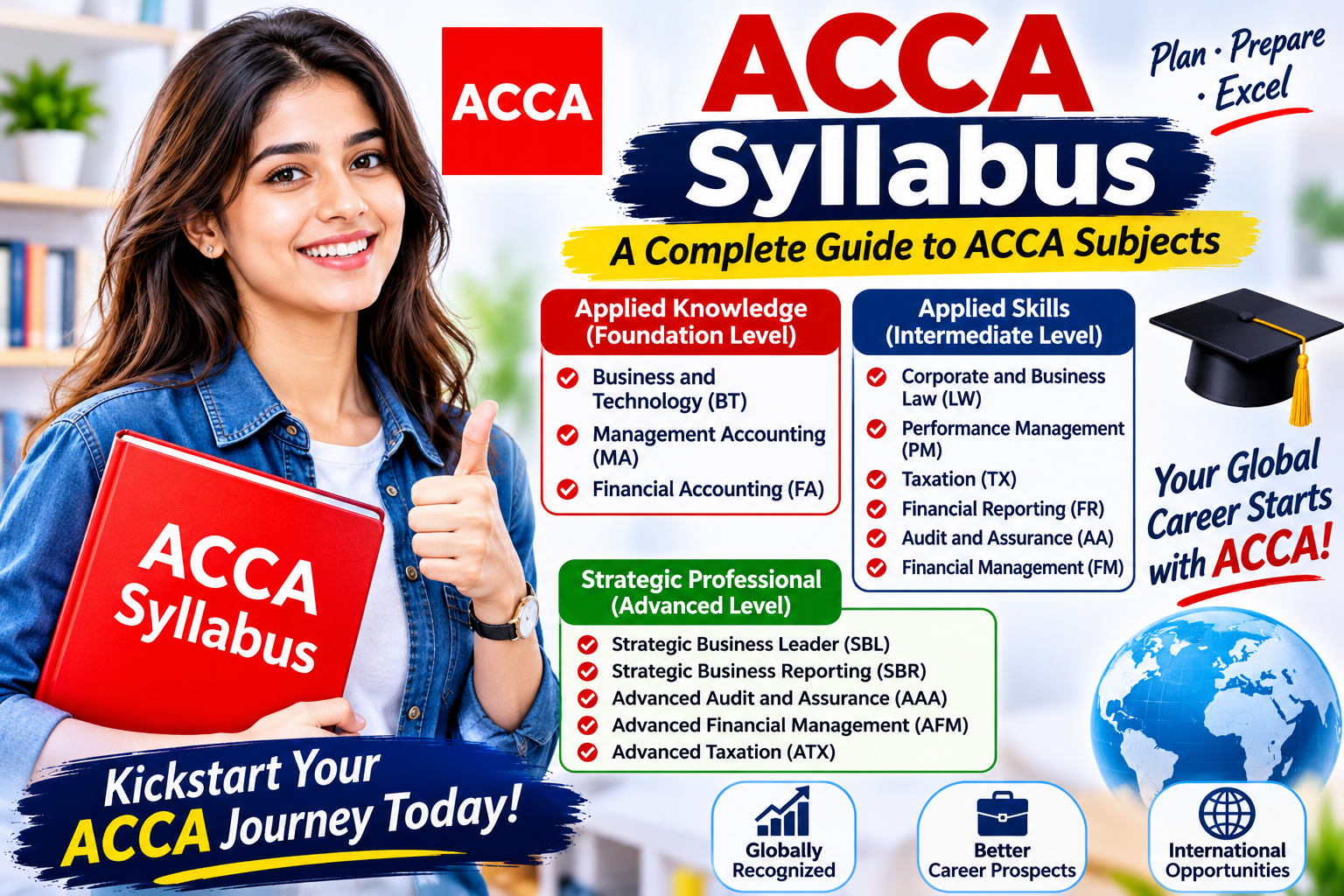
The current syllabus for the ACCA Qualification has three major areas of assessment: Applied Knowledge, Applied Skills, and Strategic Professional.
Applied Knowledge Level
At this point in their studies, students have been introduced to basic financial accounting principles. Students are also introduced to some of the core elements of the business world. This level of study is ideal for students that would like to build a solid background in finance.
The subjects included are:
Business & Technology (BT): introduces organizations, management, leadership and technology.
Management Accounting (MA): Covers costing, budgeting, planning, and financial decision making.
Financial Accounting (FA): The principles of accounting, the recording of transactions, and the preparation of financial reports.
Students will be able to use these topics to learn the fundamentals of accounting and business practices.
Applied Skills Level
The applied skill level provides advanced technical knowledge and practical application of accounting/financial concepts within a work environment.
The subjects include:
The field of Corporate and Business Law (LW) addresses those legal rules that pertain to businesses and professionals.
The performance management (PM) is focused on the measurement of performance, budget, and making management decisions.
Taxation (TX): Will introduce the students to various types of taxation systems, how to calculate taxes, and what are the required steps for compliance with these systems.
Financial Reporting (FR): Covers financial statements and reporting standards.
Audit and Assurance (AA) describes the steps involved in conducting audits, assessing risks associated with those audits, and providing assurance services.
Financial Management (FM): This area of study is concerned with how organizations use their money, make financial decisions about investments, manage their finances in general, and plan for future financial needs.
This course is intended to prepare students for careers in the field of accounting, auditing, taxation, and financial management.
Strategic Professional Level
The Strategic Professional level of the ACCA syllabus is an advanced stage that emphasizes strategic thought processes, management and leadership, and the ability to make sound professional judgments when making decisions about businesses.
Students complete two compulsory subjects:
Strategic Business Leader (SBL)
Strategic Business Reporting (SBR)
They also choose two optional subjects from the available options:
Advanced Financial Management (AFM)
Advanced Performance Management (APM)
Advanced Taxation (ATX)
Advanced Audit and Assurance (AAA)
The elective courses will enable students to build knowledge base in an area of interest for a potential job.
ACCA Course Fees in India: Complete Guide to Registration, Exam and Coaching Costs
The ACCA Course Fees in India are an important consideration for students planning to pursue a professional qualification in accounting and finance. The Association of Chartered Certified Accountants (ACCA) offers an internationally recognised qualification that helps students develop financial knowledge, accounting expertise, and business management skills.
Before enrolling, students should understand the different expenses involved, including registration fees, examination fees, annual subscription charges, exemption fees, and coaching costs. Proper financial planning can help candidates manage their ACCA journey effectively.
What Are ACCA Course Fees in India?
Affordable ACCA Course Fees in India refer to the total amount students spend to complete the ACCA Qualification. These expenses are divided into two main categories: official ACCA fees and tuition fees charged by coaching institutes.
Official fees are paid directly to ACCA, usually in British pounds. Coaching fees are paid separately to the selected learning provider and vary depending on the institute, course format, and number of subjects.
The overall cost depends on the student’s educational background, examination attempts, exemptions, and study duration.
ACCA Registration Fees
Students must pay an initial registration fee when joining ACCA as a student. This is a one-time payment required to begin the qualification.
ACCA may offer promotional or reduced registration rates, so students should check the official fee page before registering.
After registration, students must also pay an annual subscription fee to maintain their active student status.
ACCA Examination Fees in India
Examination fees form a significant part of the total ACCA course cost. Students pay an examination fee for each paper they attempt.
The ACCA Qualification includes different examination levels:
ACCA Ethics and Practical Experience
In addition to taking exams, all students are required to complete the Ethics and Professional Skills Module. The purpose of this module is to help students develop a sense of ethics, communication skills, leadership skills and professional conduct.
In addition, all candidates will need to meet the Practical Experience Requirement (PER) of completing a minimum amount of work-place experience while being able to demonstrate that they have acquired and can apply professional skills.
These requirements allow students to acquire practical experience while also developing academic knowledge.
Importance of the ACCA Syllabus
There are many ways that the ACCA syllabus will benefit you as you prepare for a professional accounting career.
The CIMA program is a structured study course which provides the candidate with an organized study schedule, while allowing him/her to develop a broad knowledge base within many aspects of finance. Additionally, the CIMA curriculum promotes a student’s understanding of ethical behavior in the workplace, as well as developing a student’s ability to use the tools learned during the CIMA program to solve actual businesses’ problems.
Students who follow their official course syllabus and study guides will be able to better plan and organize themselves when preparing for exams.
ACCA Syllabus Changes and Updates
The ACCA updates the qualification on a regular basis to ensure that the qualification remains current with the needs of today’s businesses. The ACCA Qualification will be updated starting in 2027, with new levels introduced, employability module options added and exam formats updated.
Students should check the ACCA’s official website for the syllabus that is relevant to their examination period prior to starting to prepare.
Conclusion
The ACCA syllabus provides students with a roadmap to successfully complete their studies to prepare for careers in accounting, finance, and business management. This includes developing foundational accounting principles, gaining high level financial expertise and acquiring a strong understanding of strategic professional knowledge.
By knowing the syllabus, finding appropriate study materials, and studying regularly, you will be able to establish a solid basis for your ACCA exams as well as future employment options. In addition to establishing a solid basis for your ACCA exams and future employment options, using a correct keyword strategy can help educational sites connect with students seeking ACCA syllabus info.