
A weak consumer brand strategy rarely fails loudly. Sales do not collapse overnight. Instead, ad costs creep up, discounts become the only lever that works, and customers struggle to explain why they bought from you.
Most of these problems trace back to a handful of avoidable mistakes. Below are seven we see often in growing consumer businesses, along with practical fixes you can start on this quarter.
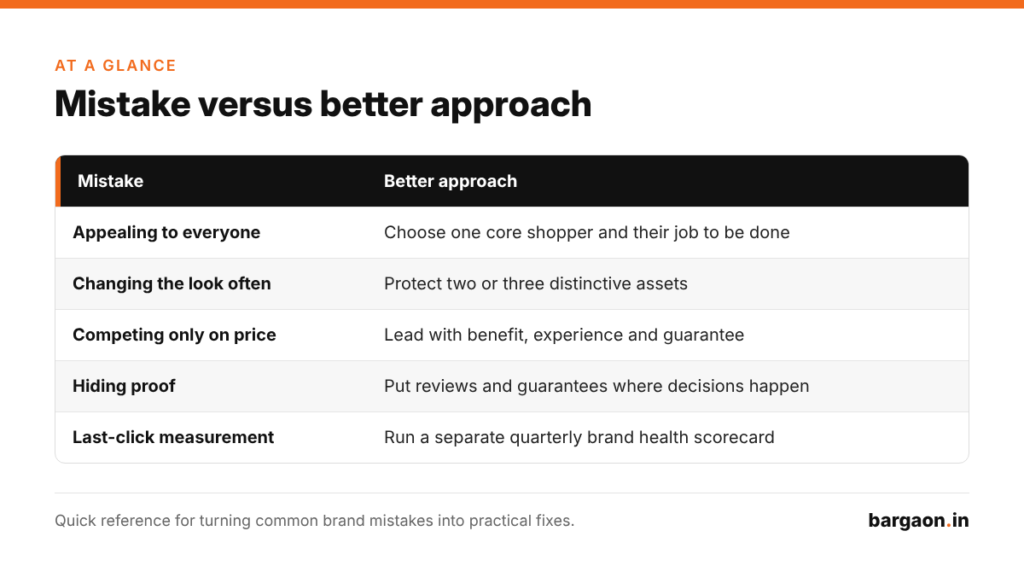
1. Trying to appeal to everyone
When a brand speaks to every age group, every budget and every need, it ends up speaking clearly to none. Shoppers cannot see themselves in a message that is built to offend no one.
Pick a primary shopper and describe the job they are hiring your product to do. The Jobs to Be Done theory from the Christensen Institute is a helpful lens for this, because it focuses on the progress a customer wants rather than demographics alone.
2. Changing the look every campaign
New creative feels exciting inside the team, but customers see your brand far less often than you do. Every time the colours, fonts or tone shift, you ask them to learn you again.
Lock in a short list of brand assets and write simple rules for using them. Let campaigns vary the message, not the identity.
A quick check helps here. Lay your last ten ads, posts and packaging shots side by side with the logo covered. If a stranger could not tell they came from the same brand, your identity is not doing its job yet.
3. Treating consumer brand strategy as a design project
A brand book with beautiful mockups is not a strategy. Strategy decides who you serve, what you promise, what you will not do, and how that shows up in pricing, packaging, service and range.
If the promise is “effortless”, but returns take three weeks, the operations team is undoing the brand work. Bring customer service and fulfilment into brand decisions early. The consumer brand strategy guide explains how to connect these pieces so the promise holds up in practice.
4. Competing only on price
Discounts can drive short-term volume, but a brand known mainly for deals trains customers to wait for the next sale. Margins shrink and loyalty stays shallow.
Give people a reason to pay full price: a clear benefit, a better experience, a stronger guarantee or a story they want to be part of. Use offers to reward behaviour, not as the default reason to buy.
Bundles, sampling, loyalty rewards and early access are useful alternatives. They add value without teaching customers that the list price is never the real price.
5. Hiding the proof
Many brands have strong reviews, certifications or founder stories, then bury them on an About page few people visit. Shoppers make decisions on product pages, in ads and in search results.
Move your strongest proof to where decisions happen. Short quotes near the buy button, a visible guarantee and real customer photos often do more than another paragraph of brand copy.
- Reviews beside the price, not in a footer tab
- Guarantees and return terms above the fold
- Ingredient or material details one tap away
6. Ignoring what customers actually say
The language customers use in reviews, support chats and social comments is often sharper than anything written in a workshop. Ignoring it means missing your best positioning lines.
Set up a simple monthly habit: export reviews and support tickets, highlight repeated words, and share the top phrases with the marketing team. This takes an hour and often surfaces benefits nobody had written down.
Collect recurring phrases every month. If several customers describe your product the same way, test that wording in headlines and ads. Harvard Business Review regularly publishes work on customer insight that is worth reading for B2C brand building teams.
7. Measuring only last-click results
If every channel is judged on immediate sales, brand-building activity will always look weak and get cut. Over time, performance channels become more expensive because fewer people already know you.
Keep a separate scorecard for brand health. Track recall, branded search, repeat rate and customer sentiment alongside revenue, and give brand work enough time to show results.
Agree upfront with finance and leadership on what success looks like over six and twelve months. That protects long-term work from being cut after one quiet month.
Fixing the foundations
None of these mistakes needs a full rebrand to fix. Most need clearer choices, better discipline and closer links between marketing and the rest of the business.
It also helps to name an owner for the brand system. Without one person accountable for consistency, small exceptions pile up across teams, agencies and marketplaces until the brand no longer looks or sounds like itself.
Start by scoring your brand against the seven points above, then work on the two weakest areas first. The full guide walks through how to make the promise recognisable, relevant and easy to choose, step by step.