Introduction
A billing specialist discovers that a completed forty-eight-thousand-dollar invoice carried the wrong tax classification. At Tech Leads IT, we use this scenario in Oracle Cloud Financials Online Training because the customer already has the invoice, so quietly editing a draft is no longer possible. The team issues a credit memo and prepares a corrected invoice, but the paperwork becomes hard to explain unless the replacement points back to the original.
That reference is part of the correction. Oracle Cloud Financials Training Online teaches learners to choose the right source, record the reason, and leave a trail any reviewer can follow.
Write Down the Correction Before You Create Anything
Start with a short correction record. It should say what is wrong, what is still valid, who approved the fix, and which transaction is affected. In this case the quantity, price, customer, and contract basis all stay the same. Only the tax treatment and the resulting total need to change. Saying that out loud keeps the rebill from turning into a chance to slip in unrelated commercial edits.
Capture the original transaction number, business unit, bill-to account, currency, completion status, disputed amount, and the expected credit and replacement totals. A preparer should be able to explain the planned document chain before typing a single field, and an approver should be able to hold it up next to the customer communication and see that the two agree.
Pick the Source by Identity, Not by Resemblance
When you prepare the replacement invoice, you select the original in the Rebill Source Transaction field. Search results can be messy. You may see similar invoice numbers, repeated customer references, or several transactions with the same amount. Before you choose one, check the business unit, customer account, transaction date, currency, and amount.
The field is meant to reference a transaction in the invoice class, and the referenced invoice has to exist and be complete. Those are helpful guardrails, but they don’t remove the operator’s responsibility. An invoice being eligible only means it can be referenced. It doesn’t prove it’s the one you meant.
Why Oracle Cloud Financials Online Training Should Include Near-Match Tests
The best way to see whether a team really picks sources by identity is to make it hard. In a practice environment, create two completed invoices for the same customer with adjacent dates and identical totals. Correct only one of them. Ask the tester to find the source through the normal search path, then write down which attributes they used to tell the two apart. Finish the rebill and inspect the relationship it created.
This exercise shows quickly whether a procedure leans too heavily on a displayed number or amount. It also surfaces data-entry habits that work fine on a small test set and turn risky in a busy receivables department, where duplicate purchase-order references and recurring monthly values are everyday occurrences. Good Oracle Cloud Financials Online Training builds in these tempting near matches on purpose, because learners who only ever see clean data never practice the judgment the job actually demands.
Carry the Reference Through Every Entry Channel
The source reference can arrive through the transaction page, AutoInvoice, or REST services. The technical shape differs in each case. A page user picks from a list of values, an import maps source details onto the interface line, and an integration places them in a payload. The business control, though, has to be the same everywhere.
Oracle’s documentation on original invoice and credit memo references for rebill invoices notes that the application checks whether the referenced invoice is eligible for rebilling. Don’t wait for that check to catch everything. Build upstream validation that flags missing or contradictory source details early, and send failures to a correction queue with the proposed rebill held in draft. Stripping out the relationship just to keep processing moving is the wrong trade.
Also don’t assume every service handles the reference just because one does. The rebill source reference is not supported through Receivables SOAP services. If you have integrations that create replacement invoices, list them and note which route each one uses.
For the AutoInvoice and REST paths, keep a stable correlation between the approved correction record, the inbound data, the processing result, and the transaction that gets created. Then test four cases: a valid source, an incomplete source invoice, a nonexistent identifier, and a source from the wrong business context. The goal isn’t only to see acceptance or rejection. You want proof that accepted records link correctly and that rejected records stay visible, owned, and safe to resubmit once they’re fixed.
Treat Completion as a Lineage Lock
While the rebill is still incomplete, review every corrected field and the source relationship together. Once the rebill is completed, the Rebill Source Transaction field becomes read-only. That makes the pre-completion review matter a great deal, because after that point the source is no longer a note you can tweak.
A simple checklist helps. Compare the replacement against both the approved correction and the original invoice. Confirm that the values you meant to keep still match, that the values you meant to change reflect the approval, that tax and accounting look right, and that the selected source is the correct one. A reviewer should be willing to reject a perfectly calculated replacement if its lineage points at the wrong original.
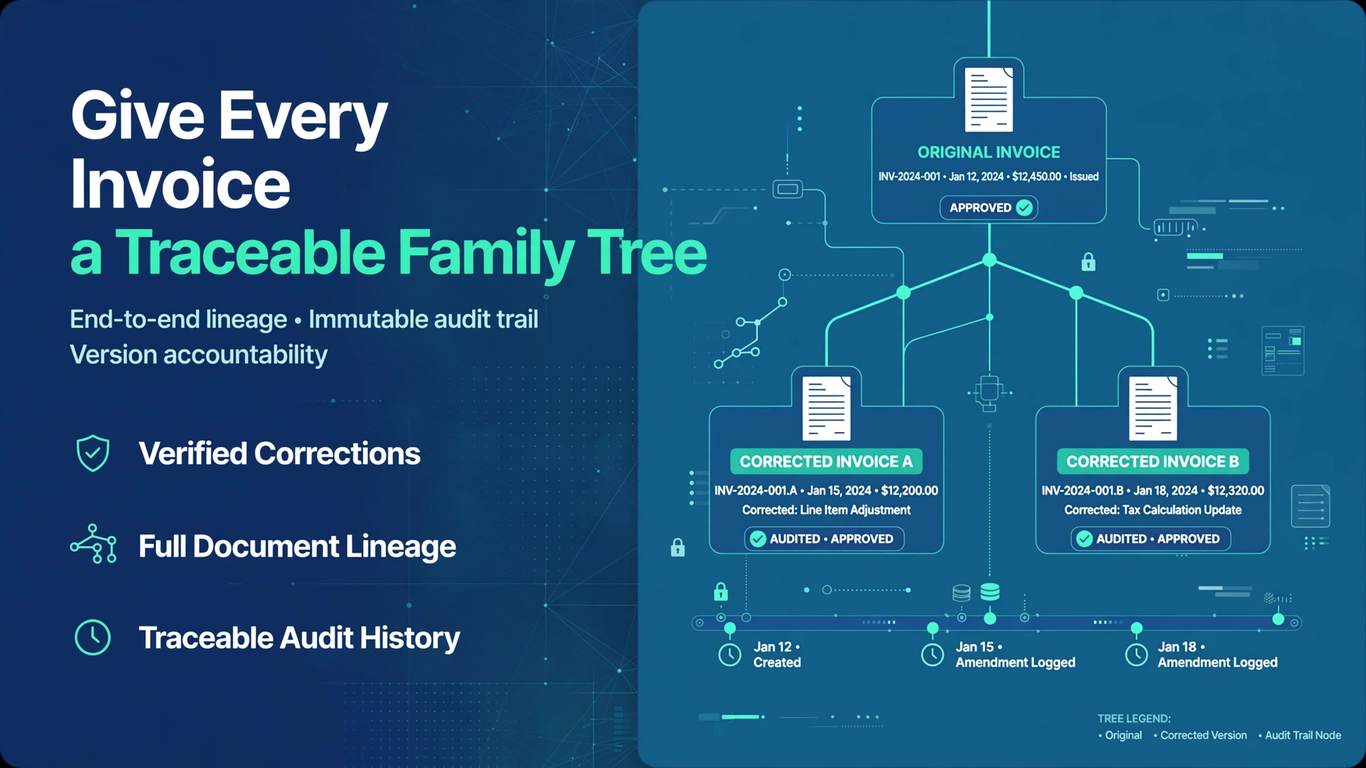
Completion also changes how the relationship gets investigated. After the rebill is complete, you can drill down from it to the original invoice. From the source transaction, you can review the related credit memo information in Transaction Activities. Test both directions as part of closeout: open the completed replacement and reach the source, then open the source and find the related credit activity. The point isn’t to prove that links exist somewhere in the data model. It’s to show that a collector, billing analyst, or auditor following the normal inquiry route can rebuild the story of why the customer saw an original charge, a reversal, and a corrected charge.
Reconcile the Whole Document Family
Reconcile the original, the credit memo, and the rebill at both line and total level. Compare original lines with credited lines and replacement lines, and be ready to explain every difference. Check tax, freight, distributions, transaction dates, accounting status, the customer balance, and any receipt treatment.
A full credit followed by a corrected rebill can produce a tidy net result, and that tidiness can hide problems. An omitted line or an accidental new charge may be sitting inside a total that looks right. Keep the approval, the original invoice, the credit memo, the rebill, the completion evidence, and the customer notice under your organization’s normal records policy. The lineage field cuts down on manual searching, but it doesn’t replace proof that the amounts and accounting are sound.
What Oracle Cloud Financials Training Online Should Test Before Release
A focused test pack beats a sprawling one. Include a correct manual rebill, a correct imported rebill, a reference to an incomplete invoice, a reference to the wrong but eligible invoice, a completed rebill whose source can no longer be edited, and a correction where the original already has receipt activity. Check the document relationship itself, not just whether processing finished.
Test recovery too. When an import fails, can the team fix the source data without creating a duplicate replacement? When a preparer picks the wrong source before completion, can the draft be corrected and independently reviewed? Clear answers to questions like these are worth more than a long script that marks every technically completed transaction as a pass. That’s the standard to aim for in any Oracle Cloud Financials Training Online program: learners should leave knowing how to prove a result, not only how to produce one.
Conclusion
A corrected invoice is easiest to defend when its family tree is built at creation, not pieced together months later. Approve the correction, verify the original invoice using several attributes, and populate the source through a supported channel. Then reviewing the relationship before completion makes it read-only, because that is the last moment to fix it.
Good Oracle Cloud Financials Online Training goes further. Learners follow the drill-down, reconcile the original, the credit memo, and the replacement, and explain the customer balance. Oracle Cloud Financials Training Online should also include near matches and failed references, so learners keep an accurate, navigable chain from the first charge to the corrected obligation.