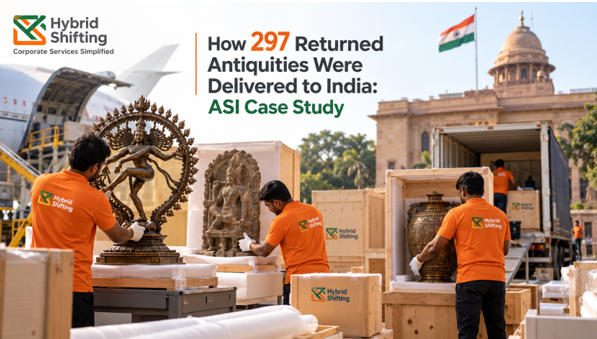
After the United States returned 297 cultural artefacts to India in September 2024, Hybrid Shifting delivered the priceless antiquities retrieved from the USA to the Archaeological Survey of India (ASI) between 26 and 30 December 2024. The project ran from origin assessment and custom crating through customs clearance, air freight, installation and final handover.
Moving a cultural artefact is nothing like moving cargo. Some of these objects are thousands of years old, and they cannot be replaced if damaged. This case study shows how a project of this kind is planned and delivered end to end.
What Was the 2024 Return of Antiquities from the US to India?
In September 2024, the United States returned 297 cultural artefacts to India. The collection included terracotta works, sculptures and vases made from stone, copper
and other materials. The pieces date from approximately 2000 BCE to 1900 CE, a span of nearly four thousand years.
Once artefacts like these are recovered, they still have to travel safely to the institution responsible for them. That is where high-value asset logistics comes in.
Who Delivered the Antiquities to the Archaeological Survey of India?
Hybrid Shifting is India’s Corporate Services Solutions company, and its High-Value Asset Logistics service handles art, antiques, designer furniture, chandeliers and precious artefacts.
An ASI certificate dated 30 December 2024 records Hybrid Shifting Solution India Private Limited (Pikkol) as the service provider for the delivery of the priceless antiquities retrieved from the USA, from 26 to 30 December 2024. The certificate describes the overall services as commendable. It was issued by the ASI’s Central Antiquity Collection Section in New Delhi.
What Was the Scope of the Project?
The project was managed as one integrated shipment lifecycle, from origin planning through destination delivery. It covered 15 stages:
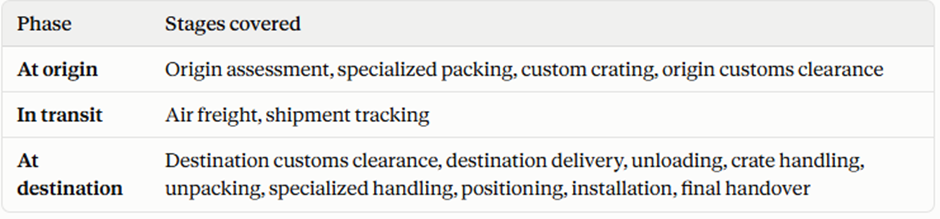
Handling these stages under one partner means fewer hand-offs and clearer accountability. When the objects are priceless, fewer hand-offs means less risk.
Why Do Cultural Artefacts Need Specialised Logistics?
Cultural artefacts need specialised logistics because their value, fragility, sensitivity and handling complexity go far beyond those of ordinary shipments.
- Value: the financial, historic and cultural significance of the object
- Fragility: delicate surfaces, structures and finishes
- Sensitivity: material and environmental requirements, such as terracotta, stone and copper each behaving differently in transit
- Complexity: dimensions, access and installation considerations
This is why the handling plan is designed around the piece, not the other way around. Every object is assessed individually according to its characteristics, value and journey.
How Does Hybrid Shifting Protect High-Value Assets in Transit?
The following describes Hybrid Shifting’s standard high-value asset process, the same framework applied across its fine art, antique and artefact projects.
1. Assessment and condition reporting. Before anything moves, the team carries out a site and access assessment, inventories each item, and records existing damage with photographs. The condition report becomes the reference point for the entire journey.
2. Specialized packing and custom crating. Protection is built in layers: surface protection, cushioning against vibration and impact, structural support for joints and vulnerable areas, immobilisation within the pack, and a custom crate suited to the piece. There is no one-size-fits-all approach.
3. Controlled movement. Vehicle readiness, trained crews, secure loading and bracing, milestone visibility, defined escalation for incidents, and tracking for real-time visibility.
4. Customs and international freight. Documentation, customs coordination, air or sea freight and insurance coordination are managed as one lifecycle. ATA Carnet coordination is available where relevant.
5. Destination handling and installation. Delivery is more than reaching the address. It includes site readiness checks, controlled unloading, crate and seal inspection before opening, condition verification, careful unpacking, positioning and installation where required, and final photography with client sign-off.
What Is Chain of Custody and Why Does It Matter?
Chain of custody is the documented record of who handled an object, in what condition, at every transfer point. Hybrid Shifting follows six steps: identify exactly what is being moved, document condition and requirements, protect with the right packing system, control critical handling points, verify condition at destination, and hand over with documented acknowledgement.
For a project involving a government institution and cultural heritage, this documentation is as important as the physical handling.
Who Else Needs High-Value Asset Logistics?
The same approach serves art collectors, artists, galleries, interior designers and architects, luxury residences, corporates, museums and institutions, and HNI and private clients. Hybrid Shifting’s high-value asset clients include design studios, designers, an artist and printmaker, and the Archaeological Survey of India.
What Infrastructure Supports These Projects?
High-value asset logistics is backed by Hybrid Shifting’s wider operating network:
- 180+ countries serviced
- 200+ containerised vehicles
- 1M+ cu. ft. of warehousing
- 15+ offices and 15,000+ PIN codes covered
- Claim ratio below 2%
FAQs
What are the 297 returned antiquities?
In September 2024, the United States returned 297 cultural artefacts to India. The collection included terracotta works, sculptures and vases made from stone, copper and other materials, dating from approximately 2000 BCE to 1900 CE.
Who delivered the retrieved antiquities to the ASI?
An ASI certificate records Hybrid Shifting Solution India Private Limited (Pikkol) as the service provider for delivering the priceless antiquities retrieved from the USA between 26 and 30 December 2024.
What does a high-value asset delivery involve?
It involves assessment and condition reporting, specialized packing, custom crating, customs clearance, air freight and tracking, destination delivery, unpacking, installation and final handover with documented sign-off.
Can art and antiques be shipped internationally?
Yes. International high-value movements are managed as one lifecycle covering origin survey and crating, export documentation, controlled air or sea transit, import customs compliance, and destination installation. ATA Carnet and insurance coordination are available where relevant.
Why is a condition report important when moving art?
A condition report records existing damage and sensitive areas with photographs before movement begins. It sets the reference point against which condition is verified at destination, which protects both the owner and the handler.How do I choose a company to move antiques and artworks?
Look for object-specific assessment, custom crating, documented chain of custody,customs and insurance coordination, and a track record with institutions or collectors.
Planning to move art, antiques or precious artefacts? Talk to Hybrid Shifting for a survey and handling plan.
For Enquiry- +91 98449 88888 | enquiry@hybridshifting.com