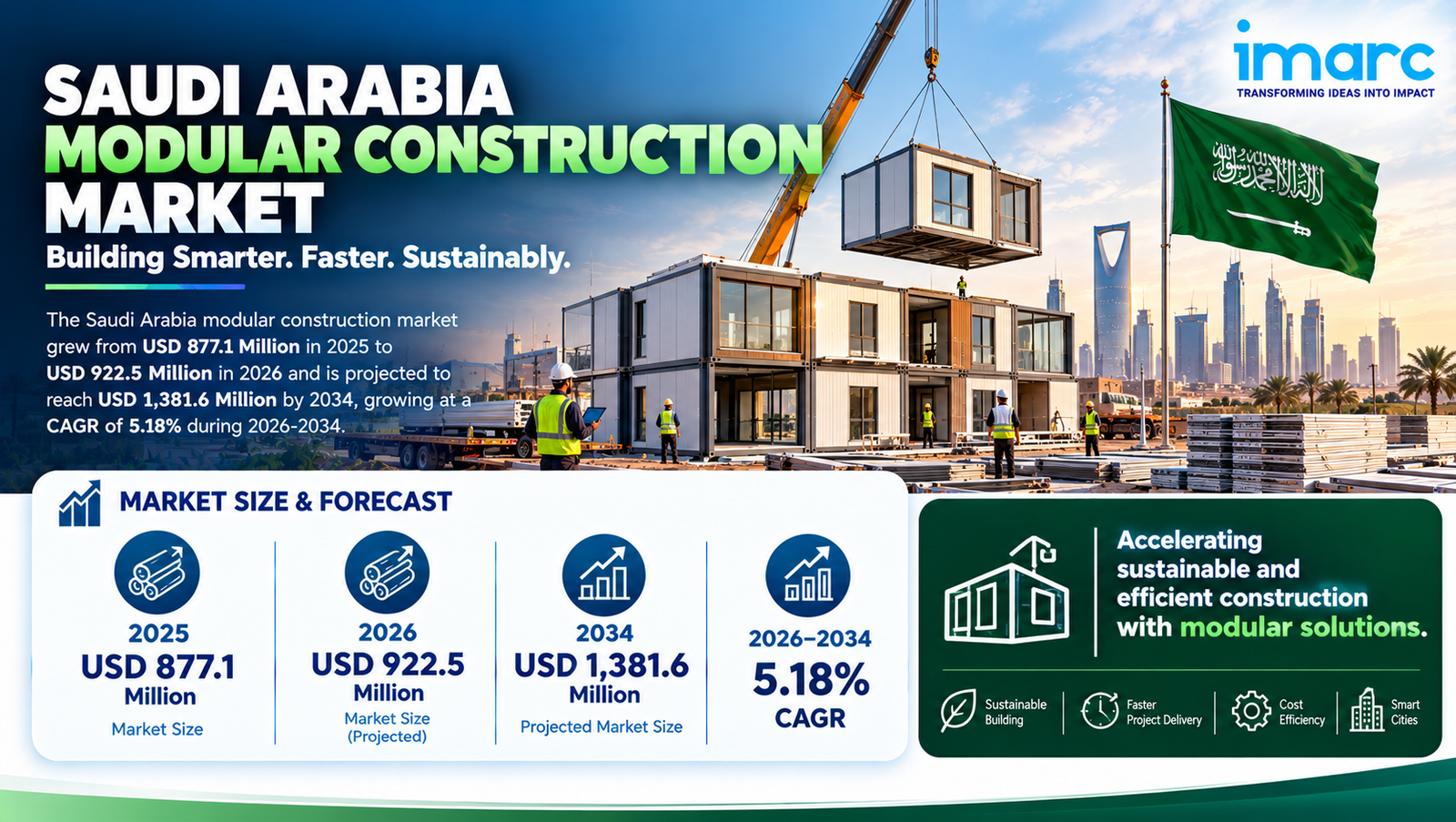
IMARC Group, a leading global market research and management consulting firm, has published its latest market intelligence report on the Saudi Arabia modular construction market. The Saudi Arabia modular construction market size increased from USD 877.1 Million in 2025 to USD 922.5 Million in 2026 and is projected to reach USD 1,381.6 Million by 2034, exhibiting a CAGR of 5.18% during 2026-2034, driven by the unprecedented scale of Vision 2030 giga-project workforce housing requirements, the growing adoption of off-site fabrication methods, and the Kingdom’s push to build a domestic modular manufacturing base.
The market is undergoing a structural shift as the Kingdom’s most ambitious construction program in its history collides with the proven ability of off-site modular fabrication to deliver complex building programs on compressed timescales that traditional construction cannot match. NEOM, Red Sea Global, Qiddiya, and Diriyah Gate are each generating a workforce housing requirement that is simply impossible to fulfil through site-based construction, while a growing share of demand is shifting from temporary worker camps toward permanent residential communities, hospitality assets, and commercial buildings that now define the bulk of the market by value.
Saudi Arabia Modular Construction Market at a Glance:
- Market Size (2025): USD 877.1 Million
- Market Size (2026): USD 922.5 Million
- Forecast Market Size (2034): USD 1,381.6 Million
- CAGR (2026-2034): 5.18%
- Leading Type (2025): Permanent, 72.4% share
- Leading Module Type (2025): Four Sided, 31.8% share
- Dominant Region (2025): Northern and Central Region, 45.3% share
How AI is Reshaping the Future of the Saudi Arabia Modular Construction Market
- AI-Driven BIM-to-Factory Production: Modular manufacturers are linking Building Information Modeling directly to factory cutting, forming, and assembly lines, letting digital design models drive production instructions without manual re-drawing, cutting fit-up errors and accelerating module turnaround for giga-project housing programs.
- Robotics-Enabled Factory Assembly: CHEC’s 200,000-square-meter Sedra facility in Riyadh runs advanced robotics across cutting, welding, and finishing operations, achieving production speed and quality consistency that site-based labor alone cannot sustain across large-volume residential module runs.
- Predictive Quality Control and Digital Twins: AI-assisted inspection systems and digital twin modeling are helping manufacturers flag structural and finish defects before modules leave the factory floor, reducing on-site rework and supporting the 50-year permanent certification standards now required on NEOM worker housing.
Grab a sample PDF of this report: https://www.imarcgroup.com/saudi-arabia-modular-construction-market/requestsample
Saudi Arabia Modular Construction Market Trends and Drivers:
The Vision 2030 giga-project pipeline is the single biggest demand driver reshaping the market. NEOM, Red Sea Global, Qiddiya, and Diriyah Gate are collectively generating a peak-construction workforce housing requirement that traditional on-site building cannot fulfil within project timescales, making modular delivery the default method for worker accommodation across the entire giga-project portfolio. Homagic’s NEOM Phase II contract to deliver 12,000 permanent worker accommodation units illustrates the scale of this demand, while Permanent-type modules, now leading at 72.4% share, show the category maturing beyond temporary camps into long-life residential and commercial stock.
Speed, cost efficiency, and sustainability requirements are reinforcing modular construction as the preferred delivery method rather than an alternative to it. Off-site fabrication compresses project timelines, cuts on-site labor needs, reduces construction waste, and enables factory-level quality control that open-air site construction cannot replicate. NEOM’s net-zero carbon construction mandate and Red Sea Global’s unprecedented prefabrication requirement for carbon-neutral operations are formalizing modular methods as a non-negotiable specification on major projects where sustainability performance and schedule certainty both matter, with four-sided volumetric modules leading at 31.8% share for the factory-complete quality they provide.
Local manufacturing investment is turning Saudi Arabia from an import-dependent modular market into a genuine production base. The February 2025 inauguration of CHEC’s 200,000-square-meter Sedra factory in Riyadh, equipped with robotics and a fully digitalized design-to-production workflow, marks a structural shift toward domestic supply, supported by the Northern and Central region’s 45.3% share reflecting Riyadh’s concentration of giga-project administration, PIF residential programs, and modular production capacity.
Government Schemes and Vision 2030 Initiatives Driving Demand:
- Vision 2030 Giga-Project Workforce Housing Mandate: NEOM, Red Sea Global, Qiddiya, and Diriyah Gate each carry government-backed construction timelines that make modular workforce accommodation a structural, state-driven requirement rather than a contractor preference.
- MOMRAH Permanent Accommodation Standards: The Ministry of Municipal, Rural Affairs and Housing has pushed worker accommodation specifications toward 50-year permanent structural certification, directly favoring modular systems engineered for long-term durability over temporary camp structures.
- Net-Zero and Sustainability Mandates: NEOM’s net-zero carbon construction requirement and Red Sea Global’s carbon-neutral operations mandate are formally embedding prefabrication and modular methods into project specifications for the Kingdom’s flagship developments.
- Local Content and Domestic Manufacturing Push: Government support for in-Kingdom industrial capacity is drawing major manufacturing investment, exemplified by CHEC’s Riyadh factory, as Saudi Arabia works to reduce reliance on imported modular components.
- Saudi Green Initiative Alignment: Modular construction’s inherent waste reduction and factory quality control dovetail with the Kingdom’s broader Green Initiative sustainability commitments, creating an additional policy tailwind for off-site building methods across public and giga-project programs.
Saudi Arabia Modular Construction Industry Segmentation:
The report has segmented the market into the following categories:
Breakup By Type:
- Permanent
- Relocatable
Permanent leads the type segment at 72.4% share in 2025, reflecting the market’s maturation from early-phase workforce camp installations toward permanent residential communities, hospitality resorts, and commercial facilities that now constitute the majority of Vision 2030 construction program value, while Relocatable modules at 27.6% continue to serve the Kingdom’s ongoing temporary workforce accommodation and event infrastructure needs.
Breakup By Module Type:
- Four Sided
- Open Sided
- Partially Open Sided
- Mixed Modules and Floor Cassettes
- Modules Supported by a Primary Structure
- Others
Four-sided modules lead at 31.8% share in 2025, as the fully enclosed volumetric module provides the highest level of factory build completeness, arriving on site with exterior walls, windows, doors, and interior finishes already installed. Mixed modules and floor cassettes follow at 22.6%, enabling hybrid approaches for larger commercial buildings, while modules supported by a primary structure at 18.7% serve complex multi-story applications and partially open-sided and open-sided modules together cover more cost-effective, site-completed applications.
Breakup By Material:
- Steel
- Concrete
- Wood
- Plastic
- Others
Material choice in Saudi Arabia modular construction is shaped by structural durability requirements, factory handling characteristics, and project-specific performance needs, with steel and concrete systems typically specified for the permanent, long-life structures that are increasingly defining the market, while lighter materials continue to serve relocatable and specialized applications.
Breakup By End Use:
- Residential
- Commercial
- Education
- Retail
- Hospitality
- Healthcare
- Others
Residential and hospitality applications are the primary growth engines in the end-use segment, driven by permanent worker and family housing communities under Vision 2030 and premium hospitality pods for Red Sea Global and Amaala resort developments, while commercial, healthcare, and education applications represent an expanding frontier as modular methods extend beyond their accommodation-focused origins.
Breakup By Region:
- Northern and Central Region
- Western Region
- Eastern Region
- Southern Region
The Northern and Central region dominates the market with a 45.3% share in 2025, supported by Riyadh’s concentration of government infrastructure projects, PIF residential developments, and modular manufacturing capacity. The Western region follows at 26.4%, driven by tourism, hospitality, and mega-project development, while the Eastern region’s 18.2% share reflects industrial, energy, and workforce accommodation demand, and the Southern region accounts for the remaining 10.1%, linked to infrastructure upgrades and cost-effective residential and commercial construction.
Competitive Landscape:
The report provides a comprehensive analysis of the competitive landscape in the Saudi Arabia modular construction market with detailed profiles of all major companies, including:
- China Harbour Engineering Company Limited
- China State Construction Group Co., Ltd. (Homagic)
- Red Sea International
- Zamil Group Holding Company
Market Concentration Analysis:
- Moderate Concentration: A small number of large specialist players command the majority of high-value contract activity, alongside a fragmented ecosystem of smaller regional and international modular providers serving niche applications and geographies.
- Chinese Manufacturing Entrants: CHEC and CSCEC’s Homagic brand are leveraging established Saudi Arabia manufacturing and delivery track records to compete for additional giga-project modular contracts at a scale regional players cannot immediately match.
- Regional Player Positioning: Established players such as Red Sea International and Zamil Group Holding Company are maintaining market position through long-standing client relationships and proven delivery credentials as international specialists compete for differentiated segments.
What Does The Full Report Cover?
If you are tracking the Saudi Arabia modular construction market for investment decisions, market entry planning, competitive benchmarking, or strategic advisory, IMARC Group’s report gives you everything in one place:
- Complete market sizing in value terms with forecasts covering the full 2026-2034 projection period
- Quantified growth driver analysis with impact scoring across type, module type, material, end use, and regional markets
- Sub-segment breakdowns for Permanent and Relocatable types, six module types, five materials, seven end-use categories, and all four regions of the Kingdom, each with individual share data
- Regional data across the Northern and Central, Western, Eastern, and Southern regions of Saudi Arabia
- Competitive profiles of leading global and national modular construction companies with strategic landscape assessment
- Value chain analysis, market concentration assessment, and investment and growth opportunity mapping
- Latest technology trends covering BIM-to-factory production, robotics-enabled assembly, digital twin quality control, and Vision 2030-driven infrastructure opportunities shaping market competition across the Kingdom
Recent News and Developments in Saudi Arabia Modular Construction Market
- December 2025: Red Sea International signed a contract with Italy’s Webuild to provide integrated facilities management services for the camps supporting NEOM’s Trojena Dam project, covering operations and maintenance for the main and secondary worker camps.
- November 2025: China Construction Integrated Building Company’s Homagic brand was awarded a contract by NEOM to deliver 12,000 permanent worker accommodation units for the Phase II construction workforce housing program, one of the largest single modular integrated construction contracts ever signed in the Middle East.
- February 2025: China Harbour Engineering Company inaugurated its 200,000-square-meter modular building factory in Riyadh for the Sedra housing project, equipped with advanced robotics and a fully digitalized design-to-production workflow.
Note: If you require specific details, data, or insights that are not currently included in the scope of this report, we are happy to accommodate your request. As part of our customization service, we will gather and provide the additional information you need, tailored to your specific requirements. Please let us know your exact needs, and we will ensure the report is updated accordingly to meet your expectations.
Key Questions This Report Answers
- What is the current Saudi Arabia modular construction market size and what is its projected value?
- Which type holds the largest share in the Saudi Arabia modular construction market?
- What are the key drivers of Saudi Arabia modular construction market growth?
- Which region dominates the Saudi Arabia modular construction market and why?
- How is Vision 2030 and the giga-project pipeline reshaping demand and competitive strategy in the Saudi Arabia modular construction industry?
- Who are the top companies in the Saudi Arabia modular construction market and what are their competitive strategies?
- What are the investment and market entry opportunities across permanent residential, hospitality, and domestic manufacturing in Saudi Arabia?
About Us
IMARC Group is a global management consulting firm that helps the world’s most ambitious changemakers to create a lasting impact. The company provides a comprehensive suite of market entry and expansion services. IMARC offerings include thorough market assessment, feasibility studies, company incorporation assistance, factory setup support, regulatory approvals and licensing navigation, branding, marketing and sales strategies, competitive landscape and benchmarking analyses, pricing and cost research, and procurement research.
Media and Sales Contact
IMARC Group
Email: sales@imarcgroup.com
United States: +1-201-971-6302
India: +91-120-433-0800
United Kingdom: +44-753-714-6104