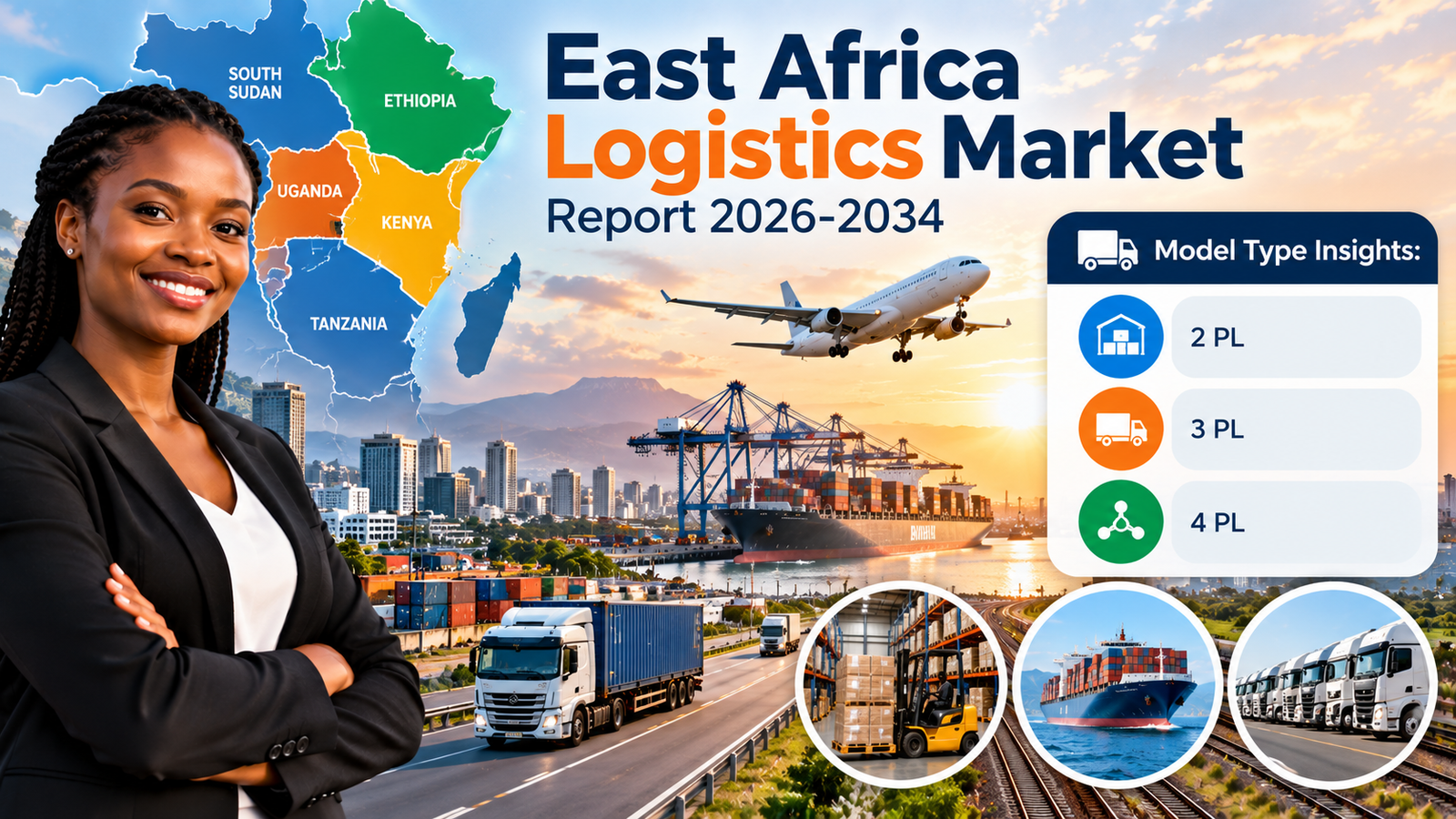
The East Africa logistics market driven by Large-scale infrastructure programs across rail, port, and road corridors, rapid expansion of e-commerce and modern retail, and trade facilitation initiatives that streamline customs procedures are driving demand for integrated logistics services across the region. East Africa logistics market size increased from USD 25.1 Billion in 2025 to USD 26.3 Billion in 2026. Looking forward, IMARC Group expects the market to reach USD 37.8 Billion by 2034, exhibiting a growth rate (CAGR) of 4.67% during 2026-2034. Additionally, growing intra-African trade and the push to connect landlocked economies with Indian Ocean ports continue to reshape freight flows and enhance market visibility.
How AI is Reshaping the Future of East Africa Logistics Market?
- AI-powered route and load optimization helps freight forwarders and trucking operators cut empty running and cross-border waiting time along the Northern and Central Corridors, which stretch roughly 1,700 km and 1,300 km respectively.
- Machine learning tools in port and customs operations support predictive vessel scheduling, risk-based cargo screening, and faster document processing, helping reduce dwell time at gateways such as Mombasa and Dar es Salaam.
- AI-enabled demand forecasting and warehouse automation allow e-commerce, retail, and fast-moving consumer goods companies to position inventory closer to Nairobi, Kampala, Kigali, and Addis Ababa and improve last-mile delivery accuracy.
- Real-time shipment tracking, IoT sensors, and AI-driven analytics are improving cold chain visibility for perishable exports such as cut flowers, fresh produce, and fish, supporting quality compliance in demanding export markets.
- Digital freight platforms using AI matching connect small transporters with shippers, increasing fleet utilization and giving small and medium enterprises access to transparent pricing.
Grab a sample PDF of this report: https://www.imarcgroup.com/east-africa-logistics-market/requestsample
Market Growth Factors
The East Africa logistics market is driven by sustained public and private investment in transport infrastructure. Tanzania is building a 2,800 km electric Standard Gauge Railway (SGR) at an estimated cost of USD 7 billion, with electric locomotives capable of speeds up to 160 km/h linking the Port of Dar es Salaam with Mwanza and neighboring landlocked markets. Syndicated financing of over USD 2.3 billion arranged by Standard Chartered is funding the remaining sections of the 1,219 km Dar es Salaam to Mwanza phase. Road-and-rail integration is also cutting inland travel times, with the journey from Dar es Salaam to the interior falling from 7 to 10 hours by road or legacy rail to under 4 hours by SGR. Along the Northern Corridor, the planned SGR from Mombasa through Nairobi and Malaba to Kampala and Kigali aims to replace the century-old narrow gauge line and lower transport costs for Uganda, Rwanda, and South Sudan.
Port performance and corridor competition are strengthening service quality across the region. Dar es Salaam Port has reached a record throughput of 33.71 million tonnes, an increase of more than 21%, while transit cargo passing through the port rose 17% to 14.61 million tonnes. Rwanda-bound transit cargo through Dar es Salaam grew 24% to 2.18 million tonnes, about 15% of the port’s transit volume. Mombasa continues to handle roughly 34 to 36 million tonnes of cargo annually and remains the region’s busiest seaport. Its deep-sea connectivity and mature clearing agent network keep it about five and a half days faster than Dar es Salaam on the route to Kigali. This competition is encouraging dredging, terminal upgrades, and faster clearance at both gateways.
Trade facilitation and regional integration are further reducing barriers to cross-border movement. Government and development partner initiatives are streamlining customs procedures, promoting one-stop border posts, and digitizing transit documentation across East African Community member states. Financing commitments are also supporting rail links, with Uganda signing a US$800 million financing agreement with the Islamic Development Bank for trade-enabling projects, including a railway to connect with Kenya’s SGR. Meanwhile, inland dry ports such as Kwala in Tanzania, with a 1,000-hectare industrial park, are decongesting ports and creating new warehousing and value-added logistics hubs.
Rising e-commerce activity, expanding modern retail chains, and growing manufacturing, agriculture, and extractives output are lifting demand for warehousing, cold chain, last-mile delivery, and contract logistics. Third-party and fourth-party providers are adding technology-led services such as fleet tracking, inventory visibility, and end-to-end supply chain management to meet the needs of both multinational shippers and local businesses.
Market Segmentation
Model Type Insights:
- 2 PL
- 3 PL
- 4 PL
Transportation Mode Insights:
- Roadways
- Seaways
- Railways
- Airways
End Use Insights:
- Manufacturing
- Consumer Goods
- Retail
- Food and Beverages
- IT Hardware
- Healthcare
- Chemicals
- Construction
- Automotive
- Telecom
- Oil and Gas
- Others
Country Insights:
- Ethiopia
- Kenya
- Tanzania
- Uganda
- Sudan
- Rwanda
- Others
Recent Development & News
- June 2026: Tanzania launched a direct freight service connecting the Port of Dar es Salaam to its electric Standard Gauge Railway network, removing an intermediate container transfer stage. The new Port Link infrastructure is designed to handle at least 100 containers initially, strengthening the port’s competitiveness against Mombasa.
- July 2025: Tanzania launched the Kwala Dry Port and SGR electric freight services, backed by a 1,000-hectare industrial park, to reduce logistics costs, decongest Dar es Salaam Port, and strengthen the country’s role as a regional trade hub.
- May 2025: Uganda signed a US$800 million financing agreement with the Islamic Development Bank to support trade-enabling projects, including a railway intended to connect with Kenya’s SGR and improve access to the Port of Mombasa.
- June 2024: The first section of Tanzania’s SGR, running from Dar es Salaam to Morogoro, officially commenced operations, with the line later extending to Dodoma and further phases under construction.
If you require any specific information that is not covered currently within the scope of the report, we will provide the same as a part of the customization.
About Us
IMARC Group is a global management consulting firm that helps the world’s most ambitious changemakers to create a lasting impact. The company provides a comprehensive suite of market entry and expansion services. IMARC offerings include thorough market assessment, feasibility studies, company incorporation assistance, factory setup support, regulatory approvals and licensing navigation, branding, marketing and sales strategies, competitive landscape and benchmarking analyses, pricing and cost research, and procurement research.
Contact Us
IMARC Group,
134 N 4th St. Brooklyn, NY 11249, USA,
Email: sales@imarcgroup.com,
Tel No: (D) +91 120 433 0800,
United States: +1-201971-6302