Introduction
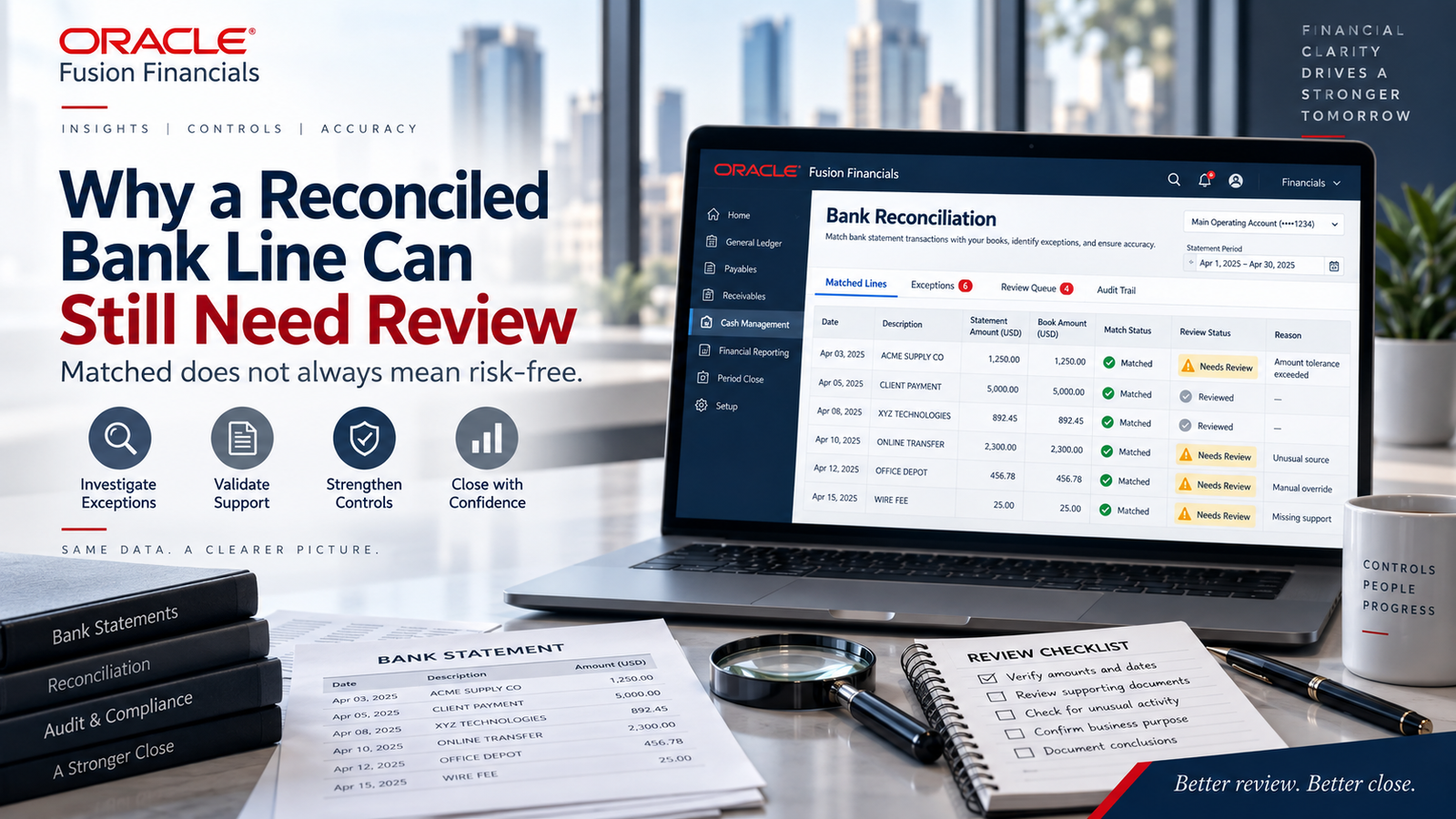
A reconciliation status can look like the end of an investigation, but it is really the result of a rule applied to available data. At Tech Leads IT, we teach finance teams that a reconciled label is only the starting point for review. A broad amount-and-date rule can pair a monthly fee with the wrong transaction and leave the correct receipt unmatched.
That is why reviewers must test why a match happened. Our Oracle Cloud Financials Online Training shifts the question from “did it match?” to “should it have matched this way?” Learners who choose Oracle Cloud Financials Training Online practice this with realistic scenarios, including ambiguous fees, grouped receipts, and tolerance decisions.
Treat Matching as a Controlled Inference
A bank statement line proves only that the bank recorded a movement. The payment, receipt, or external cash transaction in the system is the internal explanation for that movement. Reconciliation links the two, but the link is often inferred from attributes rather than supplied by the bank.
Those attributes are not equally reliable. Amount, date, transaction code, reference, and structured identifiers all carry different weights. An exact end-to-end payment reference is usually much stronger evidence than a same-day amount, and a recurring round-number amount can be especially weak. Your rules should reflect that hierarchy instead of treating every matching field as interchangeable.
Each rule should also have a documented population:
- A rule designed for uniquely numbered electronic receipts may be unsafe for bank fees, payroll aggregates, or transfers between your own accounts.
- Decide whether one statement line may match one transaction, several transactions, or a group whose total agrees.
- Express date tolerances in business terms and account for weekends and clearing conventions. A five-day window may suit checks but is far too loose for same-day wires.
Narrow populations keep a match explainable, and they stop a convenient tolerance from turning into a universal shortcut.
Sequence Strong Evidence Before Weak Evidence
The order of rules changes outcomes. An early, broad rule can consume a line that a later, more precise rule would have matched correctly. Place rules built on reliable unique references ahead of rules that depend on amount and date alone, and keep fallback rules for populations where stronger identifiers truly are not available.
If two rules can accept the same line, test which one wins and whether that priority still makes sense after bank file formats or payment methods change. The full sequence should be reviewed as a single decision tree, not as a pile of individually reasonable rules.
Tolerances deserve the same care. An amount tolerance might absorb bank charges, rounding, discounts, or foreign-exchange differences, and each of those can call for different accounting. A date tolerance can cover settlement delay, but it can also connect transactions from separate operating cycles. Set tolerances according to known causes and materiality, and retain the original variance. When the system accepts a difference, reviewers still need to know whether another entry records it and whether the pattern is growing. Accepted does not mean economically explained.
What Oracle Cloud Financials Online Training Teaches About Process Options
The Oracle Help Center documentation on Automatic Reconciliation explains that the process uses the rule set assigned to a bank account, with matching and tolerance rules prioritized by execution order. Oracle also documents process parameters such as bank account, statement identifier, statement date range, and number of days.
These details matter because the run context becomes part of the evidence. A run that completes successfully against the wrong account, statement, or date population is not a successful reconciliation. Keep the parameters, process identifier, and completion time with the review record.
The documented Generate Cash Transactions option deserves particular scrutiny. After automatic reconciliation, it can submit the creation of external cash transactions from unreconciled statement lines, using transaction creation rules tied to the account. It is an efficient route for legitimate interest, bank charges, and miscellaneous activity, but it also turns classification logic into accounting activity.
Before enabling it, define:
- which bank transaction codes are eligible
- which accounts it applies to
- how tax is treated
- what approval is expected
An unknown withdrawal should remain an exception rather than become a generic cash transaction just because automation can create one. Learners who study these options in Oracle Cloud Financials Online Training quickly see that each setting is an accounting choice, not merely a technical switch.
Review Matches by Risk, Not by Random Sample Alone
A useful review population goes beyond a random draw. It should include:
- matches made by weak rules
- items accepted near tolerance limits
- many-to-one combinations
- manual matches
- unusual transaction codes
- lines matched after a rule or bank-format change
Random sampling can supplement this work, but it may miss the small subset where ambiguity is concentrated. When reviewing, compare the statement narrative and reference with the internal transaction instead of relying on the amount. For grouped matches, confirm that the components form a credible remittance or settlement and not an accidental combination that happens to reach the target total.
Reconciled lines may also need protection from later changes. Oracle documents a Mark Reviewed feature designed to prevent accidental reversal of reconciliation for a reviewed statement. That status should follow substantive review and should not be used to shrink the open queue. Define who may mark a line reviewed, what evidence is required, and how an identified error gets reopened.
Segregation of duties helps here. Keeping rule maintenance, reconciliation operation, and review with different people prevents one person from broadening a tolerance and then approving the resulting matches.
Investigate What Remains Unreconciled
An unmatched line is not automatically a failure. It may be a new bank fee, a deposit in transit, a payment recorded under another bank account, a missing system transaction, or a line whose reference was truncated during import. Start with statement completeness and import quality before touching the matching logic. Then search by amount, nearby dates, currency, counterparty, and source reference.
If the line reflects valid activity that has not yet been recorded, create or route the appropriate transaction with supporting evidence. Do not widen a rule just to make an aging exception disappear.
Age and recurrence send different signals. A single recent card settlement may simply need time to clear. A small monthly charge left unmatched for six periods points to missing transaction-creation logic or an ownership gap. Track exceptions by cause, bank account, transaction code, value, and age.
It also helps to separate the two directions:
- Statement lines without system transactions can indicate recording or classification gaps.
- System transactions without statement lines can indicate timing, cancellation, duplicate entry, or use of the wrong cash account.
Each direction follows a different investigative path.
Use Metrics That Reveal Rule Quality
An automatic match rate is only meaningful when it is paired with measures of correctness and exception behavior. Useful indicators include:
- reversals of automatic matches
- review findings by rule
- items matched at tolerance boundaries
- recurring unmatched transaction codes
- time to resolve material exceptions
A rising match rate accompanied by more reversals is not an improvement. Test revised rules against a known historical set that contains correct matches, ambiguous cases, and items that should stay unmatched. The goal is not to push every line through automation. It is to automate the decisions that can be made reliably and to expose the rest.
Build Review Discipline with Oracle Cloud Financials Training Online
Sound reconciliation practice is as much about judgment as configuration. Teams that pursue Oracle Cloud Financials Training Online gain a chance to practice with realistic scenarios such as ambiguous fees, grouped receipts, and tolerance decisions, and to see how a rule change ripples through matching results. That hands-on exposure makes it easier to design rule sets around defined populations, to read process parameters as evidence, and to know which matches deserve a second look.
Practical training also helps clarify roles. When preparers, rule owners, and reviewers each understand what the others are checking, the process becomes a set of real controls and not a series of sign-offs.
Conclusion
Challenging a particular match does not mean distrusting automation as a whole. A defensible reconciliation links each rule to a defined population, sequences strong evidence first, constrains tolerances, and preserves run parameters. Review then concentrates on weak-rule matches, unusual combinations, generated cash activity, and recurring exceptions.
A reconciled label is valuable operational information, but it is not independent proof. Confidence comes from understanding the evidence and logic behind the status, and from correcting the process when that logic no longer fits the bank activity. Whether you build that understanding through daily practice or through Oracle Cloud Financials Online Training, the principle is the same: treat every match as a conclusion that can be tested.