Introduction
If you’ve spent any time around ERP consulting circles lately, you’ve probably noticed how often Oracle Fusion comes up in conversations about who’s hiring and what they’re hiring for. Soft Online Training gets mentioned a lot in these same conversations, mostly because people trust it to actually teach the skills that show up in job descriptions, not just the theory. Oracle Fusion isn’t a static platform Oracle pushes updates every quarter, and that alone changes what “being good at Fusion” even means from one year to the next. A developer who was solid in 2022 might feel a bit rusty in 2026 if they haven’t kept pace with how much the tooling has shifted. So what does a technical developer actually need to know right now? That’s the question this post tries to answer, and it’s also why so many people searching for direction end up looking into Oracle Fusion Technical Training in Bangalore. The city has quietly become one of the busiest hubs for this kind of work in the country.
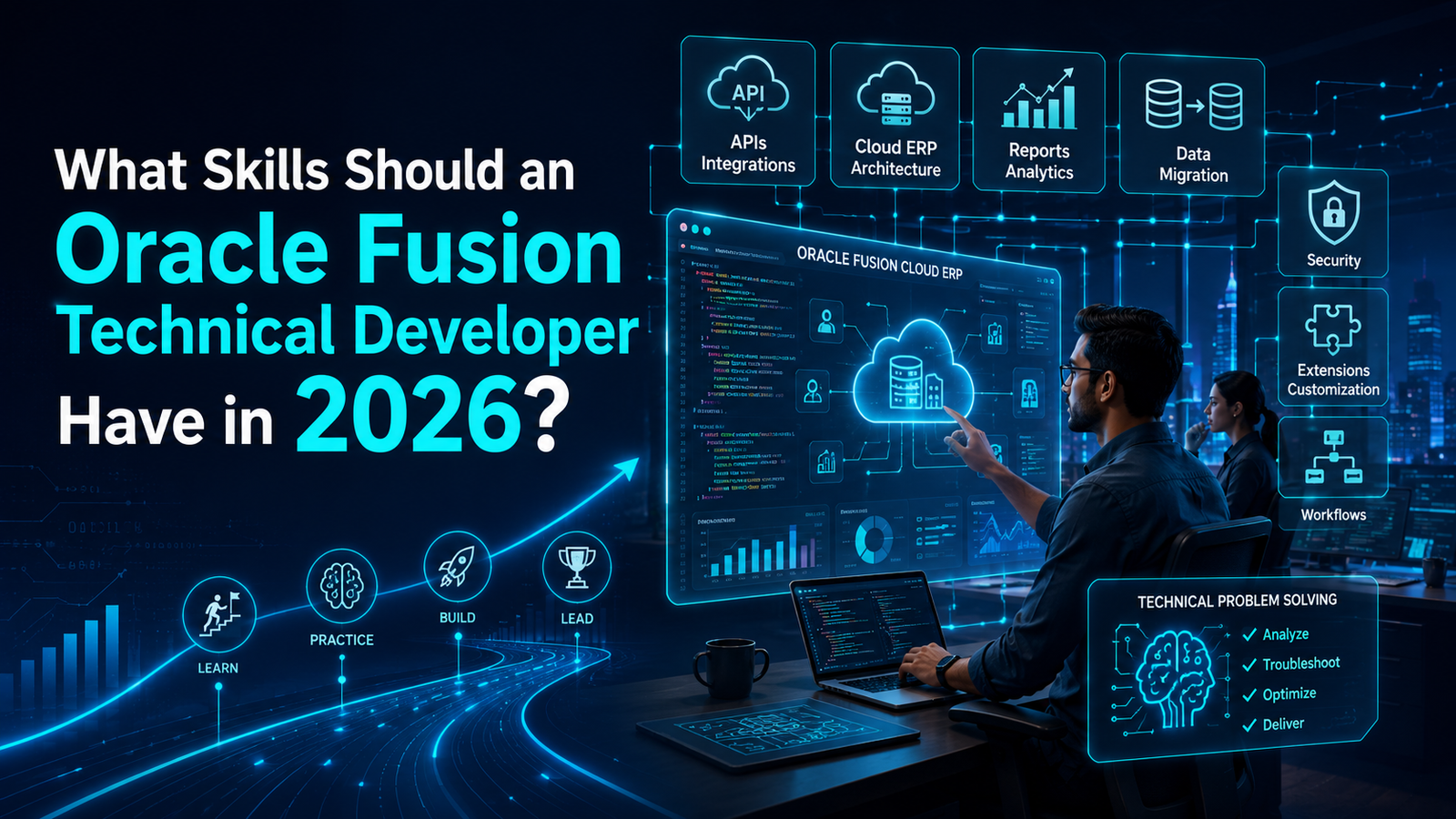
Let’s go through the skills that matter, roughly in the order you’d probably pick them up if you were starting from scratch.
Getting Comfortable with Oracle Fusion Cloud Architecture First
There’s a temptation to jump straight into tools and start “doing stuff” writing reports, building integrations, whatever. But skipping the architecture piece almost always catches up with people later. You need to know how the data model is put together, how security is layered, and how modules like Financials, SCM, and HCM actually talk to each other behind the scenes. Most decent Oracle Fusion Technical Training in Bangalore programs won’t let you skip this either, and for good reason a developer who understands the architecture can usually spot why something’s going to break before it actually breaks, instead of finding out the hard way in a client environment.
Reporting: OTBI and BI Publisher Still Matter a Lot
Reporting work hasn’t gone anywhere, and honestly, it’s still one of the most common things clients ask for. OTBI and BI Publisher remain the two go-to tools, and a developer should be able to build subject areas, put together RTF or Excel templates, schedule reports, and this is the part people underestimate actually troubleshooting when the data model doesn’t behave. Lately there’s also more demand for tying these reports into dashboards so people get real-time numbers instead of static PDFs sitting in an inbox. Reporting is one of the heavier modules in most Oracle Fusion Technical Training in Bangalore courses, and it’s easy to see why it’s the kind of skill that translates directly into billable hours for a consulting firm.
Oracle Integration Cloud Is Basically Non-Negotiable Now
Nobody runs Fusion in isolation anymore. It’s always talking to something else: a legacy system, a third-party vendor tool, another cloud app entirely. That’s where Oracle Integration Cloud comes in, and it’s become one of those skills you just can’t avoid if you want to work on full implementation projects. You’ll need to be comfortable with REST and SOAP web services, adapters, setting up error notifications properly (not just ignoring them until something breaks), and handling FBDI for bulk data loads. A lot of Oracle Fusion Technical Training in Bangalore programs have shifted their OIC modules to be almost entirely hands-on now, because reading about integrations and actually building one that survives contact with real data are two very different experiences.
Fast Formulas and Personalization the Unglamorous but Essential Stuff
Fast Formulas don’t get talked about much outside HCM circles, but if you’re doing payroll calculations, eligibility rules, or any custom business logic, you’re going to run into them. Pair that with Application Composer, sandboxes, and page composer for personalization, and you’ve got the toolkit that lets a developer actually shape the application to fit a client’s weird, specific requirements without waiting six months for Oracle to build it into a standard release. Honestly, this is often what separates someone who’s “learned Fusion” from someone who can actually be trusted on a live project.
Data Migration Isn’t Just Copy-Paste
Every single Fusion implementation involves moving data from somewhere else old HR records, years of financial history, whatever the client had before. Tools like FBDI, HDL, and ADFdi are the usual suspects here, but knowing the tool is only half the job. The harder part is validation, error handling, and reconciliation making sure the data that lands in Fusion actually matches what left the old system. Anyone who’s done a migration knows the horror stories about mismatched records or duplicate entries slipping through, so this is a skill worth taking seriously rather than treating as a checkbox.
Visual Builder Cloud Service Is Opening New Doors
VBCS has picked up a lot of momentum recently, mostly because clients want custom, modern-looking applications without paying for a full custom-build project. Developers who can design responsive UI pieces, hook them up to Fusion REST APIs, and ship either standalone or embedded apps are in a good spot right now. It pushes a developer’s skill set beyond the usual back-end customization work and into something closer to front-end development, which makes them a lot more flexible when a client’s requirements don’t fit neatly into “just customize the existing screens.” Updated Oracle Fusion Technical Training in Bangalore curriculums have started folding VBCS in as a core module rather than an optional add-on, which tells you something about where the industry is heading.
Security and Compliance Can’t Be an Afterthought
This one gets overlooked a lot, especially by developers who come from a pure coding background. But role-based access control, data security policies, and audit trails matter a lot particularly for clients in finance or healthcare where a compliance slip-up isn’t just embarrassing, it’s expensive. A developer should be able to build custom roles, chase down access issues when something’s not working right, and work alongside security administrators without creating gaps that expose data nobody’s supposed to see. It’s not the flashiest skill on this list, but it’s one that keeps coming up in interviews with more experienced hiring managers.
The Soft Skills Nobody Puts on the Job Description
Here’s the thing: you can be technically brilliant and still struggle if you can’t explain what you built to a functional consultant, or if your documentation is so sparse that the next person has to reverse-engineer your logic. Communication, clear documentation habits, and just being able to manage several projects running at once without dropping the ball these matter more than people expect going into this field. Some training providers have started weaving soft-skills coaching into their technical courses, which honestly makes sense. A developer who can talk through a solution clearly tends to move up faster than one who can code circles around everyone but can’t explain any of it.
Keeping Up with Oracle’s Never-Ending Release Cycle
This is the part that catches a lot of people off guard when they’re new to Fusion. Oracle ships updates every quarter, whether you’re ready for them or not. A good developer builds the habit of actually reading release notes, testing new features in a sandbox before they go live, and keeping an eye on how updates might quietly break something that used to work fine. It’s less about mastering everything Oracle releases and more about not getting blindsided by it. If you’re picking a training provider, it’s worth checking whether their material actually reflects recent releases outdated coursework is more common than you’d think.
Wrapping Up
There’s no single skill that makes an Oracle Fusion Technical Developer valuable in 2026; it’s really the combination: solid architectural grounding, real hands-on comfort with the tools, integration know-how, and the ability to actually communicate with the people around you. Soft Online Training has built a name for itself by covering exactly this mix rather than just the surface-level basics, which is probably why so many people mention it when this topic comes up. As more companies lean further into Oracle Fusion, developers who’ve put in the work through solid Oracle Fusion Technical Training in Bangalore are going to be the ones ready to walk into real projects not just interviews with the confidence to handle whatever comes up on day one.