Introduction
If you’re an SQL developer wondering whether your current skills can carry you into an Oracle Fusion Technical Consultant role, here’s the honest answer: yes, and probably more easily than you think. At Soft Online Training, we’ve watched dozens of SQL professionals make this jump, and the pattern is always the same: the ones who already “think in queries” pick up Oracle Fusion faster than almost anyone else walking into the field. You already speak the language of data. What you’re missing is the Oracle-specific dialect.
So let’s get into it. Why does SQL experience translate so well, what do you still need to learn, and where does a program like Oracle Fusion Technical Training in Hyderabad actually fit into the picture?
Your SQL Background Is Not a Side Skill It’s the Foundation
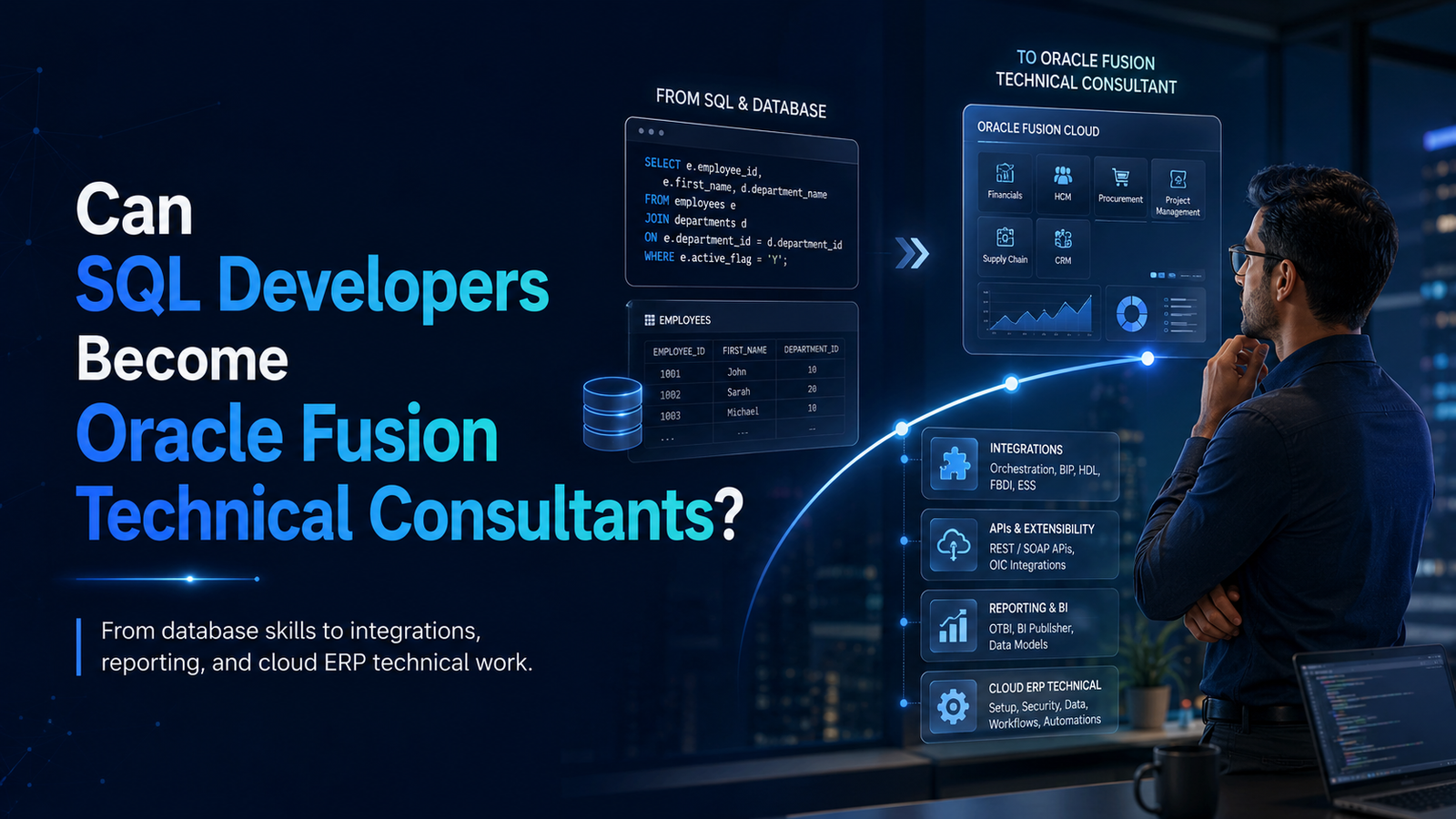
Here’s something people forget: Oracle Fusion applications are, underneath all the cloud dashboards and workflows, just large systems sitting on top of an Oracle database. Every OTBI analysis, every BI Publisher report, every FBDI file upload eventually comes down to tables, joins, and query logic. If you can already write a decent left join or untangle a messy subquery, you’re not starting from scratch, you’re starting from the middle.
That matters more than people give it credit for. A huge chunk of a technical consultant’s day is spent pulling data out, checking whether it looks right, and figuring out why a report is returning the wrong numbers. That’s SQL work wearing an Oracle Fusion costume. So when SQL developers tell us they’re worried they’ll be “behind” in a Fusion course, we usually tell them the opposite is true.
What an Oracle Fusion Technical Consultant Actually Does All Day
It helps to be clear-eyed about the role before jumping in. Technical consultants aren’t the ones configuring business processes or sitting in requirement-gathering meetings; that’s the functional consultant’s job. Technical folks build the custom reports, handle data conversions and migrations, wire up integrations between Fusion and outside systems, and fix things when they break.
Day to day, that means living inside tools like BI Publisher, OTBI, HCM Extracts, Oracle Integration Cloud, and Application Composer. None of these tools are things you’d stumble into on your own without guidance which is exactly why so many SQL developers eventually look for structured help instead of trying to piece it together from scattered blog posts and Oracle documentation.
The Skills Gap You’ll Actually Need to Close
SQL gets you in the door, but there’s a real gap between “I can query a database” and “I can build production-ready Fusion reports.” Here’s what fills that gap:
The Oracle Fusion data model. Fusion organizes data into subject areas across Financials, HCM, SCM, and Procurement, and this structure looks nothing like a typical relational schema you might be used to. Expect a learning curve here; it’s not hard, just unfamiliar.
BI Publisher and OTBI. You’ll need to build RTF and Excel-based templates, design data models, and create OTBI analyses that pull live data straight out of Fusion. This is where your report-writing instincts finally get to shine.
FBDI and HDL. These are the standard file formats for bulk-loading data into Fusion. Getting comfortable with their structure and validation quirks is non-negotiable for anyone doing migration work.
Oracle Integration Cloud. A lot of consultants end up building integrations too, so some exposure to REST and SOAP web services, adapters, and integration flows goes a long way.
Application Composer. Small UI tweaks, extra fields, business rules this is where you customize the Fusion front end without touching core code.
None of this replaces your SQL knowledge. It just stacks on top of it.
Why Trying to Learn This Alone Rarely Works Well
Could you technically self-teach all of this through Oracle’s documentation and a lot of trial and error? Sure. Should you? Probably not, unless you enjoy re-learning the same lesson three different ways after breaking something in a sandbox. Self-teaching tends to leave gaps when you learn the tool, but not how it’s actually used on a real project, under real deadlines, with real client expectations.
This is really the whole argument for structured, instructor-led learning. And it’s why Oracle Fusion Technical Training in Hyderabad specifically has become such a popular route for career-switchers. Hyderabad isn’t just another city with training centers, it’s genuinely one of India’s biggest ERP and Oracle implementation hubs, packed with consultants who’ve actually worked Fusion projects and trainers who teach from experience rather than a slide deck someone else wrote five years ago.
What a Good Oracle Fusion Technical Training in Hyderabad Program Should Look Like
Not all training is created equal, so it’s worth knowing what to look for. A solid program built for SQL developers won’t start you at zero; it’ll map what you already know onto Fusion’s world before introducing new tools. You should expect to work through the Fusion data model and subject areas, get real hands-on time building BI Publisher reports and OTBI analyses, practice preparing FBDI and HDL files, get at least an introduction to Oracle Integration Cloud, and touch Application Composer enough to understand basic customizations.
Beyond the technical content, the better programs also throw in live project-style scenarios, mock client requirements, and some help with resumes and interviews. That last part matters more than people expect switching specializations isn’t only about learning new tools, it’s about being able to explain, convincingly, why your SQL background makes you a strong fit for this work.
The Career Payoff Is Real
Here’s the part that tends to get people moving: demand for Oracle Fusion technical consultants isn’t slowing down. As more companies migrate off Oracle EBS and onto Fusion Cloud, the number of people who can actually do this work hasn’t kept pace, and that gap is exactly where SQL developers can step in.
For a lot of people, the move comes with a solid salary bump, exposure to bigger and more varied projects, and the chance to work across Finance, HR, Supply Chain, and Procurement instead of being locked into one narrow domain. And because the skill set is specialized, there’s less competition than you’d find in a general development role which tends to mean better job security too.
A Few Honest Tips Before You Start
Don’t wait until you feel “ready” to start getting familiar with cloud ERP concepts now, even loosely. Try to understand how a business process (say, an invoice approval flow) actually turns into data sitting in tables. If your training provider gives you sandbox access, use it to build a few sample reports, break something, fix it. Talk to people who already do this work; a five-minute LinkedIn conversation can tell you more about the day-to-day reality than an hour of reading.
And when you’re picking a course, be picky. A generic, one-size-fits-all Oracle course won’t serve you the way a program built specifically around your SQL background will.
Conclusion
Bottom line: SQL developers have a genuinely strong shot at becoming successful Oracle Fusion Technical Consultants, simply because so much of the work reporting, data migration, integration troubleshooting draws on the same instincts you’ve already built writing queries. At Soft Online Training, we’ve seen this transition happen again and again, and it’s almost always smoother for developers with a database background than for people starting completely fresh. What you’re really doing is adding Oracle’s tools and architecture on top of skills you already have.
If you’re ready to make that move, looking into Oracle Fusion Technical Training in Hyderabad is a smart place to start. Between the city’s deep pool of Oracle talent, the hands-on nature of the training available there, and the steady demand for Fusion consultants, it’s a genuinely practical launchpad for the next stage of your career.