
In the realm of high-end horology, where prestige is usually measured by centuries of dust and tradition, Richard Mille is a loud, high-octane anomaly. Founded in 1999, the brand didn’t try to fit into the classic Swiss mold. Instead, it smashed it with a sledgehammer made of aerospace titanium and carbon fiber.
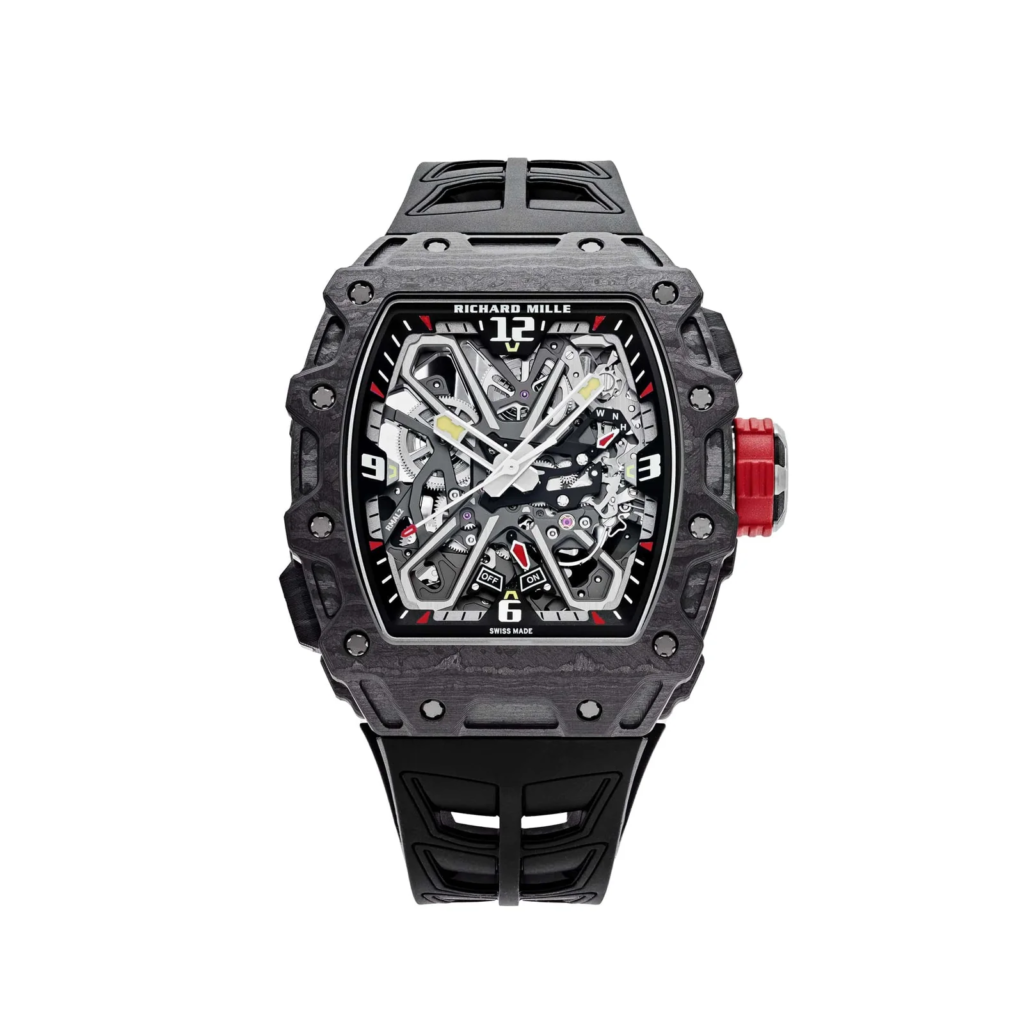
Often called “the billionaire’s handshake,” a Richard Mille watch is instantly recognizable, unapologetically futuristic, and wildly expensive. But beneath the eye-watering price tags lies a philosophy that has completely revolutionized what a luxury watch can be. Richard Mille didn’t just build a new watch brand; he built a racing machine for the wrist.
A Radical Philosophy: “A Racing Machine on the Wrist”
Richard Mille’s background wasn’t in watchmaking; it was in marketing and luxury management. When he set out to create his own brand, he teamed up with the legendary movement spotters at Audemars Piguet (specifically APRP) with a singular mission: break free from the constraints of traditional dress watches.
His muse wasn’t the classical pocket watch—it was the Formula 1 race car.
In a racing car, every single component is stripped down to its bare minimum weight while maximizing structural strength. Richard Mille applied this exact logic to watchmaking. The brand pioneered absolute skeletonization, where the watch movement, the baseplate, and the case are designed together as a unified chassis. There are no decorative, useless parts; every bridge, wheel, and screw has a high-performance structural purpose.
Materials Bored from the Aerospace and Racing Industries
While traditional houses boast about their 18k yellow gold or platinum cases, Richard Mille experiments with materials usually reserved for spacecraft, racing yachts, and jet engines.
- Carbon TPT and Quartz TPT: These aren’t standard carbon fibers. Layers of silica or carbon filaments are split, woven at alternating 45-degree angles, and baked under immense pressure. The result is a case that is virtually indestructible, featherlight, and possesses a unique, wood-grained Damascus steel aesthetic.
- Grade 5 Titanium: Used extensively for the internal baseplates and bridges. This aerospace-grade alloy provides exceptional rigidity, allowing the gear trains to operate with flawless precision even under extreme stress.
- Graphene and Alusic: Experimental composites that push the boundaries of weight reduction to the point where some Richard Mille tourbillons weigh less than a standard sheet of paper, strap included.
Built for Extreme, Real-World Abuse
Traditional luxury watches are delicate creatures; drop a classic perpetual calendar onto a marble floor, and you face a catastrophic repair bill. Richard Mille watches, however, are explicitly engineered to survive extreme shock, vibration, and G-forces.
The brand doesn’t just sponsor athletes; it uses them as real-world crash-test dummies.
Tennis legend Rafael Nadal famously wears his RM 027 tourbillon during Grand Slam matches, subjecting the delicate tourbillon cage to violent, high-speed tennis swings that would shatter standard mechanical movements. Similarly, F1 drivers wear them while pulling heavy G-forces on the track, and golfers like Bubba Watson wear them to withstand the intense, sudden deceleration of a golf swing. A Richard Mille watch is luxury that refuses to be coddled.
The Tonneau Silhouette and Modern Status
Beyond the tech, Richard Mille’s genius lies in its visual branding. The signature curved, tonneau (barrel-shaped) case conforms perfectly to the ergonomics of the human wrist. Coupled with visible spline screws on the bezel and bright, neon-colored rubber straps, it is impossible to mistake a Richard Mille for anything else.
It has become the ultimate status symbol of the 21st century—favored by elite athletes, hip-hop royalty, and tech moguls who view traditional luxury as too stuffy or antiquated. For discerning collectors looking to explore the cutting edge of modern watchmaking alongside classical icons, Aristo offers a highly curated gateway to acquiring authentic, ultra-exclusive global timepieces.
Final Thoughts
Richard Mille proved that true luxury doesn’t have to look old to be valuable. By prioritizing extreme structural engineering, radical ergonomics, and high-tech materials over centuries-old stylistic formulas, the brand created a new definition of contemporary high luxury. It is a brand that doesn’t look back at history—it builds the future.