
Most businesses know they need links from other websites, and most have received emails offering hundreds of them for a small fee. Those offers are the fastest way to waste money and invite a penalty.
Sustainable link building looks different. It is closer to public relations and content strategy than to a technical SEO task: you create something worth referencing, then make sure the right people know it exists.
This article sets out how a small team can earn links steadily without breaking search engine rules.
Understand what a link is supposed to signal
A link from another site is meant to be an editorial vote: someone found your page useful enough to point their readers to it. Search engines use those signals to understand which pages deserve trust.
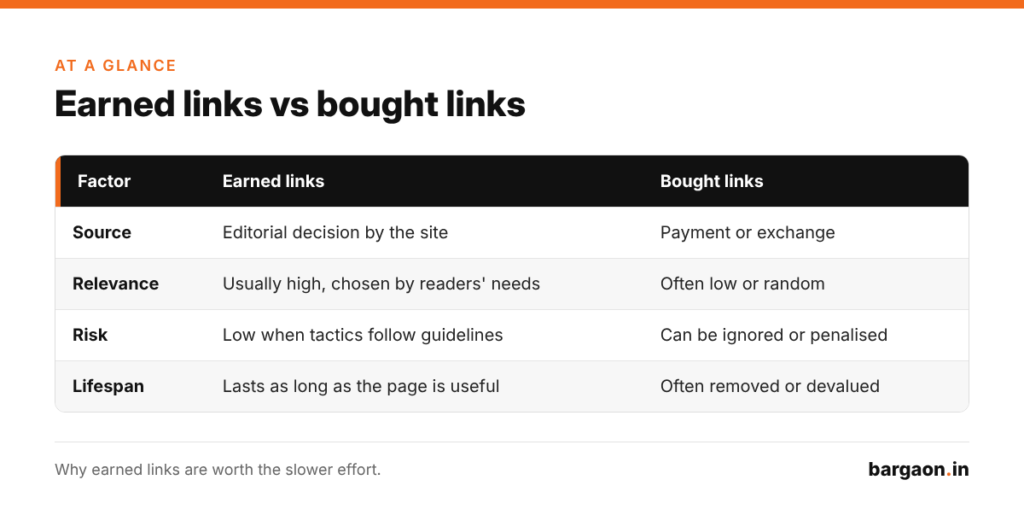
Google’s SEO starter guide is clear that links should exist because they are useful to people, and that paid or manipulative links can be ignored or penalised. That framing should guide every tactic you choose.
Thinking this way also helps you judge offers that land in your inbox. If a link would not exist without payment or a swap, it is not the kind of signal search engines want to reward.
Create link building assets that people want to cite
Links follow usefulness. The most reliable assets are things writers and editors need but do not want to create themselves.
Think about what your team knows that others do not. A logistics company may have shipping time data across Indian cities. A software firm may have anonymised usage patterns. Original information, clearly presented, earns links for years.
Before building anything, check what already exists. If ten strong versions of your idea are already published, find an angle they miss or pick a different asset.
- Original data or survey findings, with method explained
- Practical tools, calculators or templates
- Definitive explainers on a narrow subject
- Expert commentary on industry changes
Find the sites that should be linking to you
Start with the sites that already link to similar resources. Look at who links to competitors’ best content, to industry associations and to trade publications in your sector.
Prioritise relevance over authority scores. A link from a respected niche publication read by your buyers is worth more than one from a large general site nobody in your market visits. Our guide on link building explains how to score prospects so outreach effort goes where it counts.
Keep each asset maintained. A data page that is updated every year keeps earning links, while one left untouched slowly loses them to fresher sources.
Pitch like a person, not a template
Outreach fails when it reads like a mass email. Editors receive dozens of identical requests every week. A good pitch is short, specific and explains why your resource helps their readers.
Reference a particular article they wrote, explain what your asset adds and make it easy to use. Do not ask for a link directly in the first line; offer value and let the link follow.
Write each pitch as if it were going to one editor you respect, because in practice it is. Track replies and refine the message as you learn what resonates.
- Keep pitches under 150 words
- Personalise the first sentence to their work
- Offer a quote, data point or image they can use
- Follow up once, then move on
Use content partnerships and digital PR
Beyond one-to-one outreach, broader digital PR can earn links at scale when you have a genuinely newsworthy story. Industry research, expert comment on current events and collaborative reports with partners all work well.
The Content Marketing Institute publishes useful material on building content that earns attention, which is the foundation of any campaign that earns links naturally.
Partnerships can be simpler than full campaigns. Co-writing a report with a supplier, an industry body or a university department combines expertise and gives both parties a reason to share the work widely.
Expert commentary also works well for smaller teams. Journalists often need a quick, credible quote on a trend, and a responsive specialist from your business can earn coverage and links over time.
Measure links by their business value
Counting links alone can mislead. Track which links send referral traffic, which appear on sites your buyers read and whether priority pages improve in rankings over the following months.
Link building is slow, but white hat link building compounds. Each strong asset keeps attracting links long after the outreach ends. The full guide covers prospect scoring, pitch templates and how to handle links you did not ask for.
Avoid shortcuts that look tempting under pressure: private blog networks, link swaps at scale, paid guest posts presented as editorial and comment spam. These can bring short-term gains, but they also bring risk that is hard to undo.
Set expectations with leadership early. Strong links often take months to arrive, and a quarter with few new links can still be a good quarter if the assets being built are solid.
Review your existing backlink profile once or twice a year as well. It shows which assets have earned the most links and which topics deserve another resource.