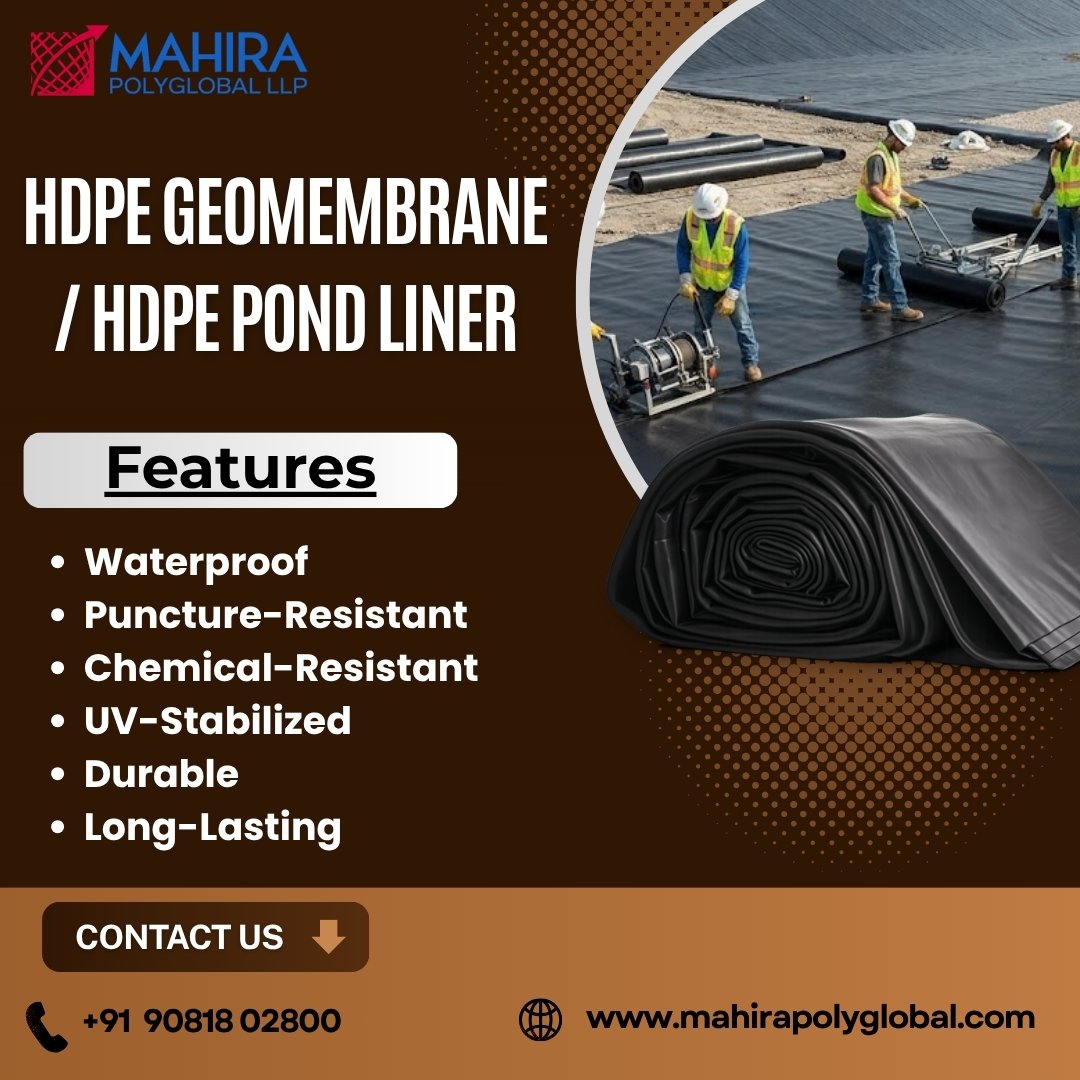
HDPE Pond Liner acts as an excellent mechanism for guaranteeing that there is no leak of any sort in ponds, reservoirs, lakes, or other water storage bodies. The abbreviation HDPE refers to the high-density polyethylene, which is a strong, flexible, and moisture-resistant plastic material. It acts as an impermeable membrane that creates a barrier between the water inside the facility and the soil around it, thus ensuring that the water level remains at a certain height for a longer time. At present, pond liners are being widely used for various purposes, including agriculture, aquaculture, water conservation, industry, and wastewater management.
Important Characteristics and Quality of Material
HDPE Pond Liner is popular due to its valuable characteristics and qualities. The primary advantage of the material is that it provides excellent resistance to water permeation, preventing any unwanted leakage. The material also provides good tensile strength, puncture resistance, and dimensional stability in appropriate conditions. One more significant characteristic is high resistance to many chemicals, thus it can be used for building industrial ponds and wastewater containment. UV resistance is also important, since pond liners are usually exposed to sun rays for a long period of time. Quality liners are made to work outdoors and to work effectively in case of selection based on the needs of your project. But there is no such thing as an identical liner.
Choosing the right thickness and specifications
Selecting the appropriate HDPE Pond Liner involves careful consideration of several technical parameters. The first thing that must be considered is the thickness since it determines the strength and applicability of the liner to a particular project. There are various project requirements that require various thicknesses to suit their specifications. Other parameters that need to be considered include tensile strength, elongation, puncture resistance, chemical compatibility, and UV stability among others. One must conduct measurements of the pond before buying, which includes the length, width, depth, slopes, and corners of the pond. Allowances should be made for anchoring trenches and overlapping or welding of sections. Consumers who seek and HDPE Pond Liner Supplier Ahmedabad can compare various products with regards to specification, availability of sizes, quality certificates, and delivery schedules.
Applications in Various Industries
HDPE Pond Liner has a great variety of applications due to the need to protect water in various industries. It is widely used in agriculture in such structures as irrigation ponds, reservoirs on farms, and rainwater harvesting systems. The farmer will be able to collect water during rains and use it for watering his crops. Fish farming is one of the major applications where HDPE liners will be used to create a controlled environment for water storage. These liners are also used in industrial facilities for such purposes as water storage tanks, wastewater treatment ponds, and containment ponds. They are also suitable for some mining and environmental protection projects where it is important to control the water seepage.
Advantages of Using HDPE Pond Liner
There are many reasons for which HDPE pond liners are superior to traditional methods used to contain water. Their ability to prevent water loss and durable structure will allow you to use them for long periods, provided that they have been installed and maintained properly. In addition, the weight of HDPE is considerably lower than that of some traditional liners. Moreover, they can be resistant to many different types of chemicals, which is quite important when the water in the pond contains various substances. Another advantage is that they come in various thicknesses and dimensions, giving the project owner the possibility to choose the right size. HDPE liners may also contribute to reducing routine maintenance.
Installation and Maintenance Procedures
Proper installation is an important aspect for the functioning of an HDPE Pond Liner. First, adequate ground preparation must be done. This will include the removal of all sharp stones, root pieces, cracked material, and any other debris that may be harmful to the liner.Ground preparation should be done as per the design of the project. If necessary, a protective geotextile fabric can be put down. Once this is done, the liner is carefully laid over the pond ground without any unnecessary pulling or stretching. For bigger ponds, the sections of the liners are properly joined using appropriate welding techniques which are normally done by professionals using special equipment.
Market Availability and Reliable Purchase Decision
There has been rising demand for HDPE Pond Liner as projects in agriculture, aquaculture, infrastructure, and industry concentrate on efficient use of water resources. Buyers have the option to source various product lines from local distributors and companies catering to the national as well as international market. While assessing HDPE Pond Liner Supplier Ahmedabad, it would be prudent to see the quality of product, technical support provided, pricing, customizations offered, and delivery arrangements. Mahira Polyglobal LLP is one company buyers may consider to make enquires for HDPE pond liner related products. It would be wise to inquire about the product specifications, materials used, manufacturing processes, certifications held, and supply capacities. Buyers looking for HDPE Pond Liner Exporter Ahmedabad must confirm the experience of the exporter in exports, quality of packaging, documentation, and shipping timelines. Comparison of various quotations could help, but it is unwise to depend on price alone.
Conclusion
HDPE Pond Liner can be considered as an efficient method to prevent water leakage and increase the effectiveness of ponds, reservoirs, and other water storage structures. This material possesses various advantages such as high durability, waterproof nature, chemical resistance, and diverse thickness options which makes it appropriate for various purposes including agricultural, industrial, fishery, and environmental uses. It is recommended to compare technical characteristics and check project needs before making a purchase. For companies in search of an HDPE Pond Liner Exporter Ahmedabad, there are many features that they can compare, including packaging, exportation certificates, delivery time schedules, and product consistency.
Frequently Asked Questions (FAQs)
1 .Uses of HDPE Pond Liner?
HDPE Pond Liner is used to stop the seepage of water in agricultural ponds, fisheries, reservoirs, artificial lakes, and water storage facilities in industries.
2. What should be the thickness of HDPE Pond Liner?
It depends upon the depth of the pond, soil nature, usage of the pond, and the force that is applied to the liner. It is advisable to seek technical information before choosing the suitable thickness.
3. Is HDPE Pond Liner suitable for outdoor use?
Yes, the appropriate HDPE Pond Liners which are suitable for outdoor uses are available.
4. What is the lifespan of the HDPE Pond Liner?
It depends on material quality, thickness, installation, conditions of exposure, and maintenance procedures.Proper installation helps improve durability.
5 Who is the largest supplier of HDPE Pond Liner ?
There is no official verification of the world data for identifying a company as the biggest manufacturer of HDPE Pond Liner. Mahira Polyglobal LLP is a company based in India that manufactures HDPE Pond Liner products suitable for use in agriculture ponds, fish farming, reservoirs, water storage, and industries. While selecting a supplier of the product, customers need to take into account certain criteria such as quality, thickness, tensile strength, and so on.