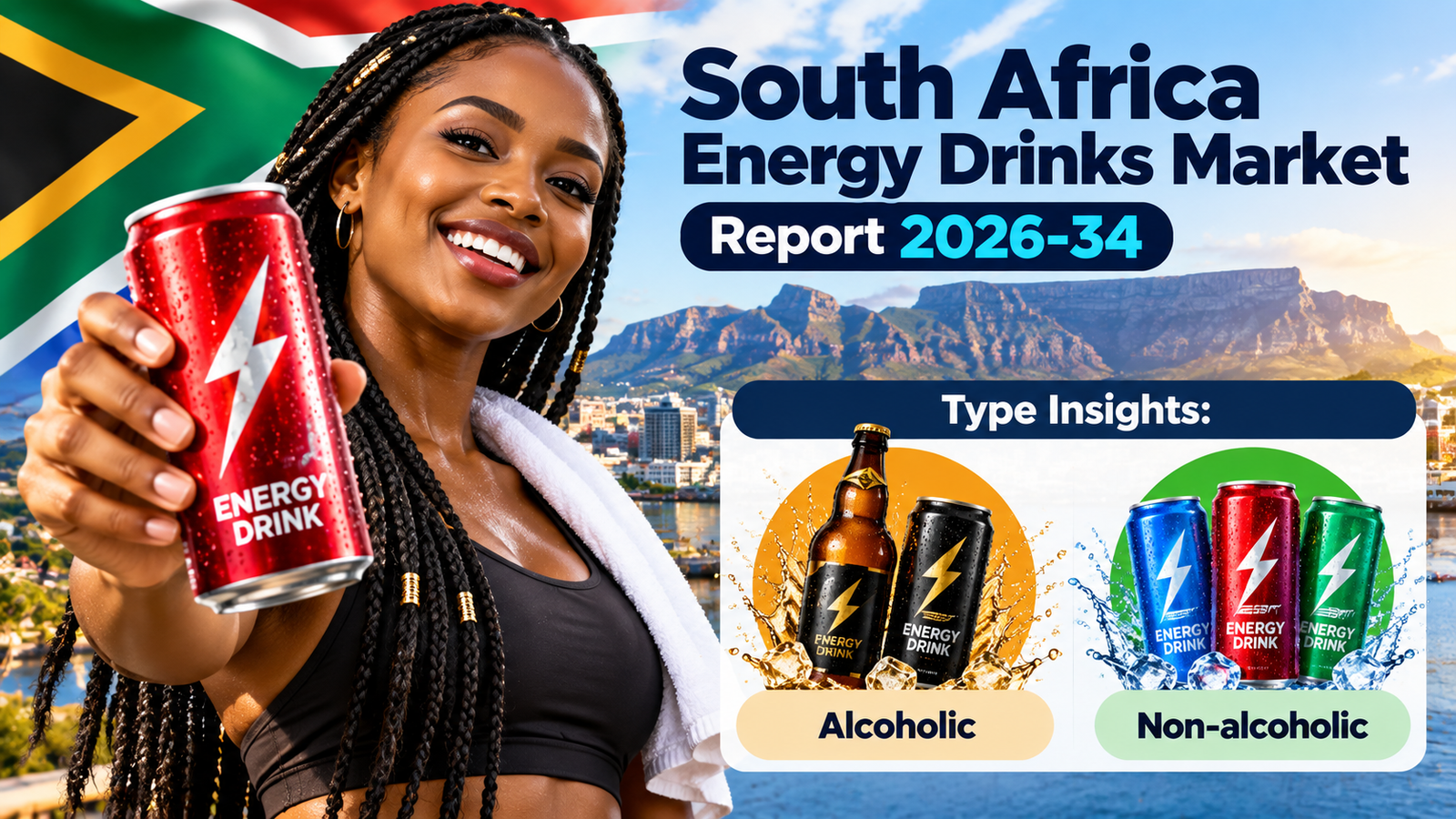
IMARC Group, a leading global market research and management consulting firm, has published its latest market intelligence report on the South Africa energy drinks market size reached USD 227.8 Million in 2025. Looking forward, IMARC Group expects the market to reach USD 370.2 Million by 2034, exhibiting a growth rate (CAGR) of 5.38% during 2026-2034. Growth is driven by rising fitness participation, demand for on-the-go convenience, expanding urban youth consumption, steady product innovation in flavors and sugar-free formats, and the strong reach of supermarkets, forecourts, and spaza shops across the country.
The market is gaining momentum as energy drinks move from a niche late-night product to an everyday functional beverage. Commuters, taxi-rank traders, students, gym-goers, and shift workers rely on a quick, affordable energy boost, and a single 250 ml can of Red Bull contains 80 mg of caffeine, about the same as a home-brewed cup of coffee. The category is also supported by a clear price split, with global premium brands such as Red Bull, Monster, and Rockstar sitting alongside affordable local brands such as Score, Switch, and Dragon. This two-tier structure lets the category reach both aspirational buyers and budget-conscious households.
How AI is Reshaping the Future of the South Africa Energy Drinks Market?
- AI-Powered Demand Forecasting and Route-to-Market Optimization: Beverage companies are using machine learning to analyze outlet-level sales, weather, event calendars, and festive cycles. This helps them keep chilled stock available in supermarkets, forecourts, and spaza shops, where cold cans drive impulse purchases, and cut stock-outs in high-traffic locations such as taxi ranks and sports venues.
- Personalized Marketing and Social Media Analytics: Brands are mining social sentiment and purchase data to shape campaigns for youth audiences. Athlete sponsorships, gaming and music activations, and flavor limited editions are increasingly tested with data before launch, so spend goes to the audiences most likely to convert.
- AI-Assisted Formulation and Sugar Reduction: Product development teams are using AI tools to speed up flavor matching and to build zero-sugar and lower-sugar recipes. This matters in South Africa because the Health Promotion Levy taxes sugary drinks, which makes reformulation a direct commercial priority.
- Smarter E-Commerce and Subscription Models: Online retailers and quick-delivery platforms use recommendation engines to promote multipacks, bundles, and subscription deliveries, which supports growth in online energy drink sales.
Grab a sample PDF of this report: https://www.imarcgroup.com/south-africa-energy-drinks-market/requestsample
South Africa Energy Drinks Market Trends and Drivers
The South African energy drinks market is expanding steadily, supported by convenience-led lifestyles, a young urban population, and growing interest in sport and fitness. Analysts value the local energy drink category at around R24 billion, which shows how large the category has become within the wider soft drinks landscape. Euromonitor reports strong retail volume growth, driven by urban mobility, convenience needs, and rising participation in fitness activities. Coca-Cola’s Monster Energy brand holds overall leadership, while the low-cost Score brand has grown quickly, a sign of how important affordability is in the mass market.
Distribution reach is a major strength. Supermarkets and hypermarkets such as Pick n Pay, Checkers, and Woolworths remain the main points of sale, offering both global brands and local options. Metal cans dominate packaging because they suit chilled, single-serve, impulse purchases across forecourts, convenience stores, and spaza supply chains. Premium brands lean on sports sponsorship and nightlife visibility, such as Red Bull’s events in Cape Town and Durban, while local brands compete through township penetration, flavor variety, and local identity. Campaigns such as Score’s “Get Up To Your Go” show how local brands use a “made for the South African hustle” message to build loyalty.
Regulation and health awareness are shaping product strategy. South Africa’s Health Promotion Levy, in place since April 2018, taxes sweetened beverages, including energy drinks, at 2.1 cents per gram of sugar above 4 g per 100 ml. The levy has not been increased since it began, and in the March budget presentation the government proposed cancelling a planned increase to give the sugar industry more time to restructure. Public health groups continue to call for a higher rate, including a campaign calling for a 20% increase, while sugar growers have urged the government to scrap the tax altogether. This debate is pushing manufacturers toward zero-sugar variants, as seen in the arrival of Red Bull Xero, and toward more locally sourced ingredients, such as the sugarcane-based Shesha energy drink.
South Africa Energy Drinks Industry Segmentation:
The report has segmented the market into the following categories:
Breakup By Type:
- Alcoholic
- Non-Alcoholic
Non-alcoholic energy drinks form the core of everyday consumption, with sugar-free and zero-sugar variants gaining attention under the Health Promotion Levy. Alcoholic energy drinks serve a smaller, more specialized demand.
Breakup By End User:
- Kids
- Adults
- Teenagers
Adults and young professionals, including students, commuters, and shift workers, are the core users. Teenage consumption draws regular public health attention because of caffeine content, which keeps labeling and responsible marketing in focus.
Breakup By Distribution Channel:
- Supermarkets and Hypermarkets
- Convenience Stores
- Online Stores
- Others
Supermarkets lead on reach and promotions, while forecourts, convenience stores, and spaza shops drive impulse buying. Online stores are growing as quick-delivery services and multipack offers expand.
Breakup By Region:
- Gauteng
- KwaZulu-Natal
- Western Cape
- Eastern Cape
- Others
Gauteng, the Western Cape, and KwaZulu-Natal anchor demand through dense urban populations, strong retail networks, and active sport and nightlife scenes in Johannesburg, Cape Town, and Durban.
Competitive Landscape:
The report provides a comprehensive analysis of the competitive landscape in the South Africa energy drinks market. The market combines global premium brands with strong domestic challengers. Key players operating in the market include:
- Red Bull GmbH
- Monster Beverage Corporation
- Switch Beverage Company
- Tiger Brands
- MoFaya Beverage Company
Recent News and Developments in South Africa Energy Drinks Market
- May 2026: Red Bull launched its Winter Edition in Fuji Apple-Ginger flavor in South Africa on 21 May, using a seasonal limited edition to refresh its local range. In the same month, Monster Energy announced that Springbok rugby great Tendai “The Beast” Mtawarira had joined its athlete roster, strengthening its sports marketing presence.
- February 2026: Public debate on the Health Promotion Levy intensified ahead of the national budget, with health groups urging a higher rate while sugar growers called for the tax to be removed. The outcome matters for pricing and reformulation decisions across the category.
- November 2025: Red Bull Xero arrived nationwide, available at major retailers, convenience stores, and gyms. It offers a no-sugar option distinct from Red Bull Sugarfree, targeting health-conscious consumers.
- October 2025: Shesha, a locally developed energy drink, launched nationally to challenge global brands, with a stated aim of reviving the local sugarcane industry.
- March 2025: The government proposed in the budget presentation on 12 March to cancel the planned increase in the Health Promotion Levy, giving the sugar industry more time to adjust to regional competition.
About Us:
IMARC Group is a global management consulting firm that helps the world’s most ambitious changemakers to create a lasting impact. The company provides a comprehensive suite of market entry and expansion services. IMARC offerings include thorough market assessment, feasibility studies, company incorporation assistance, factory setup support, regulatory approvals and licensing navigation, branding, marketing and sales strategies, competitive landscape and benchmarking analyses, pricing and cost research, and procurement research.
Contact Us
IMARC Group,
134 N 4th St. Brooklyn, NY 11249, USA,
Email: sales@imarcgroup.com,
Tel No: (D) +91 120 433 0800,
United States: +1-201971-6302