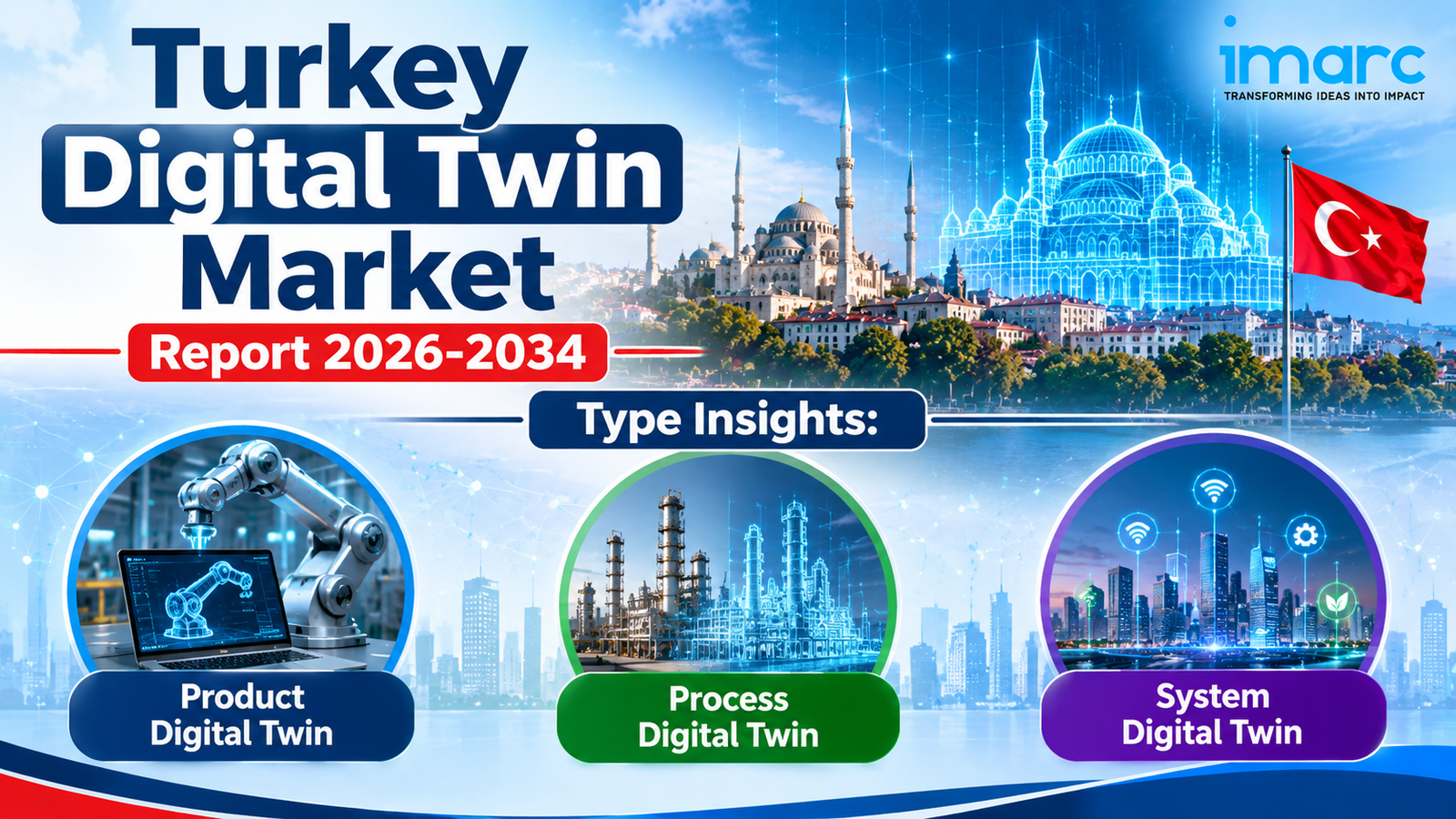
Turkey Digital Twin Market Report highlights the growing adoption of digital twin technologies across manufacturing, energy, healthcare, and urban management sectors. Increasing digitalization is encouraging businesses to leverage digital twins for real-time monitoring, predictive maintenance, operational efficiency, and data-driven decision-making. The Digital Twin Market size in Turkey reached USD 380.5 Million in 2025 and is projected to reach USD 2,598.5 Million by 2034, growing at a CAGR of 23.08% during 2026–2034. Furthermore, government-backed digital transformation initiatives, model factories, and smart city development projects are accelerating technology adoption and creating new business opportunities across the country.
How AI is Reshaping the Future of Turkey Digital Twin Market?
- AI-powered predictive maintenance is enabling Turkish manufacturers to feed sensor data from machines into digital twins, flagging failures before they occur and cutting unplanned downtime on production lines.
- Machine learning is improving the accuracy of process and system twins, allowing factories, utilities, and logistics operators to simulate energy use, throughput, and supply chain disruptions before making real-world changes.
- Municipalities are pairing AI analytics with city-scale 3D models. For example, Bornova in Izmir is combining more than 3,000 cameras and sensors with its district digital twin to support security, cleanliness, and infrastructure management.
- AI-driven simulation is supporting disaster preparedness and urban planning, helping local authorities test the impact of investments, energy solutions, and emergency scenarios before committing budgets.
- Global technology providers such as Siemens Türkiye are prioritizing AI-powered applications, industrial automation, energy efficiency, and digital twin technologies, accelerating the transfer of advanced capabilities to Turkish industry.
Grab a sample PDF of this report: https://www.imarcgroup.com/turkey-digital-twin-market/requestsample
Market Growth Factors
The Turkey digital twin market is driven by the country’s national push toward a twin green and digital transformation of industry. Türkiye is expected to invest between USD 1 Billion and USD 1.5 Billion annually over the next decade to integrate Industry 4.0 solutions, and full adoption could save around USD 10 Billion a year in manufacturing costs through an estimated 4% to 7% productivity gain. The government is backing this shift through digital transformation centers and model factories in organized industrial zones and technology development zones. Türkiye’s Ministry of Industry and Technology also launched the HIT-30 High Technology Investment Program in July 2024 to position the country as a high-tech manufacturing hub by 2030. Frameworks such as the TÜBİTAK TÜSSİDE DDX Digital Transformation Model give SMEs tailored roadmaps, bringing simulation-based tools into everyday operations.
Smart manufacturing is the strongest practical use case. With around 29,200 operational industrial robots, about 30% of them in the automotive industry, Turkish factories already generate the machine data that process and product twins depend on. Manufacturers use virtual models to monitor machine performance, energy consumption, and production throughput, which improves responsiveness and supports resilience against supply chain disruption. Public research capacity strengthens this base, as seen in the TÜBİTAK BİLGEM Super Twin ecosystem, which extends high-performance computing to industrial digital twins. Universities, technoparks, and research centers add further momentum by testing twin applications in health, climate modeling, agriculture, and infrastructure resilience.
Urbanization, construction, and energy modernization are widening the addressable base. Local governments are building city-scale twins to plan infrastructure, manage disaster risk, and track energy and environmental data in real time. Türkiye has also stated it will intensify the twin transformation of its construction sector, combining green technologies with digital innovation. Technology suppliers including Siemens and Schneider Electric highlight digital twin, IoT, and automation as core tools for energy efficiency and smart grid development, while 5G and AI integration make real-time synchronization between physical assets and virtual models more practical for both large enterprises and SMEs.
Market Segmentation
Type Insights:
- Product Digital Twin
- Process Digital Twin
- System Digital Twin
Technology Insights:
- IoT and IIoT
- Blockchain
- Artificial Intelligence and Machine Learning
- Augmented Reality, Virtual Reality and Mixed Reality
- Big Data Analytics
- 5G
End Use Insights:
- Aerospace and Defense
- Automotive and Transportation
- Healthcare
- Energy and Utilities
- Oil and Gas
- Agriculture
- Residential and Commercial
- Retail and Consumer Goods
- Telecommunication
- Others
Regional Insights:
- Marmara
- Central Anatolia
- Mediterranean
- Aegean
- Southeastern Anatolia
- Black Sea
- Eastern Anatolia
Recent Development & News
- July 2024: Türkiye’s Ministry of Industry and Technology launched the HIT-30 High Technology Investment Program, aimed at making the country a global high-tech manufacturing hub by 2030 with strategic investments in advanced manufacturing, digital technologies, green energy, and semiconductors.
- October 2024: TÜBİTAK TÜSSİDE introduced the DDX Digital Transformation Model under its support program, offering businesses tailored roadmaps to improve productivity and system monitoring through digital tools, including simulation-based approaches such as digital twins.
- March 2025: Kayseri Metropolitan Municipality hosted a Digital Twin Meeting under its Smart Urbanism initiative with representatives from SAMPAŞ Holding, discussing how digital twins can improve infrastructure oversight, disaster preparedness, and city planning.
- June 2025: Bornova Municipality in Izmir opened its Smart City Management and Innovation Center and created a 3D digital twin of the district, described as the first full district-level digital twin in Türkiye.
- December 2025: Siemens Türkiye outlined its priorities, naming digitalization, AI-powered applications, energy efficiency, industrial automation, and digital twin technologies as focus areas, and positioned Türkiye as a technology export hub.
- February 2026: The Denizli Model Factory, Türkiye’s 11th, opened in cooperation with the Ministry of Industry and Technology and UNDP, providing SMEs with a digital transformation and capability development center along with a green transformation and efficiency testing center.
If you require any specific information that is not covered currently within the scope of the report, we will provide the same as a part of the customization.
About Us
IMARC Group is a global management consulting firm that helps the world’s most ambitious changemakers to create a lasting impact. The company provides a comprehensive suite of market entry and expansion services. IMARC offerings include thorough market assessment, feasibility studies, company incorporation assistance, factory setup support, regulatory approvals and licensing navigation, branding, marketing and sales strategies, competitive landscape and benchmarking analyses, pricing and cost research, and procurement research.
Contact Us
IMARC Group,
134 N 4th St. Brooklyn, NY 11249, USA,
Email: sales@imarcgroup.com,
Tel No: (D) +91 120 433 0800,
United States: +1-201971-6302