
Introduction
If you’re a CA, CMA, or MBA in finance, you’ve probably heard colleagues talk about Oracle Fusion Financials and wondered if it’s meant for you. Many people in your position ask Soft Online Training what Oracle Fusion Financials Training in Chennai actually involves, because the switch looks like a huge jump from the outside. It isn’t. Your accounting knowledge already covers most of what you’ll need, and the right training simply shows you where Oracle keeps everything.
Why Your Finance Background Is the Hard Part
Here’s something people from IT often admit: the software is the easy bit. Learning what a journal entry is, why a period gets closed, or how an accrual works takes them months. You did that years ago.
Oracle Fusion Financials is built around those same ideas. Payables is the supplier side of the books you’ve handled. Receivables are customer billing and collections. General Ledger is where everything lands. Fixed Assets, Cash Management, Tax: none of it will feel foreign when you see the screens. You’ll just be learning where Oracle keeps things.
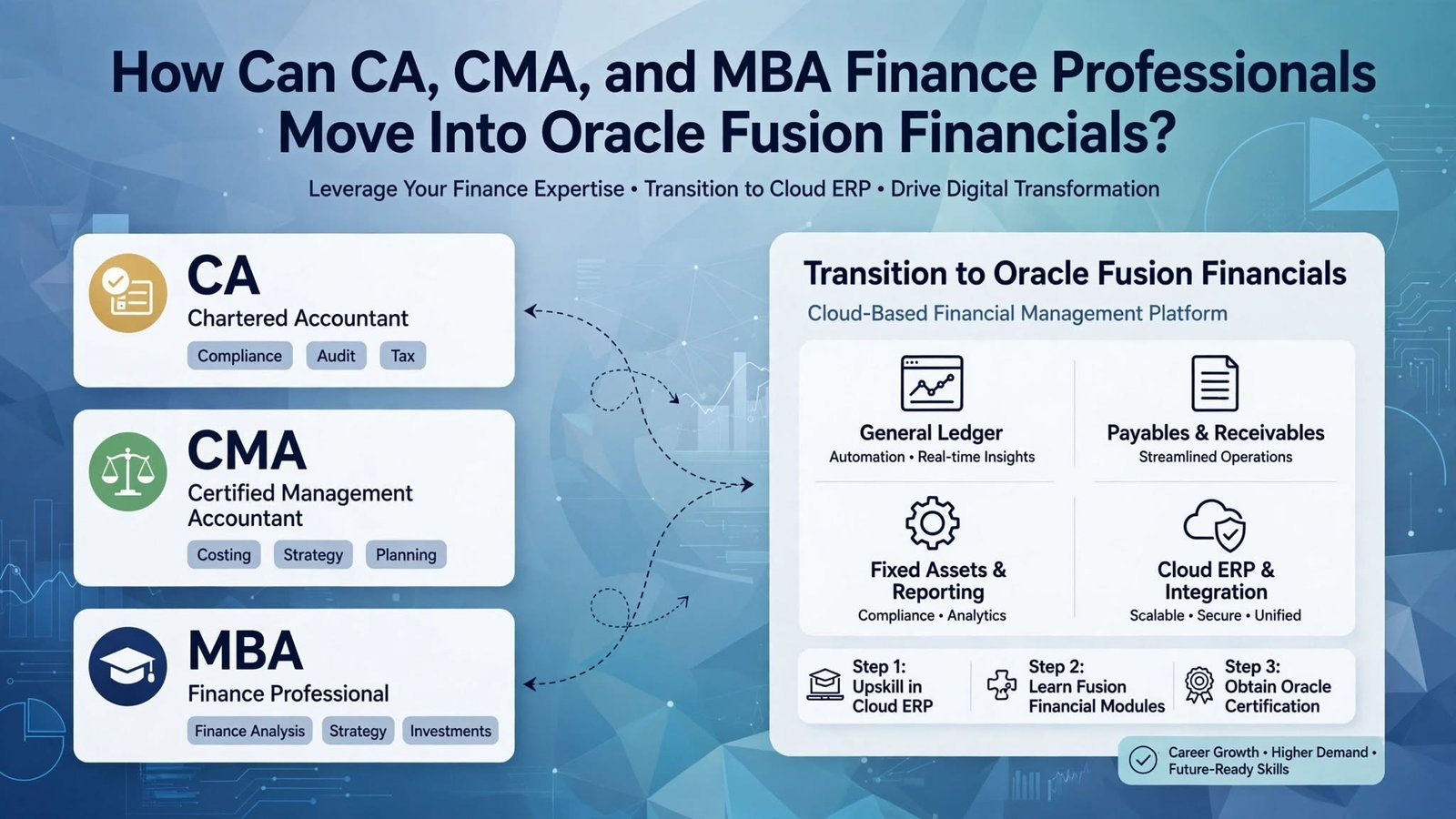
A CA who has sat through a tough audit already understands why controls and approvals matter, and those are everywhere in the system. A CMA who has argued over cost allocations will see the same thinking in how Oracle builds accounting rules. An MBA who has spent years translating between finance and the business will be useful the moment a project needs someone who can explain what the team actually wants.
Pick the Role That Fits How You Already Work
Not every finance professional ends up in the same seat, and that’s fine.
CAs often settle into Payables, Receivables, or General Ledger consulting, where compliance and control knowledge is gold. Some become business analysts on implementation projects, sitting between the client’s finance team and the people configuring the system.
CMAs tend to enjoy costing, budgeting, and asset work, plus anything involving reporting, since they’re used to digging into numbers and asking why they moved.
MBA finance people often drift toward solution design or project coordination. If you like running workshops and keeping a project on track, that route suits you.
Don’t treat this as a fixed choice. Plenty of consultants start in one module, get comfortable, and branch out a year later.
Learning It Properly: Oracle Fusion Financials Training in Chennai
You can read documentation all week and still freeze the first time you open a live environment. The learning happens when your hands are on the system. That’s the main reason professionals look for Oracle Fusion Financials Training in Chennai that gives them a real practice instance, not just slide decks.
Whatever program you choose, check a few things. Will you create a supplier, enter an invoice, run a payment, post a journal, and close a period yourself? Does the trainer explain why a setup is done a certain way, or just click through it? Do you get project-style scenarios, where something goes wrong and you have to work out why? That last one matters more than people expect. Real projects are mostly about fixing things that didn’t behave.
Because you already have the accounting side, you should move faster than a fresher in the same batch. A good trainer will notice that and not slow you down.
The Skills That Aren’t in the Syllabus
Knowing the screens will get you through the first interview. Getting hired, and staying employed, takes a bit more.
You need to be able to walk someone through how a purchase becomes a payment and then a ledger entry, in plain words. You need to be comfortable with configuration, since setting up ledgers, calendars, and account rules is a big part of any implementation. Basic reporting helps, because finance managers always want the numbers in some particular shape. And you’ll need patience for listening, because half of consulting is hearing what a client says, working out what they mean, and turning that into a setup that works.
Coding isn’t required to get started. If you’re good with spreadsheets, you’re already ahead. You can pick up more technical skills later if you decide you want them.
A Realistic Plan for Working Professionals
You likely have a job and not much spare time, so here’s a sensible way to do this without burning out.
Spend the first few weeks getting the big picture. Understand how the modules connect, then go deep on General Ledger and one subledger. Everything else hangs off those.
Then add Payables and Receivables, and practice full cycles end to end instead of isolated screens. Process an invoice all the way to payment. Raise a customer bill and apply the receipt. Reconcile a bank statement. These small exercises become your interview stories. Saying “I set up a ledger and ran a period close myself” lands better than any certificate on its own.
Once you’re comfortable, think about certification. It shows employers you’re serious, and the preparation pushes you to cover corners you might have skipped.
When you update your resume, keep your finance experience at the front. Hiring managers for these roles want someone who has done the accounting, not only someone who can configure the tool.
Is the Switch Worth It?
For most finance people, yes. Companies running Oracle Fusion keep struggling to find people who understand both the accounting and the system, and that gap hasn’t closed. Your CA, CMA, or MBA stops being something you have to set aside and becomes the reason you’re hired.
It also opens doors. You could join an implementation partner, move into a corporate finance systems team, or eventually consult on your own. Every rollout, upgrade, and support cycle needs people who get finance.
Conclusion
Moving into Oracle Fusion Financials isn’t really starting over. You’re taking what you already know and learning a new way to put it to work. With the right guidance from Soft Online Training and steady time spent in the system, Oracle Fusion Financials Training in Chennai can get you job-ready quicker than most people expect. Pick one module, get your hands dirty, and let your finance background carry you the rest of the way.